Situation Summary
Nicaragua remains at composite threat level 18 globally, with Managua Department driving 94% of sub-national risk (score 31.3). The immediate security picture reflects political and institutional upheaval rather than new civil violence: President Daniel Ortega's announcement on 21–22 July that Nicaragua will not hold democratic elections has triggered UN condemnation and legislative moves to codify one-party rule, signaling a structural shift toward closed authoritarianism. No significant new protests, armed clashes, or public-order incidents have been reported in open sources within the last 24–48 hours, but the political trajectory is sharply negative for rule of law, civic space, and international oversight.
Key Developments
- National level, 22–23 July: UN High Commissioner for Human Rights Volker Türk and UN Secretary-General's office issued formal statements condemning Ortega's decision to end democratic elections, citing "deepening erosion of civic and political rights" and warning of deteriorating rule of law. This represents sustained international institutional pressure and increases reputational and diplomatic risk for the regime.
- National Assembly, Managua, week of 20–24 July: Ruling-party-controlled legislature is debating legal measures to bar opposition parties from elections, with a vote scheduled for early August. This legislative codification of electoral exclusion represents imminent formal abolition of multi-party competition at the statutory level.
- National level, mid–late July: Nicaraguan authorities announced the country's withdrawal from the UN Human Rights Council, occurring one day after the Council released a report implicating the Nicaraguan Army in repression of political opponents. This move eliminates a formal international accountability mechanism and signals hardening against external scrutiny.
- National level, ongoing pattern referenced in 22 July UN statement: At least 46 individuals remain arbitrarily detained on political grounds, and multiple lawyers' professional credentials have been revoked without legal justification. These actions reflect sustained selective repression of legal and political opposition.
- Diplomatic, 22 July: United States stated it is evaluating its response to Ortega's announcement ending elections, with potential for new sanctions. Previous US sanctions packages targeted members of the Ortega and Murillo families in April 2026; further escalation could expand financial and travel restrictions.
- No new violent incidents reported, last 48 hours: Open-source reporting shows no credible multi-sourced accounts of new protests, armed clashes, infrastructure attacks, or significant crime spikes within Nicaragua proper in the last 24–48 hours, despite elevated political tension.
Highest-Risk Areas
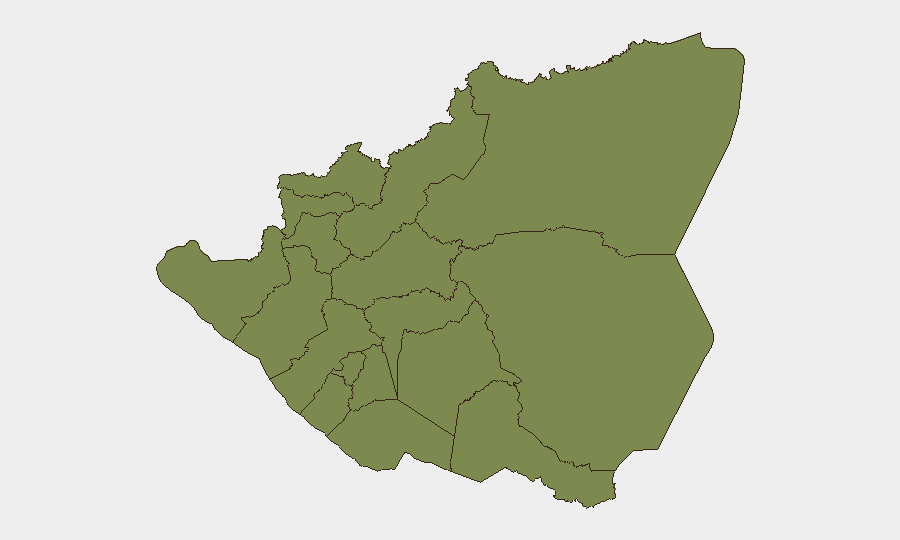
Managua Department dominates the national risk profile (31.3 vs. 2.0 for Estelí, the second-ranked department), reflecting concentration of government, security forces, political activity, and international presence in the capital. All other tracked departments register minimal scores (1.3 each). Risk in Managua is driven by political repression, selective arrests, and administrative crackdowns on opposition rather than widespread street violence; corporate and diplomatic presence in Managua remains the primary exposure vector for international organizations and businesses.
How GeoBit Would Assist
Security teams in Nicaragua would deploy AOI Monitoring & Early Warning on Managua and legislative sites to detect rapid changes in protest activity, security-force deployment, or arrest patterns. Regime-Stability Search and Network & Actor Analysis would map opposition networks and detainee cases to assess knock-on risks to staff and partners. Intel Sweep and multi-language OSINT fusion tracking Nicaraguan media, Telegram, and government announcements would provide 24–48-hour lead time on legal or administrative actions affecting business licenses, movement restrictions, or asset seizure.
7-Day Outlook
Legislative vote on electoral-exclusion measures is scheduled for early August; passage would formally cement one-party rule and likely trigger delayed protest activity and international condemnation. Selective arrests of opposition figures and further revocation of professional credentials are probable. No imminent signs of large-scale street unrest or security-force mobilization, but political repression is expected to intensify as the regime consolidates institutional control.
Highest-Risk Areas — Ranked
| # | State / Region | Risk |
|---|---|---|
| 1 | Managua Department | 31.3 |
| 2 | Estelí Department | 2 |
| 3 | Carazo Department | 1.3 |
| 4 | Chontales Department | 1.3 |
| 5 | Rivas Department | 1.3 |
| 6 | Río San Juan Department | 1.3 |
| 7 | South Caribbean Coast | 1.3 |
| 8 | Chinandega Department | 1.3 |
| 9 | Nueva Segovia Department | 1.3 |
| 10 | Madriz Department | 1.3 |
| 11 | León Department | 1.3 |
| 12 | Masaya Department | 1.3 |
Sources
Previous Daily Briefs
A new Nicaragua brief is written every day — each with its own risk map and downloadable CSV. Here's the last week; use the calendar to go further back.
📅 Browse every day by calendar →
Highlighted days have a brief. Tap a day for that day's map & analysis, or “csv” for that day's dataset ($5).
Atlas — our AI intelligence desk — emails them this snapshot personally. Nothing else, no list.