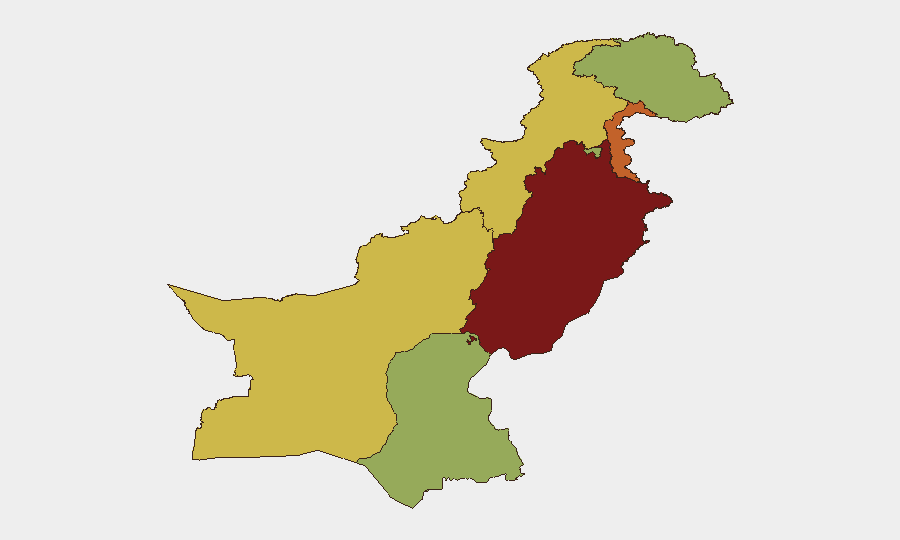
Situation Summary
Pakistan remains at composite threat rank #17 globally, with insurgency as the primary driver across 711 tracked events. The country is experiencing active cross-border military escalation with Afghanistan, concurrent with domestic detention operations and statements from regional actors (Iran, Saudi Arabia, US) signaling broader regional pressure. The security environment shows no signs of near-term stabilization; risk concentration in Punjab (81.9) and Azad Kashmir (75.2) reflects both militant activity and administrative complexity.
Key Developments
- Pakistan-Afghanistan Border (Khost, Kunar, Paktika provinces) — 2026-06-10/11: Pakistan conducted airstrikes along the eastern border, claiming 26 militants killed. Taliban and Afghan sources reported at least 13 deaths and alleged civilian casualties, indicating disputed casualty figures and escalating cross-border tension. [Confirmed cross-source]
- Taliban Arrest/Detention Operation — 2026-06-10: Pakistani authorities conducted arrest or detention operations linked to Taliban elements, suggesting continued anti-militant enforcement. Specifics on location and scale remain limited in current reporting.
- Iranian Military Activity — 2026-06-08: Iran conducted or announced artillery/tank operations (reported twice in signal log), with concurrent expulsion action against Pakistan. The nature and location of Iranian operations require clarification; context suggests possible border-region activity or posturing.
- Saudi/Coalition Aerial Activity — 2026-06-09: Kingdom-attributed aerial weapons activity was recorded, though location and target remain unspecified in available reporting. Likely signals broader Gulf-region military presence or intelligence-gathering operations in the region.
- Multi-Actor Public Statements — 2026-06-08 to 2026-06-09: Pakistan's authorities, army, and government issued multiple public statements; concurrent disapproval from US government noted on 2026-06-09. These statements suggest diplomatic friction and likely relate to the cross-border military operations or regional alignment questions.
Highest-Risk Areas
Punjab (81.9) and Azad Kashmir (75.2) drive Pakistan's overall threat profile, with Punjab's elevation reflecting both militant organizational presence and the density of economic/population targets in the province. Khyber Pakhtunkhwa (65.9) remains a traditional insurgent stronghold, while Balochistan (61.9) continues low-intensity separatist and militant activity. Islamabad Capital Territory (59.6) ranks notably high for a capital region, indicating insider-threat, political violence, or terrorism risk directed at government and diplomatic targets.
How GeoBit Would Assist
Corporate security teams should deploy AOI Monitoring & Early Warning on Punjab and KP to track militant movement and detention operations in real time. Battle Mapping and Force Structure tracking would clarify Iranian, Saudi, and Pakistani military activity on the eastern and western borders, while OSINT Fusion (X/Twitter, Telegram, local media) would resolve conflicting casualty and targeting claims from cross-border strikes. Network & Actor Analysis would map Taliban, militant, and state-actor relationships driving detention and airstrikes.
7-Day Outlook
Cross-border airstrikes and Taliban detention operations signal that Pakistan's military and security services are pursuing tactical counter-insurgency despite regional diplomatic friction. US disapproval and Iranian military activity suggest the window for unilateral Pakistani operations may narrow; further escalation or US/Iranian positioning in response is plausible within 7 days. Expect continued statements and possible secondary operations in Punjab and KP.
Highest-Risk Areas — Ranked
| # | State / Region | Risk |
|---|---|---|
| 1 | Punjab | 81.9 |
| 2 | Azad Kashmir | 75.2 |
| 3 | Khyber Pakhtunkhwa | 65.9 |
| 4 | Balochistan | 61.9 |
| 5 | Islamabad Capital Territory | 59.6 |
| 6 | Sindh | 57.5 |
| 7 | Gilgit-Baltistan | 52.5 |
Sources
Previous Daily Briefs
A new Pakistan brief is written every day — each with its own risk map and downloadable CSV. Here's the last week; use the calendar to go further back.
📅 Browse every day by calendar →
Highlighted days have a brief. Tap a day for that day's map & analysis, or “csv” for that day's dataset ($5).