Situation Summary
Thailand remains at composite threat level #19 globally (score 74) with 109 tracked events, reflecting a contained but fragile security environment. The most significant current pressure point is the Thai–Cambodian border, where official statements on 15–16 June confirm heightened military readiness and acknowledged tension, though no confirmed cross-border kinetic incidents have occurred in the last 48 hours. Nationwide, no acute escalation in terrorism, civil unrest, or infrastructure disruption is reported; chronic baseline risks (southern insurgency, organized crime, financial fraud) persist but remain localized. The government's approval of an anti-drone centre signals concern over emerging airspace threats in a regional context.
Key Developments
- Thai–Cambodian border: official posture shift (15 June). Prime Minister Anutin Charnvirakul and defence officials publicly dismissed reports of Cambodian tank movements near the border but affirmed full Thai military preparedness; the National Security Council approved establishment of an anti-drone centre in response to regional security concerns.
- NSC assesses border as "fragile but under control" (16 June). National Security Council secretary-general Chatchai stated the Thai–Cambodian frontier remains under tension linked to reported Chinese weapons supplies to Cambodia, but no new cross-border incursions or clashes have been confirmed in the last 24–48 hours.
- No verified cross-border incidents in last 48 hours (16 June). Regional security briefs confirm no additional discrete kinetic events at the Thai–Cambodian boundary despite elevated political and media commentary; situation remains within stated government control parameters.
- Anti-drone centre approved as infrastructure response (15 June). NSC approval of a dedicated counter-unmanned-aerial-vehicle facility reflects concern over drone-based surveillance or attack vectors in the regional security context.
- No nationwide escalation flagged (as of 16 June). Comprehensive review of recent reporting identified no new large-scale terrorist attacks, widespread civil unrest, or major infrastructure disruptions across Thailand in the last 48 hours; activity remains routine law-enforcement and political commentary.
Highest-Risk Areas
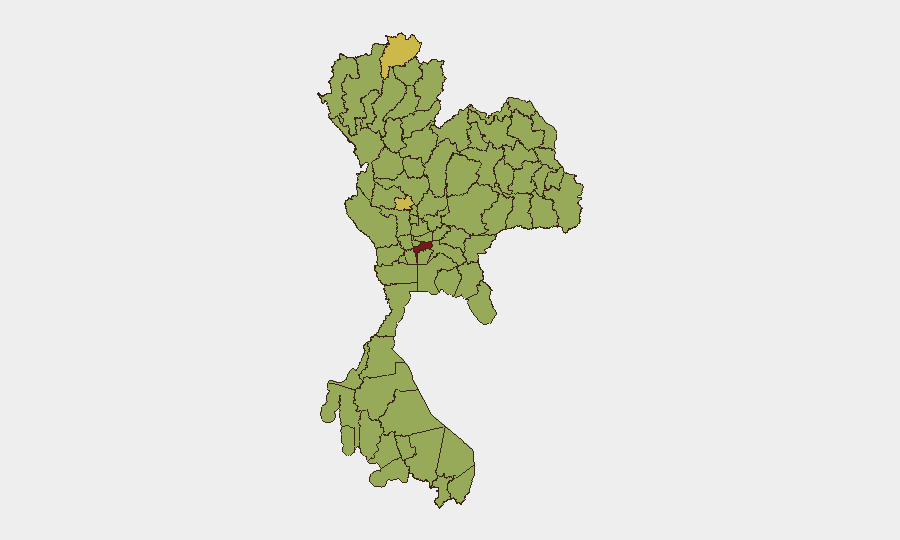
Bangkok dominates the sub-national ranking (risk 81.9) and reflects concentration of political, commercial, and infrastructure assets in Thailand's capital. Chai Nat Province (66.3) and Chiang Rai Province (60.9) follow, with Chai Nat's elevation likely tied to border-proximate vulnerability and Chiang Rai's position near the northern Myanmar and Laos frontiers. Phuket (59.1), a major tourism and commercial hub, carries elevated risk from transnational crime, narcotics trafficking, and maritime security concerns. The Mekong River provinces (Loei, Nong Khai, Udon Thani, Sakon Nakhon, Nakhon Phanom, and Bueng Kan—all scoring 51.9–57.3) reflect cross-border vulnerability to Laotian and Cambodian spillover and trafficking networks. These rankings reflect geographic proximity to conflict zones, transnational crime networks, and infrastructure density rather than imminent localized escalation.
How GeoBit Would Assist
Security teams would deploy AOI Monitoring & Early Warning on Bangkok, the Thai–Cambodian border, and Phuket to track rapid changes in military posture, protest activity, or transnational crime indicators with persistent alerting. OSINT Fusion & Corroboration across Thai government statements, regional media, and Telegram/social channels would distinguish signal from noise in border tension reporting and prevent false escalation assessments. Routing & Network Analysis would support contingency planning for personnel or supply chains affected by border closures or military checkpoints, while Satellite & Imagery Analysis could provide corroborating evidence of troop movements or infrastructure changes independently of official claims.
7-Day Outlook
The Thai–Cambodian border is expected to remain elevated but contained over the next 7 days, with official Thai posture focused on deterrence and air-defence infrastructure rather than offensive mobilization. Absent new cross-border incidents or regional political shocks, the government's stated control narrative will likely hold, reducing immediate evacuation or travel-restriction risk. Monitoring should focus on any disruption to the NSC messaging discipline or unscheduled military movements that would signal loss of control.
Highest-Risk Areas — Ranked
| # | State / Region | Risk |
|---|---|---|
| 1 | Bangkok | 81.9 |
| 2 | Chai Nat Province | 66.3 |
| 3 | Chiang Rai Province | 60.9 |
| 4 | Phuket Province | 59.1 |
| 5 | Loei Province | 57.3 |
| 6 | Phetchaburi Province | 56.1 |
| 7 | Bueng Kan Province | 51.9 |
| 8 | Nong Khai Province | 51.9 |
| 9 | Udon Thani Province | 51.9 |
| 10 | Sakon Nakhon Province | 51.9 |
| 11 | Nakhon Phanom Province | 51.9 |
| 12 | Chaiyaphum Province | 51.9 |
Sources
Previous Daily Briefs
A new Thailand brief is written every day — each with its own risk map and downloadable CSV. Here's the last week; use the calendar to go further back.
📅 Browse every day by calendar →
Highlighted days have a brief. Tap a day for that day's map & analysis, or “csv” for that day's dataset ($5).