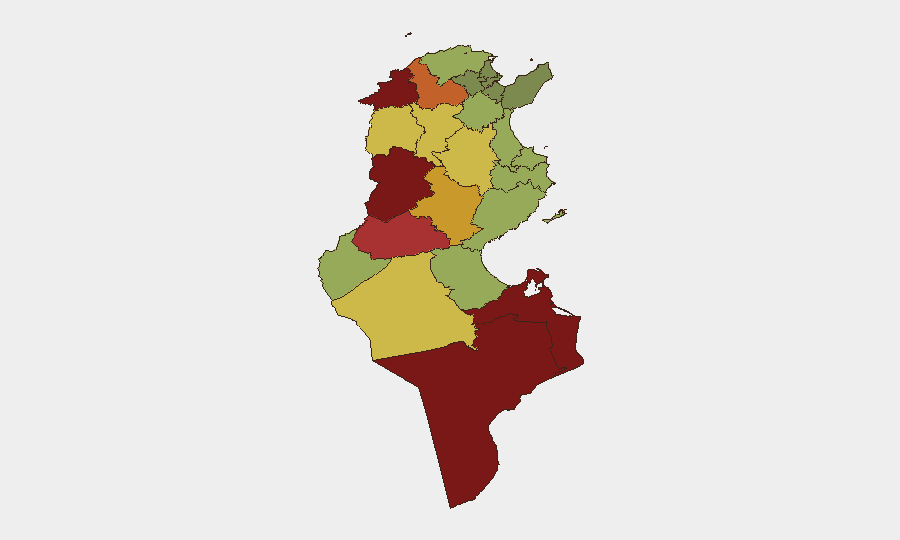
Situation Summary
Tunisia remains at relatively low global risk (rank #76, composite score 28), but experiences localized civil unrest driven by police accountability concerns, economic hardship, and service-delivery grievances. The past week saw a concentrated wave of protests and clashes across the capital and Sfax Governorate, triggered by deaths allegedly linked to security operations. While incidents are geographically dispersed rather than part of a coordinated national movement, the frequency and intensity of confrontations signal underlying dissatisfaction that may persist if underlying grievances remain unaddressed.
Key Developments
- Ettadhamen, Tunis — 22 October: Police deployed tear gas against protesters following the death of a man detained on suspicion of drug dealing; demonstrators blocked roads, burned tires, and threw stones. Security forces subsequently protected a National Guard facility as protesters erected barricades around the neighborhood.
- Jebeniana, Sfax Governorate — 22 October: Clashes erupted after a young man died during or while fleeing a police/security pursuit; family members disputed official circumstances surrounding the death.
- Agareb, Sfax Governorate — 22 October: Demonstrators clashed with security forces in response to a death attributed by residents to security operations.
- Sfax Governorate — 21–22 October: Multiple localized protests occurred across Sfax communities; university institutions organized a general strike in solidarity with broader demonstrations.
- Menzel Bouzelfa, Nabeul Governorate — 21–22 October: Local mobilization was reported as part of the broader 48-hour wave of protests linked to contested security interventions.
- Tunis and southern Tunisia — 22 October: Protest activity connected deaths allegedly involving police actions to wider complaints about deteriorating living conditions, public services, and perceived lack of accountability.
Highest-Risk Areas
Kasserine, Jendouba, and Tataouine dominate the sub-national risk ranking (scores 92, 88, and 85 respectively), driven by historical marginalization, limited economic opportunity, and proximity to ungoverned or contested border areas in the west and south. Médenine and Gafsa remain elevated (83 and 78), reflecting chronic unemployment and grievances in mining-dependent regions. Coastal and central governorates including Tunis, Sfax, and Nabeul show lower but volatile risk; this week's incidents in Ettadhamen and Sfax underscore that civil unrest can erupt rapidly in urban centers with limited warning, even when sub-national risk scores remain moderate.
How GeoBit Would Assist
Security teams should use AOI Monitoring & Early Warning to track Kasserine, Jendouba, and Sfax Governorate for protest activity, roadblocks, and security responses; OSINT fusion (X/Telegram, local media, and event corroboration) to identify emerging flashpoints in peripheral governorates before escalation; and sentiment & temporal analysis to detect shifts in protest rhetoric or coordination that may signal organized action. Conflict mapping and network actor analysis can distinguish between isolated local grievances and coordinated political mobilization, reducing false alarms while preserving early-warning sensitivity.
7-Day Outlook
Unrest is likely to remain localized unless a high-profile triggering event—such as an in-custody death or security-force escalation—catalyzes broader coordination. Kasserine, Jendouba, and southern governorates warrant continued monitoring for recruitment or resource flows to militant groups. Urban volatility in Tunis and Sfax may recur if police accountability concerns persist or economic conditions deteriorate, though current trajectories do not suggest imminent nationwide destabilization.
Highest-Risk Areas — Ranked
| # | State / Region | Risk |
|---|---|---|
| 1 | Kasserine | 92 |
| 2 | Jendouba | 88 |
| 3 | Tataouine | 85 |
| 4 | Médenine | 83 |
| 5 | Gafsa | 78 |
| 6 | Béja | 75 |
| 7 | Sidi Bouzid | 72 |
| 8 | Al Kaf | 70 |
| 9 | Kébili | 68 |
| 10 | Kairouan | 65 |
| 11 | Siliana | 62 |
| 12 | Tozeur | 58 |
Sources
Previous Weekly Briefs
A new Tunisia brief is written every Monday, covering the week — each with its own risk map and downloadable CSV. Use the calendar to go further back.
- October 20, 2026
- October 13, 2026
- October 6, 2026
- September 29, 2026
- September 22, 2026
- September 15, 2026
- September 8, 2026
📅 Browse past briefs by calendar →
Highlighted days have a brief. Tap a day for that day's map & analysis, or “csv” for that day's dataset ($5).
Atlas — our AI intelligence desk — emails them this snapshot personally. Nothing else, no list.