Situation Summary
Turkmenistan presents a low current threat environment with no verifiable security incidents, civil unrest, or infrastructure disruption reported in the last 24–48 hours. The country remains focused on energy sector development and international diplomacy, as evidenced by concurrent high-level visits and major gas-sector agreements. Despite a tightly controlled information environment that may obscure small-scale localized incidents, open-source reporting and cross-checked intelligence signals indicate no acute destabilization, conflict, or travel-risk escalation at the national level.
Key Developments
- Ashgabat, 19 June 2026 – PETRONAS announced new strategic agreements to advance cooperation in Turkmenistan's gas sector, marking 30 years of operational presence; framed as investment and energy-security milestone with no indication of disruption to energy infrastructure or investment climate.
- Ashgabat, 18–19 June 2026 – Malaysian Prime Minister Anwar Ibrahim concluded an official state visit focused on bilateral energy, economic cooperation, and diplomatic ties; the visit proceeded without reported security incidents or stated stability concerns affecting the delegation's movement.
- Ashgabat, 19 June 2026 – Malaysian government media hailed a "breakthrough" gas-field development deal with PETRONAS as a positive energy-security outcome, reinforcing absence of crisis framing around the country's operational and political environment.
- Tbilisi, Georgia, 19 June 2026 – Turkmenistan's ambassador met Georgia's newly appointed Minister of Internal Affairs to discuss public security and inter-agency cooperation; characterized as routine diplomatic engagement with no emergency or cross-border incident context.
- Ashgabat, 18–19 June 2026 – OSCE Centre facilitated a structured civil-society exchange on gender-based violence response between Turkmenistan and Moldova representatives; event proceeded as planned with no indication of operational disruption.
- Multi-region, 8–14 June 2026 – Turkmen technical specialists participated in a regional study visit to Uzbekistan on sustainable water management and climate-resilient technologies; no security implications reported.
- No discrete security, protest, infrastructure, or crime events were corroborated in open-source reporting, social media monitoring, or cross-checked intelligence feeds for the 18–19 June window.
Highest-Risk Areas
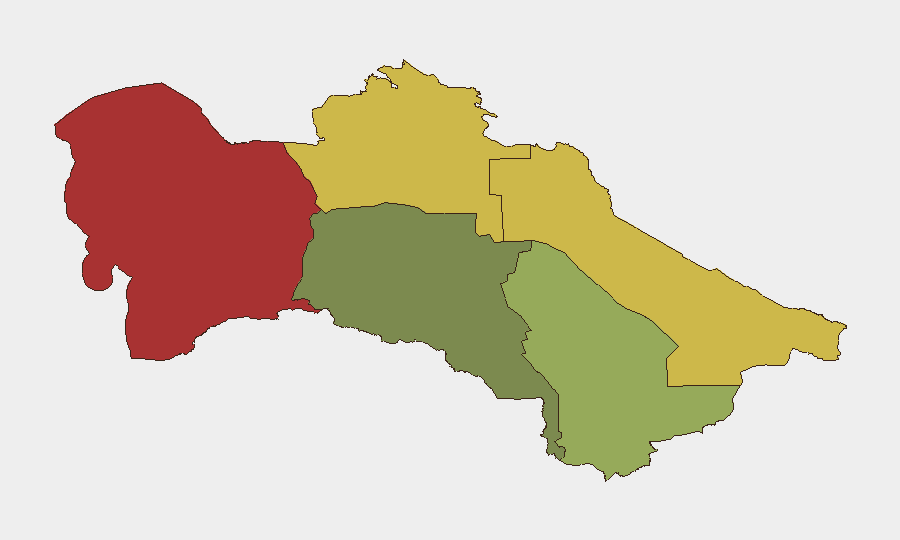
The Balkan Region (risk 78) and Lebap Region (risk 68) drive the country's elevated composite risk scores, likely reflecting border proximity, remoter governance capacity, and persistent but low-level smuggling or transnational crime patterns. Dashoguz Region (risk 62), in the north, similarly borders higher-risk jurisdictions. By contrast, Ashgabat City (risk 18) and central Ahal Region (risk 35) remain significantly lower-risk, consistent with capital-city security infrastructure and closer state oversight. Organizations with personnel or assets in the northern and western regions should maintain standard duty-of-care protocols and situational awareness; those in Ashgabat face routine operational risk only.
How GeoBit Would Assist
Security teams should deploy AOI Monitoring & Early Warning on Balkan and Lebap regions to detect emerging civil unrest, border incidents, or infrastructure disruption in real time. Multi-language OSINT fusion (Intel Sweep, Telegram/X monitoring, regional media ingestion) remains essential given Turkmenistan's restricted information environment and risk of under-reporting. Network & Actor Analysis on cross-border smuggling or transnational crime networks would provide context on why northern regions carry elevated scores and inform asset-protection decisions.
7-Day Outlook
No acute security escalation is forecast for the next seven days. Energy sector engagement and diplomatic activity are likely to continue at normal pace. Continued low-level monitoring of northern border regions and routine vigilance on infrastructure remain standard precautions; no operational posture change is warranted at this time.
Highest-Risk Areas — Ranked
| # | State / Region | Risk |
|---|---|---|
| 1 | Balkan Region | 78 |
| 2 | Lebap Region | 68 |
| 3 | Dashoguz Region | 62 |
| 4 | Mary Region | 42 |
| 5 | Ahal Region | 35 |
| 6 | Ashgabat City | 18 |
Sources
Previous Daily Briefs
A new Turkmenistan brief is written every day — each with its own risk map and downloadable CSV. Here's the last week; use the calendar to go further back.
📅 Browse every day by calendar →
Highlighted days have a brief. Tap a day for that day's map & analysis, or “csv” for that day's dataset ($5).