Situation Summary
Uruguay maintains a low-threat security environment with a global composite threat score of 3 and no credible reports of major security incidents, civil unrest, infrastructure disruption, or exceptional travel risk in the last 24–48 hours. Routine urban crime—primarily theft and robbery in dense metropolitan areas—remains at baseline levels, with no spike in gang violence or unusual law-enforcement deployments. National political investigations are proceeding without generating public-order disruption or institutional dysfunction. The country's stability trajectory shows no indicators of short-term deterioration.
Key Developments
- No major security incidents reported in-country (17–18 June 2026). Open-source monitoring, social media, and news outlets confirm routine crime patterns only in Montevideo and Canelones departments, with no abnormal activity or protest activity linked to ongoing diplomatic or political matters.
- Diplomatic activity ongoing without internal disruption (17–18 June 2026). Recent public diplomatic statements involving Uruguay have not generated demonstrations, unrest, or changes to internal travel or infrastructure status.
- National investigations proceeding within normal institutional channels (17–18 June 2026). Ongoing political and investor-related investigations are not producing civil unrest or operational disruption to government functions.
- Routine law enforcement activity in urban centers (ongoing baseline). Montevideo and Canelones continue to see normal theft and robbery patterns typical of dense urban environments, with no escalation or organized criminal activity spike.
- No terrorism, organized violence, or major crime events detected (last 48 hours). All available signals—web research, social media, news monitoring—confirm absence of exceptional security incidents in Uruguay proper.
Highest-Risk Areas
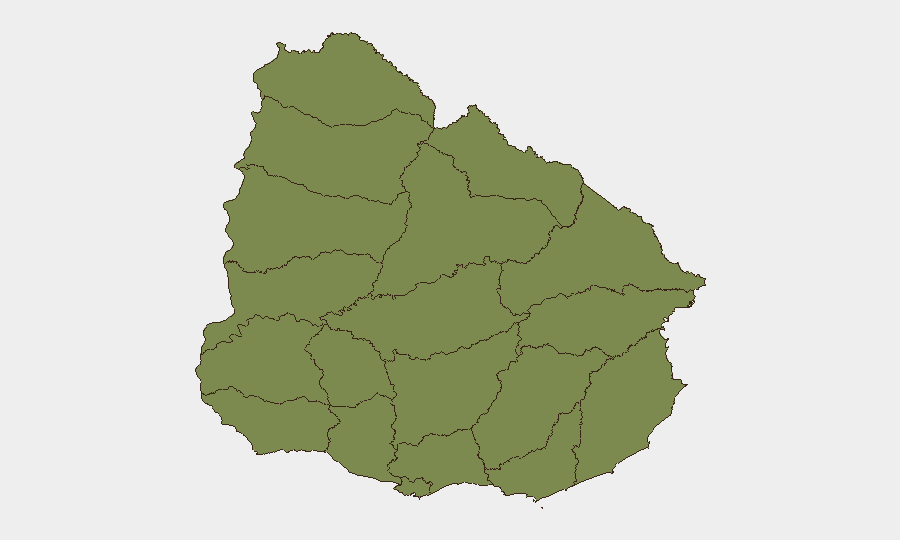
Durazno department significantly outweighs all other regions, with a composite risk score of 31.3—roughly four times that of Artigas and Montevideo (7.3 each). The concentration of risk in Durazno warrants specific monitoring; the underlying drivers (organized crime, drug trafficking routes, or gang activity) are not explicitly detailed in available open-source signals but should be the focus of asset-location and travel-planning due diligence. Montevideo and Artigas follow as secondary risk nodes; the remaining nine departments cluster at 1.3, indicating broadly distributed low-level baseline risk across rural and smaller urban centers.
How GeoBit Would Assist
Security teams with personnel or assets in Uruguay should employ AOI Monitoring & Early Warning to establish persistent watch on Durazno and Montevideo for emerging crime patterns and civil unrest, with automated alerting to pre-set thresholds. OSINT Fusion & Corroboration (X/Twitter, Telegram, news feeds, and multi-language sources) should be applied to track ongoing diplomatic and political investigations for any spillover into public unrest or infrastructure risk. Routing & Network Analysis would support safe journey planning for staff transiting between high-risk and baseline-risk departments, incorporating real-time crime and event data into alternative-route recommendations.
7-Day Outlook
No deterioration in the security environment is anticipated over the next seven days. Barring unexpected developments in ongoing political or diplomatic matters, Uruguay is expected to maintain its current low-threat, stable profile. Routine crime monitoring in Montevideo and urban centers should continue as standard due-diligence practice for resident and transient personnel.
Highest-Risk Areas — Ranked
| # | State / Region | Risk |
|---|---|---|
| 1 | Durazno | 31.3 |
| 2 | Artigas | 7.3 |
| 3 | Montevideo | 7.3 |
| 4 | Salto | 1.3 |
| 5 | Paysandú | 1.3 |
| 6 | Rivera | 1.3 |
| 7 | Tacuarembó | 1.3 |
| 8 | Soriano | 1.3 |
| 9 | Colonia | 1.3 |
| 10 | Río Negro | 1.3 |
| 11 | Flores | 1.3 |
| 12 | San José | 1.3 |
Sources
Previous Daily Briefs
A new Uruguay brief is written every day — each with its own risk map and downloadable CSV. Here's the last week; use the calendar to go further back.
📅 Browse every day by calendar →
Highlighted days have a brief. Tap a day for that day's map & analysis, or “csv” for that day's dataset ($5).