Situation Summary
Vietnam remains a composite threat level 7 (ranked #131 globally), with 141 tracked events over the monitoring period. The security environment is shaped primarily by political-administrative dynamics and cyber-governance rather than active kinetic conflict or organized criminal violence. A major nationwide legal regime change—the 2025 Law on Cybersecurity entering force on 1 July 2026—has reshaped the digital and information-control landscape, affecting corporate compliance, platform operations, and online activity across all sectors.
Key Developments
- 1 July 2026 – Hanoi – Cybersecurity Law Implementation
Vietnam's 2025 Law on Cybersecurity entered into force nationwide, establishing unified legal controls on digital platforms, AI/deepfake content, cross-border digital services, data security, and social-media groups. Penalties for violations and AI misuse have been tightened; all corporate and NGO online operations fall under the new regime effective immediately.
- 30 June – Multiple Disapproval Signals
Three distinct disapproval events were recorded on 30 June, including state-level disapproval actions, disapproval directed at non-state actors (Phoenix), and disapproval involving police and national institutions. The cluster suggests heightened administrative scrutiny and policy enforcement at the central level.
- 1 July – Diplomatic Public Statement (South Korea–Vietnam)
A public statement was issued by Gyeongsang (South Korea) regarding Vietnam, indicating bilateral engagement or messaging; timing suggests alignment with or reaction to Vietnam's cybersecurity law or other recent policy shifts.
- 30 June – State Demand to Military
A recorded demand event from state authorities to military entities on 30 June points to internal security directive activity, consistent with enforcement of new cyber and information policies across defense and security branches.
- 1 July – Rejection & Unconventional Violence Event
A rejection action and one unconventional-violence event were recorded on 1 July, coinciding with cybersecurity law implementation. Neither can be clearly linked to discrete incidents in public reporting, but both suggest friction at the moment of regime transition.
- 29 June – Foreign Ministry Public Statement
Vietnam issued a public statement to foreign ministries, likely signaling implementation of new legal frameworks or reaffirming sovereignty over digital/information policy to international partners.
Note on Current Incident Reporting: Live web research did not identify clearly time-stamped, discrete security incidents (protests, attacks, infrastructure disruptions) within the last 24–48 hours. The primary current event is regulatory/policy implementation; further incident granularity requires Vietnamese-language source feeds or official police/local news monitoring.
Highest-Risk Areas
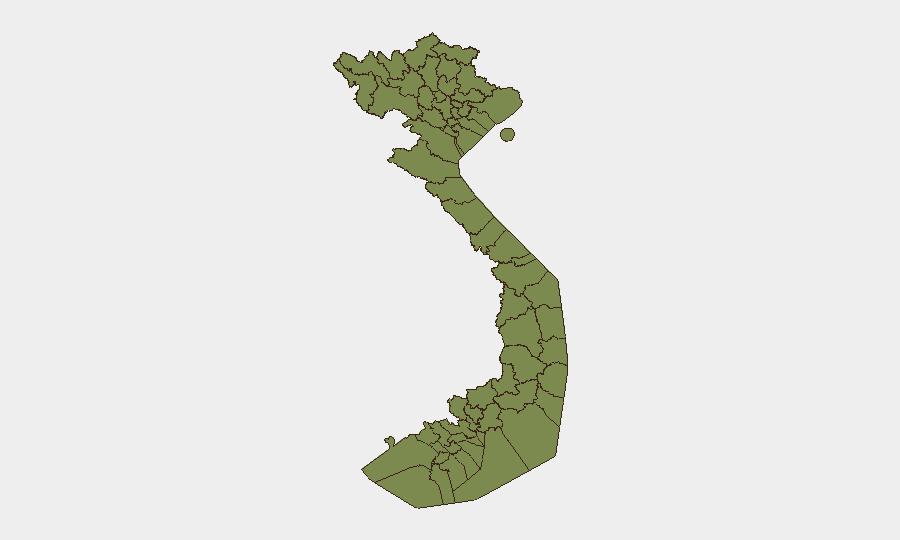
Huế dominates the sub-national risk ranking (34.5), followed by Hà Nội (20.4), creating a two-tier concentration in central and northern zones. Huế's elevated score reflects political-administrative sensitivity and historical institutional presence; Hà Nội's reflects capital-level governance, diplomatic, and cyber-infrastructure concentration. The remaining northern border provinces (Lào Cai, Hà Giang, Cao Bằng, Điện Biên, and others) cluster at 4.5, reflecting cross-border trafficking, criminality, and limited state-capacity zones typical of remote frontier regions. Corporate assets and personnel should prioritize awareness of cybersecurity compliance (nationwide) and exercise heightened situational awareness in Huế and Hà Nội pending clarity on implementation effects.
How GeoBit Would Assist
Teams should deploy AOI Monitoring & Early Warning on Huế and Hà Nội to track incident emergence and administrative action signals in real time. Intel Sweep and multi-language search (Vietnamese-language news, official channels, Telegram/X) will identify implementation friction, business-impact notices, and localized unrest as the cybersecurity law takes effect. Entity extraction and network analysis of enforcement actions will help map compliance obligations and actor intent.
7-Day Outlook
The immediate risk trajectory is driven by cybersecurity law implementation friction rather than instability. Corporate compliance demands will intensify; digital platform operation and data handling must align with new standards within days. Monitoring should remain elevated in Huế and Hà Nội to detect any administrative crackdowns or public resistance; no escalation to kinetic conflict is currently signaled.
Highest-Risk Areas — Ranked
| # | State / Region | Risk |
|---|---|---|
| 1 | Huế | 34.5 |
| 2 | Hà Nội | 20.4 |
| 3 | Hà Tĩnh Province | 9.8 |
| 4 | Lai Châu Province | 4.5 |
| 5 | Lào Cai Province | 4.5 |
| 6 | Hà Giang Province | 4.5 |
| 7 | Tuyên Quang Province | 4.5 |
| 8 | Cao Bằng Province | 4.5 |
| 9 | Bắc Kạn Province | 4.5 |
| 10 | Điện Biên Province | 4.5 |
| 11 | Yên Bái Province | 4.5 |
| 12 | Sơn La Province | 4.5 |
Sources
Previous Daily Briefs
A new Vietnam brief is written every day — each with its own risk map and downloadable CSV. Here's the last week; use the calendar to go further back.
📅 Browse every day by calendar →
Highlighted days have a brief. Tap a day for that day's map & analysis, or “csv” for that day's dataset ($5).