Situation Summary
Afghanistan remains a high-volatility operating environment characterized by active insurgency, cross-border military tension, and fragmented governance. The national threat composite score of 73 reflects persistent small-arms combat between Taliban and police forces, alongside judicial and defense-sector instability. Cross-border Pakistani military operations and domestic legal disputes signal fracturing state cohesion, while humanitarian access constraints and migrant flow disruptions add operational complexity for corporate presence.
Key Developments
- Pakistani-Afghan border escalation (June 10–11): Pakistani conventional military forces conducted multi-province airstrikes, triggering formal rejection statements from Afghan government and defense officials. Cross-border small-arms combat and military posturing remain elevated through June 12.
- Taliban–police armed engagement (June 12): Small-arms combat between Taliban and Afghan police reported; followed by police public statements of disapproval, indicating command-level friction or operational breakdown in contested zones.
- Judicial-defense sector conflict (June 11): Unconventional violence reported between prosecutor and military elements; defense attorney public statements and formal rejection declarations (June 13) suggest internal state fragmentation over security or personnel matters.
- UN conventional military deployment (June 12): UN forces reported on ground; operational scope and mandate unclear from available reporting, but consistent with humanitarian or observer presence amid deteriorating local security.
- Government-Defense Ministry discord (June 12): Public statements between government and Ministry of Defense signal institutional misalignment on security posture or resource allocation.
- Migrant and displaced-person activity (June 13): Public statements from migrant populations reflect ongoing forced displacement or border-crossing pressure, likely tied to insecurity and cross-border operations.
Highest-Risk Areas
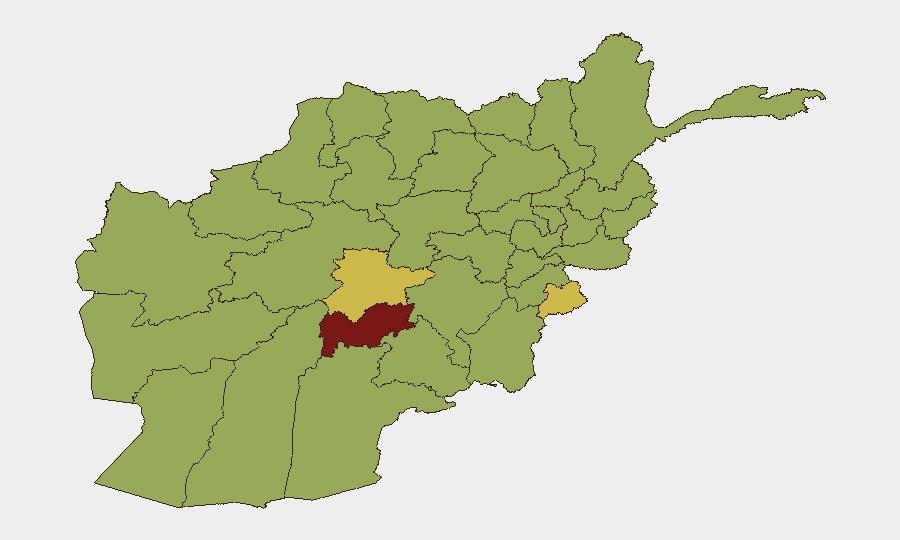
Uruzgan Province (80.9) and Daykundi Province (62.7) present the most acute risk and dominate the threat profile; Khost Province matches Daykundi at 62.7, with Herat and Kabul provinces also scoring above 56. Uruzgan's extreme score reflects sustained Taliban insurgency activity, light government presence, and proximity to Pakistan border tensions. The clustering of six provinces at 50.9 risk (Zabul, Kandahar, Ghazni, Paktika, Farah, plus Helmand and Maidan Wardak at 51.9) indicates a broad southern and eastern arc of active conflict, cross-border spillover, and limited state control. Kabul's elevated risk (56.3) reflects the institutional fragmentation evident in recent judicial and defense disputes, multiplying operational unpredictability for corporate entities in the capital.
How GeoBit Would Assist
Security and duty-of-care teams should deploy Intel Sweep and multi-language event feed monitoring to track Taliban–police clashes, judicial incidents, and cross-border military activity in real time, enabling rapid escalation protocols. AOI Monitoring & Early Warning on Uruzgan, Daykundi, and border zones provides persistent alerting for small-arms combat, military buildups, or kidnapping risk. Network & Actor Analysis applied to government, Taliban, prosecutor, and military entities clarifies institutional fracture lines and predicts state-actor reliability for negotiations or coordination.
7-Day Outlook
Cross-border tension with Pakistan is likely to persist or spike further if diplomatic de-escalation stalls; expect elevated military posturing and occasional small-arms incidents in eastern and southern provinces. Domestic institutional friction between defense, judiciary, and government suggests continued policy unpredictability and potential disruptions to security-force operations. Corporate operations in Kabul and southern provinces should anticipate localized mobility constraints and heightened staff vetting requirements through mid-to-late June.
Highest-Risk Areas — Ranked
| # | State / Region | Risk |
|---|---|---|
| 1 | Uruzgan Province | 80.9 |
| 2 | Daykundi Province | 62.7 |
| 3 | Khost Province | 62.7 |
| 4 | Herat Province | 56.8 |
| 5 | Kabul Province | 56.3 |
| 6 | Helmand Province | 51.9 |
| 7 | Maidan Wardak Province | 51.9 |
| 8 | Zabul Province | 50.9 |
| 9 | Kandahar Province | 50.9 |
| 10 | Ghazni Province | 50.9 |
| 11 | Paktika Province | 50.9 |
| 12 | Farah Province | 50.9 |
Sources
Previous Daily Briefs
A new Afghanistan brief is written every day — each with its own risk map and downloadable CSV. Here's the last week; use the calendar to go further back.
📅 Browse every day by calendar →
Highlighted days have a brief. Tap a day for that day's map & analysis, or “csv” for that day's dataset ($5).