Situation Summary
Azerbaijan remains a stable but geopolitically sensitive country with composite threat score 4/10 and 24 tracked events, ranking #169 globally. The security environment is dominated by political and diplomatic activity rather than acute incidents; no major armed clashes, terror attacks, or civil unrest have been reported in the past 24–48 hours. However, ongoing regional tensions—particularly around Armenia–Azerbaijan relations, Russian alignment shifts, and Middle East security positioning—create latent risks to political stability and diaspora-linked activism abroad.
Key Developments
- Baku – 24 June 2026 – Iran–Azerbaijan high-level security dialogue. Iranian Parliament Speaker Mohammad Bagher Ghalibaf met President Ilham Aliyev to discuss regional political and security architecture, signaling active repositioning of Azerbaijan's strategic partnerships and potential implications for future conflict dynamics in the South Caucasus.
- Baku – 24 June 2026 – Regional security messaging on foreign influence. Ghalibaf publicly argued for regional countries to determine Middle East security order without external power involvement, amplifying messaging that reflects Azerbaijan's evolving diplomatic posture and may inform future policy shifts.
- Baku – 24 June 2026 – Commentary on Russia–Azerbaijan tensions. Social and media discourse tied to the Iranian visit referenced Azerbaijan's prior closure of Russian cultural centres and alleged mistreatment of Russian journalists and citizens, reflecting current sensitivities around Russian nationals and media operations in-country.
- Washington, D.C. – 24 June 2026 – "Western Azerbaijan" diaspora campaign event. A conference organized by the Baku Initiative Group on Azerbaijani displacement claims and rights of return fuelled renewed Armenia–Azerbaijan narrative confrontation, with potential for diaspora protest activity and cyber-activism targeting Azerbaijani interests abroad.
- Online/global – 24 June 2026 – Renewed human-rights scrutiny. US lawmakers and international observers renewed criticism of Azerbaijan's detention and alleged torture practices against Armenian prisoners, contributing to reputational risk and increased scrutiny of Azerbaijani diplomatic missions and events.
- National – 24 June 2026 – Terrorism and ordnance threat posture unchanged. Canadian travel advisories confirm ongoing high-degree-of-caution posture due to terrorism threats and unexploded ordnance in western districts; no new major incidents reported since September 2023, but sporadic ceasefire-violation and landmine-accident risk persists.
Highest-Risk Areas
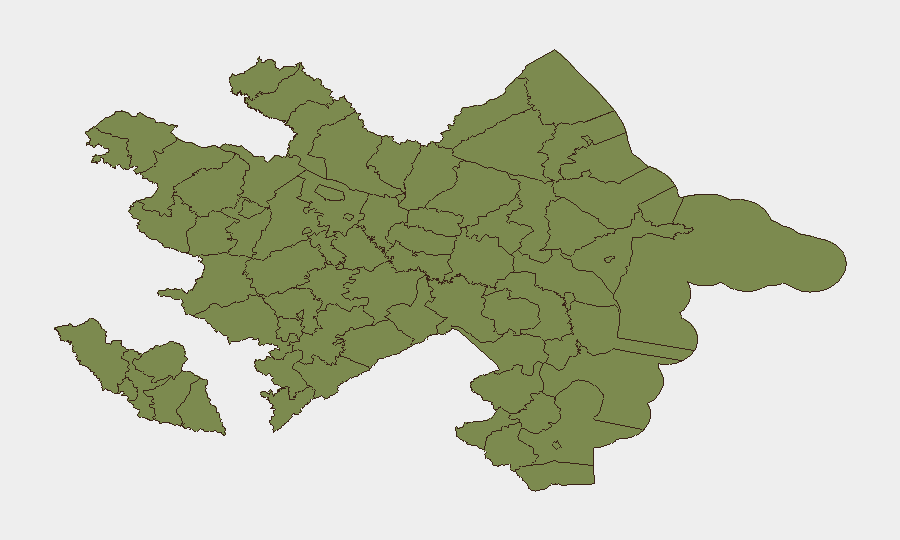
Baku City dominates risk assessment (31.9), reflecting its status as the capital and primary hub for diplomatic, political, and media activity. The remaining 11 ranked districts and Nakhchivan Autonomous Republic register materially lower risk (1.9 each), with hazards concentrated in border-proximal zones (Sadarak, Qazakh, Sharur, Tovuz, Qakh) where unexploded ordnance, ceasefire-violation incidents, and Armenia-border sensitivities persist. Risk in these areas is primarily structural and sporadic rather than acute; however, Baku's political and diplomatic concentration means that senior-level decision-making and geopolitical friction (e.g., Iran alignment, Russia relations) originate there and can drive broader instability.
How GeoBit Would Assist
Teams with personnel or assets in Azerbaijan should leverage GeoBit's AOI Monitoring & Early Warning on Baku and border districts to detect emerging clashes, protest activity, or security incidents in real time. Intel Sweep and multi-language OSINT fusion on political statements, media discourse, and social signals track alignment shifts and diaspora activism that may affect diplomatic stability or pressure on Azerbaijani institutions. Risk & Threat Assessment and Network & Actor Analysis on Iran–Azerbaijan–Russia triangulation and Armenia–diaspora networks provide early signals of escalation vectors relevant to duty-of-care planning.
7-Day Outlook
Near-term trajectory remains politically active but operationally stable. Iran–Azerbaijan engagement and regional security positioning will likely continue; no imminent armed escalation is signalled by current intelligence. However, diaspora activism, human-rights scrutiny, and diplomatic friction around Armenia relations and Russian alignment may intensify, creating reputational and protest risk to Azerbaijani interests globally and modest indirect pressure on domestic governance. Border-zone ordnance and sporadic ceasefire incidents remain a persistent low-level hazard.
Highest-Risk Areas — Ranked
| # | State / Region | Risk |
|---|---|---|
| 1 | Baku City | 31.9 |
| 2 | Sadarak District | 1.9 |
| 3 | Qazakh District | 1.9 |
| 4 | Sharur District | 1.9 |
| 5 | Yevlakh District | 1.9 |
| 6 | Kangarli District | 1.9 |
| 7 | Nakhchivan Autonomous Republic | 1.9 |
| 8 | Aghstafa District | 1.9 |
| 9 | Tovuz District | 1.9 |
| 10 | Qakh District | 1.9 |
| 11 | Shaki | 1.9 |
| 12 | Sheki District | 1.9 |
Sources
Previous Daily Briefs
A new Azerbaijan brief is written every day — each with its own risk map and downloadable CSV. Here's the last week; use the calendar to go further back.
📅 Browse every day by calendar →
Highlighted days have a brief. Tap a day for that day's map & analysis, or “csv” for that day's dataset ($5).