Situation Summary
Bulgaria faces a moderate near-term security environment marked by a nationwide cluster of bomb threats to public institutions, elevated criminal activity including weapons seizures and organized street racing, and localized infrastructure disruptions. No confirmed explosive devices have been recovered, and threat escalation remains contained, but the coordinated nature of the threats across multiple cities warrants active monitoring. Road safety remains a persistent concern, with elevated accident rates across the national network.
Key Developments
- Nationwide (Sofia, Plovdiv, Varna, Burgas, other cities) – 2–3 August 2026
Police reported email bomb threats targeting courthouses and public buildings across multiple regions, prompting evacuations and security sweeps; no explosive devices have been found to date.
- Sofia city center – night of 2 August 2026
Interior Ministry detained three individuals for organizing a dangerous illegal street racing event involving high-speed driving in central Sofia, posing public safety and traffic risks.
- Pernik region (southwest Bulgaria) – 2 August 2026
Specialized police operation seized a significant illegal weapons cache including firearms, ammunition, and explosives from three detained individuals linked to a high-value theft investigation.
- Lukoil group companies (national) – 2 August 2026 decision, implementation within days
Government designated Lukoil Aviation Bulgaria and Lukoil Bulgaria Bunker as national security assets in a closed session, enabling emergency state control over aviation and marine fuel supplies to protect refinery operations and fuel market stability.
- Lom (northern Bulgaria, Danube area) – 2 August 2026
Heavy rainfall and blocked drainage systems caused urban flooding, disrupting traffic and affecting low-lying infrastructure with no major casualties reported; motorists advised to exercise caution.
- Black Sea coast near Ahtopol (Camping Delfin) – 2 August 2026
A 62-year-old man from Kostinbrod drowned at an unguarded beach area, highlighting elevated drowning risk at unpatrolled coastal sites.
- National roads – 24 hours to 2 August 2026
Traffic police reported elevated incident rates: 37 injuries in one update and 5 fatalities with 30 injuries in a separate 24-hour update, indicating sustained road-safety risk across the national network.
Highest-Risk Areas
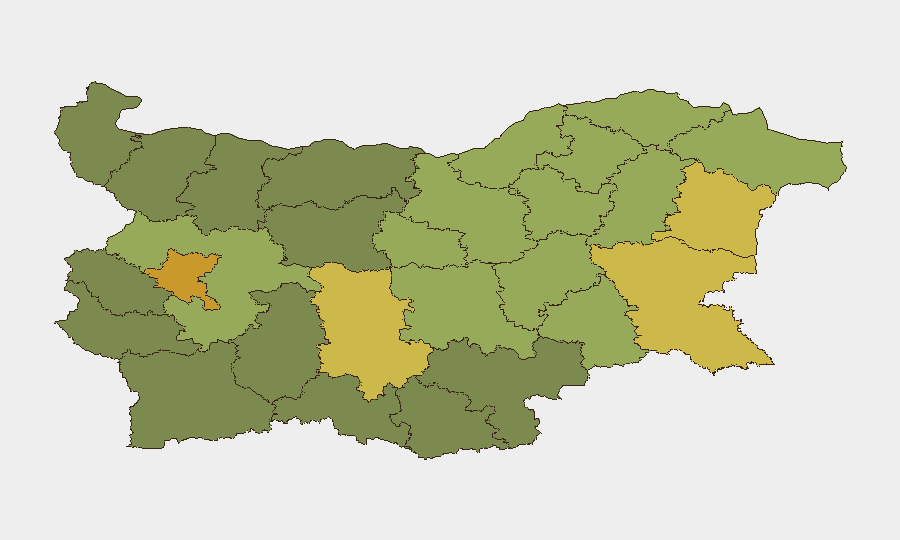
Sofia-City (risk 72) and Plovdiv (68) drive the national risk profile, followed by the Black Sea ports of Varna (65) and Burgas (62). The concentration of bomb threats across Sofia-City, Plovdiv, Varna, and Burgas reflects both the urban density and institutional infrastructure in these centers; the weapons seizure in Pernik and ongoing street racing in Sofia indicate organized criminal activity in the capital and surrounding southwest region. Coastal areas, including Varna and Burgas, carry compounded risk from both maritime-sector vulnerabilities and public safety incidents.
How GeoBit Would Assist
Security teams should leverage Intel Sweep and multi-language OSINT to monitor Telegram, email threat channels, and dark-web communications for indicators of coordinated threat campaigns behind the bomb-threat cluster. AOI Monitoring & Early Warning on high-risk cities—particularly Sofia-City, Plovdiv, and the ports—would enable persistent watch for emerging criminal networks, infrastructure vulnerabilities, and public-order incidents. Network & Actor Analysis can map relationships between detained individuals and broader organized crime networks, informing protective posture for personnel in Pernik, Sofia, and surrounding regions.
7-Day Outlook
Bomb-threat activity is likely to persist or escalate unless attribution and coordinated response occur; police sweeps should continue across institutional and transport nodes. Criminal activity (weapons trafficking, street racing, organized theft) is expected to remain at elevated levels absent enforcement intensification. Road safety and coastal drowning risks will remain persistent background concerns, particularly with seasonal weather variability.
Highest-Risk Areas — Ranked
| # | State / Region | Risk |
|---|---|---|
| 1 | Sofia-City | 72 |
| 2 | Plovdiv | 68 |
| 3 | Varna | 65 |
| 4 | Burgas | 62 |
| 5 | Sofia | 58 |
| 6 | Ruse | 55 |
| 7 | Stara Zagora | 52 |
| 8 | Sliven | 50 |
| 9 | Shumen | 48 |
| 10 | Razgrad | 47 |
| 11 | Yambol | 45 |
| 12 | Dobrich | 44 |
Sources
Previous Daily Briefs
A new Bulgaria brief is written every day — each with its own risk map and downloadable CSV. Here's the last week; use the calendar to go further back.
📅 Browse every day by calendar →
Highlighted days have a brief. Tap a day for that day's map & analysis, or “csv” for that day's dataset ($5).
Atlas — our AI intelligence desk — emails them this snapshot personally. Nothing else, no list.