Situation Summary
China's security environment remains stable at the national level with no verified large-scale unrest, kinetic incidents, or infrastructure disruptions reported in the last 48 hours. However, the threat picture is characterized by tightening administrative and digital enforcement, particularly in major economic and coastal hubs, rather than by physical violence or public unrest. Risk is being driven by regulatory compliance operations, targeted detentions under political scrutiny, and heightened device/movement controls on public transit. The national composite threat score of 77 reflects structural vulnerabilities and enforcement intensity rather than acute crisis conditions.
Key Developments
- Shanghai, 2026-06-16 (ongoing): Authorities conducting spot checks on public transit, including digital-device searches targeting VPNs, social media platforms, and cryptocurrency apps. Represents heightened surveillance enforcement directly affecting business travelers and expatriate movement.
- Beijing, 2026-06-13 to 14: Targeted arrest/detention events involving a scholar and citizen under political and academic scrutiny. Detentions are unrelated to visible civil unrest but reflect continued use of security powers against perceived information-related risks.
- Nationwide, 2026-06-15 to 16: Multiple arrest/detention signals across regions (minimum three separate events flagged 2026-06-16) and investigation activity, coupled with public statements and diplomatic rejections. Pattern suggests routine but elevated enforcement operations rather than response to specific incidents.
- Coastal and inland economic hubs (Shanghai, Jiangsu, Guangdong, Yunnan), 2026-06-14 to 16: Moderate-to-elevated regulatory and inspection pressure focused on cross-border movement controls and technology-sector enforcement. No violence reported, but heightened business and transit delays likely.
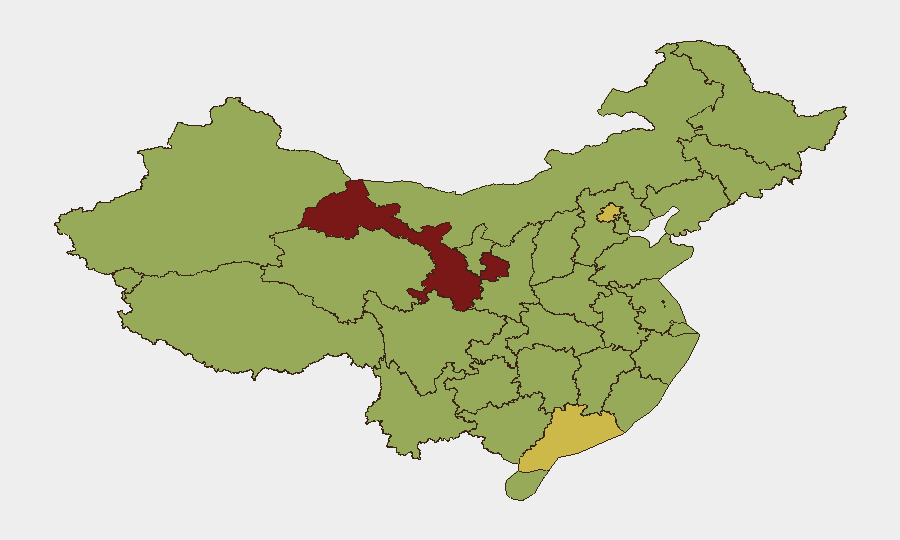
- Northwestern baseline (Gansu, Qinghai): Persistent structural risk (Gansu at 83.7 composite score) driven by border sensitivities; no newly verified incidents in last 48 hours.
- China-linked cyber activity, last 24–48 hours (global context): Ongoing espionage and intrusion campaigns attributed to China-linked actors targeting governments and critical infrastructure globally. Not domestic physical-security incidents, but relevant for corporate cyber-risk exposure.
Highest-Risk Areas
Gansu emerges as the single highest-risk region (83.7) due to border sensitivities and structural vulnerabilities, followed by Beijing (65.5), driven by political and administrative enforcement intensity. Coastal and eastern economic centers—Guangdong, Shanghai, Zhejiang, Jiangsu—all rank 54–61, reflecting a combination of high visibility, regulatory scrutiny, cross-border exposure, and enforcement operations. The concentration of corporate and expatriate presence in Shanghai, Beijing, and Guangdong means that administrative tightening in these zones carries direct duty-of-care implications for staff safety, movement, and asset security, even absent kinetic threat.
How GeoBit Would Assist
Security teams operating in China should deploy Intel Sweep and multi-language OSINT feeds to monitor regulatory enforcement, detention patterns, and administrative changes in real time across sub-national zones. AOI Monitoring with alerting on major economic hubs (Shanghai, Beijing, Guangdong) and border regions (Gansu, Yunnan) enables early warning of enforcement escalation or new checkpoint activity. Routing & Network Analysis supports operational planning of staff movement and asset transit in response to heightened compliance controls on transit and at borders.
7-Day Outlook
Enforcement and compliance intensity is expected to remain elevated across coastal and economic hubs without material de-escalation. No major kinetic incidents or unrest are forecast, but regulatory delays, device searches, and targeted detentions are likely to continue. Corporate and expatriate personnel should expect sustained operational friction rather than acute physical security events.
Highest-Risk Areas — Ranked
| # | State / Region | Risk |
|---|---|---|
| 1 | Gansu | 83.7 |
| 2 | Beijing | 65.5 |
| 3 | Guangdong Province | 60.6 |
| 4 | Shanghai | 56.3 |
| 5 | Zhejiang | 54.9 |
| 6 | Jiangxi | 54.5 |
| 7 | Hubei | 54.3 |
| 8 | Fujian | 54.2 |
| 9 | Jilin | 54.1 |
| 10 | Jiangsu | 54.1 |
| 11 | Yunnan | 53.9 |
| 12 | Henan | 53.9 |
Sources
Previous Daily Briefs
A new China brief is written every day — each with its own risk map and downloadable CSV. Here's the last week; use the calendar to go further back.
📅 Browse every day by calendar →
Highlighted days have a brief. Tap a day for that day's map & analysis, or “csv” for that day's dataset ($5).