Situation Summary
Ghana remains a moderate-risk operating environment (global rank #114, composite threat score 8) with concentrated vulnerabilities in Greater Accra Region and Bono East Region. Recent signal activity (28 tracked events) shows escalating political and civil-tension indicators, including arrests, demonstrations, and statements of disapproval directed at sovereign entities. The security posture is stable relative to West African peers, but localized friction points—particularly in Accra—warrant active duty-of-care monitoring for corporate and expatriate populations.
Key Developments
- 2026-06-28 · Demonstration/Rally Activity (Accra) – Civil demonstration activity recorded in Accra with Pan-African messaging; no casualties or operational disruption reported at time of publication, but reflects elevated civic tension.
- 2026-06-28 · Ghana–US Relations Friction – Public reduction in Ghana–US relations recorded; geopolitical positioning may create secondary effects on business, visa processing, and security cooperation frameworks.
- 2026-06-26 · Arrest/Detention Activity (Accra) – Multiple arrest/detention incidents logged in Accra, including press-related detentions; suggests heightened law-enforcement activity and possible media/speech-related friction.
- 2026-06-26 · High Court Statement – Judicial institutions issued public statements; context suggests potential governance or constitutional-order signaling.
- 2026-06-27 · Employee–Company Dispute Statement – Labor-relation incident with public-statement component; indicates possible labor-market or workplace-grievance escalation.
- 2026-06-27 · Australian Government Statement on Ghana – Third-party diplomatic signal; reason/context not yet clarified in available intelligence, warrants monitoring for sanctions, travel advisory, or human-rights concerns.
Data Limitation Note: Supplementary web-based verification of these signals did not return granular incident detail (specific times, locations, casualty figures, or organizational claims). Further corroboration via OSINT, local media monitoring, and in-country asset reporting is recommended before issuing internal escalations.
Highest-Risk Areas
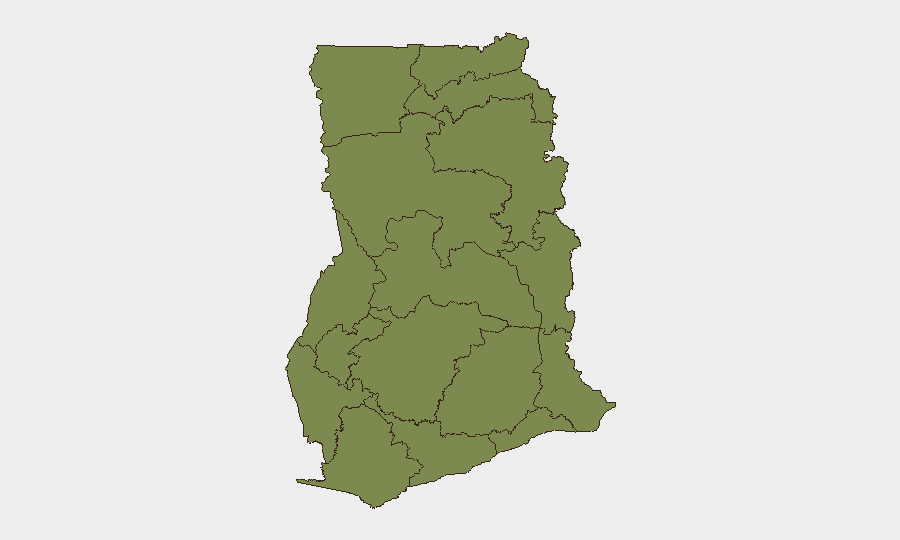
Greater Accra Region (risk 34.2) dominates the national threat profile and is the locus of political signaling, arrests, and civil activity. Bono East Region (risk 22.1) represents a secondary concentration, though incident drivers are not yet explicitly characterized. All other regions score below 5.3, indicating risk is spatially concentrated in the south-central corridor. Corporate teams with personnel or assets in Accra should assume elevated baseline operational risk and maintain heightened situational awareness; remote/northern regions pose conventional threat levels consistent with broader West African instability but not acute Ghana-specific triggers at present.
How GeoBit Would Assist
Teams should deploy OSINT fusion and multi-language social-media monitoring (X, Telegram, local news feeds) to track government statements, labor actions, and civil sentiment in real time. Area-of-interest (AOI) monitoring with persistent alerting on Accra and secondary risk zones enables early warning of demonstrations, arrests, or security-force deployments. Network and actor analysis of government, security, and opposition entities clarifies political-friction drivers and second-order business impacts (visa delays, asset freezes, curfews). Routine Intel Sweeps and entity-extraction workflows flag regime-stability or sanctions-related shifts requiring immediate duty-of-care reassessment.
7-Day Outlook
Political and civil-friction signals are likely to persist or intensify over the next 7 days pending resolution of the underlying governance or labor disputes. Accra and southern regions should remain under elevated watch; no imminent large-scale security breakdown is indicated, but localized disruptions (demonstrations, checkpoints, transport delays) are plausible. Expatriate and corporate security teams should confirm communication protocols, safe-haven procedures, and embassy contact points.
Highest-Risk Areas — Ranked
| # | State / Region | Risk |
|---|---|---|
| 1 | Greater Accra Region | 34.2 |
| 2 | Bono East Region | 22.1 |
| 3 | Oti Region | 5.3 |
| 4 | Upper East Region | 4.2 |
| 5 | Upper West Region | 4.2 |
| 6 | Savannah Region | 4.2 |
| 7 | North East Region | 4.2 |
| 8 | Northern Region | 4.2 |
| 9 | Eastern Region | 4.2 |
| 10 | Volta Region | 4.2 |
| 11 | Bono Region | 4.2 |
| 12 | Ahafo Region | 4.2 |
Sources
Previous Daily Briefs
A new Ghana brief is written every day — each with its own risk map and downloadable CSV. Here's the last week; use the calendar to go further back.
📅 Browse every day by calendar →
Highlighted days have a brief. Tap a day for that day's map & analysis, or “csv” for that day's dataset ($5).