Situation Summary
Greece remains a low-threat jurisdiction globally (rank #94, composite score 12), but faces acute political-violence risk concentrated in Central Greece and the greater Athens region (Attica). A coordinated firebomb attack on ruling-party officials' homes in Thessaloniki on 2026-07-01 has elevated immediate threat posture and triggered anti-terrorism investigation. Political tensions, anti-government sentiment, and prior patterns of coordinated incendiary attacks suggest elevated risk of further politically motivated violence in the near term.
Key Developments
- Thessaloniki, 2026-07-01 — Coordinated firebomb attacks targeted three residences/apartment buildings linked to New Democracy officials before dawn; improvised incendiary devices (gas canisters) were used in what authorities classify as a likely coordinated political-violence incident.
- Thessaloniki, 2026-07-01 — At least one fatality (Afroditi Nestora's mother) and three confirmed injuries sustained from burns; New Democracy candidate Afroditi Nestora was wounded in one of the attacks.
- Thessaloniki, 2026-07-02 — Greek anti-terrorism unit assumed investigative lead; authorities reviewed video evidence and confirmed assessment of the attacks as terrorism.
- Thessaloniki, 2026-07-02 — Prime Minister Kyriakos Mitsotakis visited injured victims in hospital and condemned the assault as "terrorism" and "blind violence," signaling elevated political and security tensions.
- Greece-wide, 2026-07-02–07-03 — Series of public statements from government, civil-society, and international actors (Red Cross reference noted in signal data) indicate broad official and diplomatic engagement on the incident and its implications for rule of law.
Highest-Risk Areas
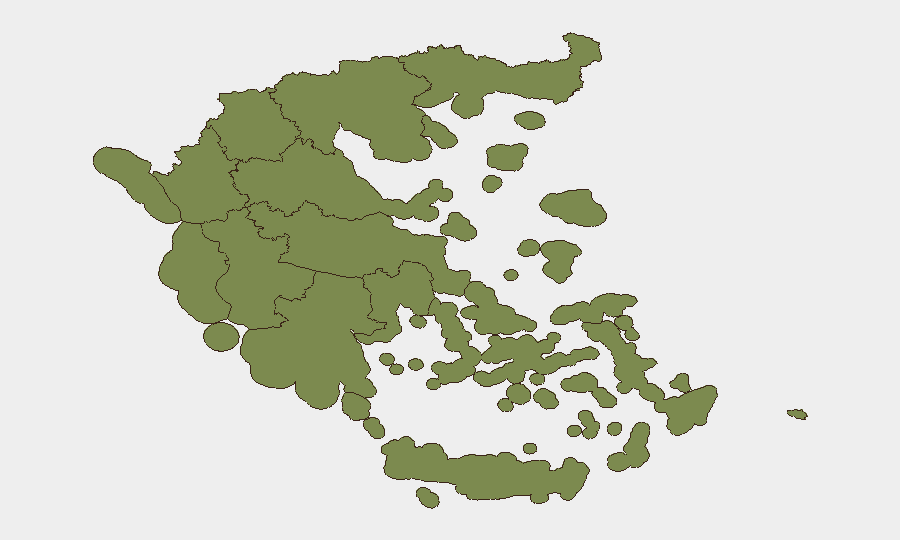
Central Greece and Attica (Athens metro) account for 84% of the country's tracked composite risk, with Central Greece alone at 31.8. The Thessaloniki firebombing, occurring in Thessaly/Central Macedonia (composite risk 6.4), underscores that political-violence actors are not confined to the capital. Attica's elevated baseline (20) reflects legacy and persistent anti-state extremism, organized-crime activity, and protest-related disorder; the current Central Greece surge reflects the active political-violence incident and potential for copycat or retaliatory attacks. All other regions remain at minimal risk (1.8–4.8).
How GeoBit Would Assist
Security teams with personnel or assets in Greece should deploy Area-of-Interest (AOI) Monitoring & Early Warning on Central Greece, Thessaly, and Attica to detect emerging actor statements, protest mobilization, or weapons-related OSINT on X/Telegram and open media. Network & Actor Analysis and sentiment & temporal analysis capabilities would isolate extremist cells claiming or coordinating similar attacks, and track rhetoric escalation preceding violence. Real-time conflict and political-violence search feeds, combined with multi-language OSINT fusion, enable duty-of-care teams to anticipate secondary incidents and route staff away from high-risk zones.
7-Day Outlook
The immediate 7-day threat window remains elevated. Anti-terrorism investigation momentum, Prime Minister engagement, and political pressure for arrests may deter immediate copycat attacks, but historical patterns suggest 2–4 week windows of heightened political-violence activity following coordinated incidents. Monitor police statements on suspect detention and any claims of responsibility; absence of a clear actor attribution increases uncertainty and duration of alert status.
Highest-Risk Areas — Ranked
| # | State / Region | Risk |
|---|---|---|
| 1 | Central Greece | 31.8 |
| 2 | Attica | 20 |
| 3 | Central Macedonia | 6.4 |
| 4 | Eastern Macedonia and Thrace | 4.8 |
| 5 | Western Greece | 1.9 |
| 6 | South Aegean | 1.9 |
| 7 | Western Macedonia | 1.8 |
| 8 | Peloponnese Region | 1.8 |
| 9 | Thessaly | 1.8 |
| 10 | Autonomous Monastic State of the Holy Mountain | 1.8 |
| 11 | Northern Aegean | 1.8 |
| 12 | Crete | 1.8 |
Sources
Previous Daily Briefs
A new Greece brief is written every day — each with its own risk map and downloadable CSV. Here's the last week; use the calendar to go further back.
📅 Browse every day by calendar →
Highlighted days have a brief. Tap a day for that day's map & analysis, or “csv” for that day's dataset ($5).