Situation Summary
Guyana remains stable at the national level, with no reported large-scale civil unrest, armed conflict, or political instability in the last 24–48 hours. However, routine crime—including suspected arson, narcotics trafficking, illegal firearms seizures, and a mining-related homicide—continues to undermine security in localized areas, particularly in Demerara-Mahaica and interior mining zones. Political tensions persist around the MV Barima maritime disaster (73 recovered, ~30 missing) and governance scrutiny, but these have not yet triggered public disorder. The threat environment remains diffuse, driven by organized crime and localized violence rather than systemic collapse.
Key Developments
- Georgetown, 30 July 2026: Customs Anti-Narcotics Unit (CANU) seized GY$80 million in foreign cannabis and five firearms during a raid, signaling active criminal markets and law-enforcement operations in the capital.
- Interior mining zone (unspecified), 30 July 2026: A 32-year-old gold miner, Ceton Mark Courtman, was shot dead following an altercation with a security officer attached to a dredge, highlighting firearm and interpersonal violence risks at remote mining sites.
- Berbice Region 6, 29–30 July 2026: Two residential homes were destroyed in separate fires; one blaze is suspected to have been maliciously set (arson), the other caused by occupant-initiated rubbish burning. Both incidents raise localized crime and fire-safety concerns.
- Long Creek area (near Soesdyke–Linden Highway, Region 4), 30 July 2026: Transparency International Guyana called for an independent investigation into President Irfaan Ali's ownership of a livestock farm, citing potential conflicts of interest and misuse of public resources—a governance risk with no accompanying civil unrest reported.
- MV Barima maritime search zone (off Guyana coast), 29 July 2026: Updated casualty toll: 73 bodies recovered, approximately 30 persons still missing; 18 assets (3 aircraft, 15 vessels) remain deployed. Opposition and civil-society figures have renewed calls for an independent or IMO-led investigation into the disaster, sustaining political contention.
- Guyana National Stadium, Providence (Region 4), 30 July 2026: Investigation into an earlier confrontation between Guyana Fire Service and Guyana Police Force ranks remains ongoing with no resolution announced; potential inter-agency tension, though no fresh clash is reported.
Highest-Risk Areas
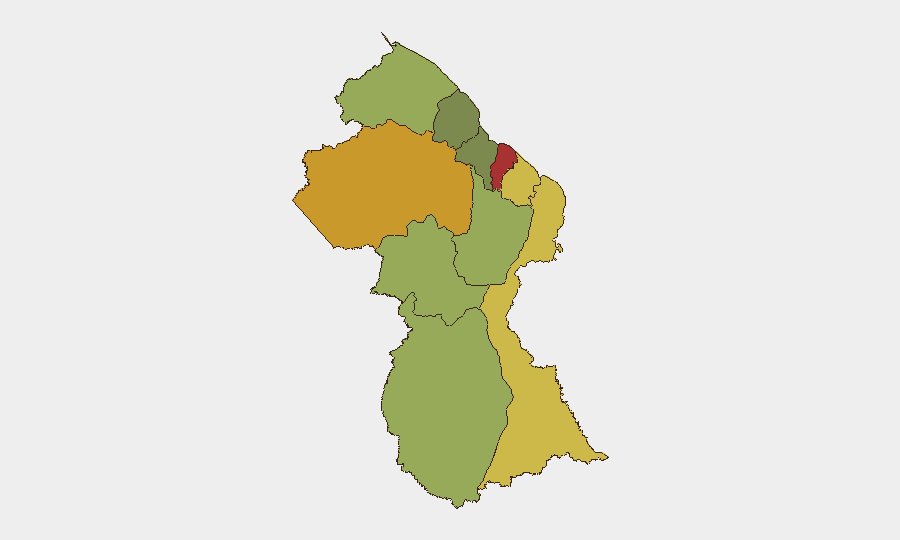
Demerara-Mahaica (risk 78) and Cuyuni-Mazaruni (risk 72) drive the highest sub-national threat scores, driven by organized crime, narcotics trafficking, firearms distribution, and violent crime concentrated in Georgetown and surrounding urban zones. Mahaica-Berbice (risk 65) and East Berbice-Corentyne (risk 62) follow, reflecting ongoing armed robbery, gang activity, and illicit trafficking patterns. Interior mining regions (Upper Demerara-Berbice, risk 58; Potaro-Siparuni, risk 48) face elevated homicide risk linked to disputes over claims, security operations, and firearm access—exemplified by the 30 July mining death. Urban centers remain the primary locus of narcotics and arms crime; interior zones face isolation and weak law-enforcement presence, enabling both criminal enterprise and workplace violence.
How GeoBit Would Assist
Teams with personnel or assets in Guyana should deploy AOI Monitoring & Early Warning on high-risk regions (Demerara-Mahaica, Cuyuni-Mazaruni, interior mining zones) to detect upticks in violent crime, trafficking activity, and inter-agency tensions before they escalate. Intel Sweep and multi-language OSINT fusion would track political contention around the MV Barima investigation and governance concerns, enabling early identification of protest risk or reputational damage. Routing & Network Analysis can assist security teams in planning alternative routes around Georgetown and mining transport corridors where crime and firearm incidents cluster.
7-Day Outlook
Routine crime—narcotics trafficking, armed robbery, workplace homicides, and arson—will likely persist at current levels in Georgetown and mining zones without significant escalation. Political scrutiny of the government over the MV Barima response and alleged conflicts of interest may intensify media and civil-society pressure but is unlikely to spark mass protests in the near term. Security teams should maintain heightened vigilance in Demerara-Mahaica and interior mining areas and monitor inter-agency tensions for potential public-order impacts.
Highest-Risk Areas — Ranked
| # | State / Region | Risk |
|---|---|---|
| 1 | Demerara-Mahaica | 78 |
| 2 | Cuyuni-Mazaruni | 72 |
| 3 | Mahaica-Berbice | 65 |
| 4 | East Berbice-Corentyne | 62 |
| 5 | Upper Demerara-Berbice | 58 |
| 6 | Potaro-Siparuni | 48 |
| 7 | Barima-Waini | 45 |
| 8 | Upper Takutu-Upper Essequibo | 42 |
| 9 | Pomeroon-Supenaam | 38 |
| 10 | Essequibo Islands | 35 |
Sources
Previous Daily Briefs
A new Guyana brief is written every day — each with its own risk map and downloadable CSV. Here's the last week; use the calendar to go further back.
📅 Browse every day by calendar →
Highlighted days have a brief. Tap a day for that day's map & analysis, or “csv” for that day's dataset ($5).
Atlas — our AI intelligence desk — emails them this snapshot personally. Nothing else, no list.