Situation Summary
Indonesia's composite threat score of 39 (rank #47 globally) reflects a two-tier security environment: acute institutional and governance tensions in Jakarta, and sustained armed conflict in Papua driving civilian displacement and aviation risk. Over the past 48 hours, high-profile police corruption raids and subsequent military protective deployment at a senior prosecutor's residence have triggered social-media speculation about police–military institutional rifts, compounding perceptions of justice-sector fragility in the capital. Simultaneously, Papua Province remains in active conflict with armed separatist groups, 122,000 internally displaced persons, and confirmed fatalities among foreign and local populations. Risk trajectory is elevated but containable outside conflict zones, pending resolution of Jakarta's institutional messaging.
Key Developments
- Jakarta – Coordinated police raids on Deputy Attorney General's residence, July 9–10. Indonesian National Police seized approximately 74 kg of gold bars, cash and foreign currencies valued at ~US$26.3 million from a house south of Jakarta owned by Deputy Attorney General for Special Crimes Febrie Adriansyah; raids cited corruption and money-laundering investigations linked to alleged coal-supply graft and recent power blackouts.
- South Jakarta – Currency seizures from commercial establishments, July 9–10. Police recovered rupiah and foreign currency equivalent to >US$3 million from a concealed safe at a restaurant and adjacent money changer, as part of the same enforcement sweep.
- Jakarta – Armed military deployment to prosecutor's residence, evening July 9–10. Indonesian military personnel deployed to guard Deputy Attorney General Adriansyah's residence following police raids; military spokesman stated the arrangement was protective and coordinated, but visible troop presence has been widely interpreted on social media as signaling institutional strain between National Police and armed forces (TNI).
- Jakarta – Intensified social-media discourse on police–military relations, July 10. Posts circulating on X/Twitter and regional platforms frame the raids and military response as evidence of possible institutional conflict; authorities have repeatedly denied rifts but continued messaging indicates sustained concern about governance-sector optics and political stability.
- Papua Province – Ongoing clashes between security forces and armed separatist groups, early July. Joint Indonesian security forces remain engaged with armed groups across multiple regencies; recent week has included at least three civilian deaths and continued displacement.
- Puncak Regency, Central Papua – Confirmation of American pilot fatality, reported early July. Body of American pilot killed by armed separatists following aircraft attack and burning in Puncak Regency has been recovered and confirmed; incident highlights persistent aviation and foreign-personnel risk in conflict zones.
- Papua Province – Large-scale civilian displacement officially acknowledged, July 10. Indonesian authorities reported ~122,000 internally displaced Papuans due to recent conflict, with situation described as worsened over the past month; infrastructure and travel disruption affecting roads, health facilities and markets across affected regencies.
Highest-Risk Areas
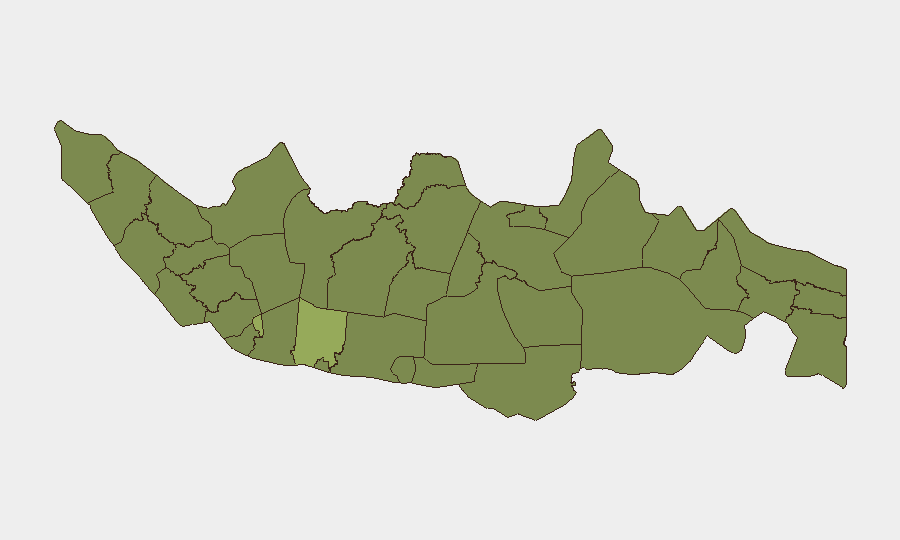
Jakarta (57.4) dominates the sub-national ranking and anchors national threat profile, driven by the convergence of police corruption investigations, military protective deployments and institutional-messaging ambiguity. Central Java (41.5) and West Kalimantan (36.6) follow as secondary concern zones, though recent event signals cluster heavily in the capital. Papua Province, though not ranked in the sub-national composite snapshot, represents the most acute kinetic risk—active armed conflict, confirmed foreign fatalities, large-scale displacement and aviation interdiction—and requires separate operational treatment.
How GeoBit Would Assist
Duty-of-care teams should deploy Intel Sweep and X/Twitter OSINT to monitor Jakarta institutional messaging in real time and assess police–military narrative divergence; use AOI Monitoring & Early Warning to track displacement flows and security-force movements in Papua's conflict regencies; and employ Routing & Network Analysis for alternative journey planning for personnel or supply chains transiting affected provinces. Sentiment & temporal analysis on social platforms will flag escalating institutional-strain discourse before formal policy shifts occur.
7-Day Outlook
Police corruption investigations are likely to continue with periodic asset seizures, sustaining media and social-media attention but not immediately escalating to institutional confrontation if military and police messaging remains coordinated. Papua conflict clashes will persist at current intensity; aviation access to interior regencies should be considered restricted. Jakarta remains operationally accessible but governance-sector uncertainty warrants heightened stakeholder communication.
Highest-Risk Areas — Ranked
| # | State / Region | Risk |
|---|---|---|
| 1 | Special capital Region of Jakarta | 57.4 |
| 2 | Central Java | 41.5 |
| 3 | West Kalimantan | 36.6 |
| 4 | East Java | 33.1 |
| 5 | West Java | 32.3 |
| 6 | South Sulawesi | 31.5 |
| 7 | North Sulawesi | 30.5 |
| 8 | North Sumatra | 30.3 |
| 9 | Banten | 28.7 |
| 10 | Southeast Sulawesi | 28.2 |
| 11 | Bali | 28 |
| 12 | Riau | 27.8 |
Sources
Previous Daily Briefs
A new Indonesia brief is written every day — each with its own risk map and downloadable CSV. Here's the last week; use the calendar to go further back.
📅 Browse every day by calendar →
Highlighted days have a brief. Tap a day for that day's map & analysis, or “csv” for that day's dataset ($5).
Atlas — our AI intelligence desk — emails them this snapshot personally. Nothing else, no list.