Situation Summary
Latvia remains in a stable security posture with no major acute incidents in the past 24–48 hours, but faces sustained hybrid-threat pressure from Russia manifested in cyber activity, airspace incursions, and border operations. The primary near-term disruption is a temporary IT-systems failure at the Latvia–Belarus border (August 4), which has suspended normal cross-border processing and prompted a formal advisory against travel to Belarus. Eastern border regions continue to experience elevated monitoring due to drone threats and Russian military posturing, while national cyber infrastructure faces ongoing multi-vector exploitation attempts.
Key Developments
- Latvia–Belarus border crossing points (multiple locations), August 4: Interior Ministry announced temporary closure of all border crossings with Belarus due to national information-systems malfunction; State Border Guard confirmed IT failure with no immediate restoration timeline, disrupting traveller and freight processing.
- Interior Ministry travel advisory, August 3–4: Interior Minister Janis Dombrava issued public warning against travel to Belarus and urged Latvian citizens currently there to return, citing heightened security concerns linked to the border-crossing disruption and broader instability.
- Eastern border sector (Latvia–Belarus), August 4–5: Border-control operations remain partially suspended pending restoration of IT systems; cross-border movement processing unable to proceed at normal capacity.
- National cyber infrastructure, August 4–5: Open-source monitoring confirms ongoing multi-vector cyber pressure against Latvian networks with active exploitation attempts; sustained activity poses operational risk to public and private digital infrastructure.
- Eastern districts airspace alerts (Ludza, Krāslava, Rēzekne), ongoing: Latvia maintains elevated airspace threat warnings in three eastern border districts following earlier Russian drone incursions; continuing alerts affect operational planning in these regions.
- NATO summit messaging, August 5: Latvian officials publicly framed current security environment as Russian hybrid-threat campaign (cyber, information, border pressure) aligned with broader war doctrine; statement reflects political assessment of current threat posture rather than new incident.
Highest-Risk Areas
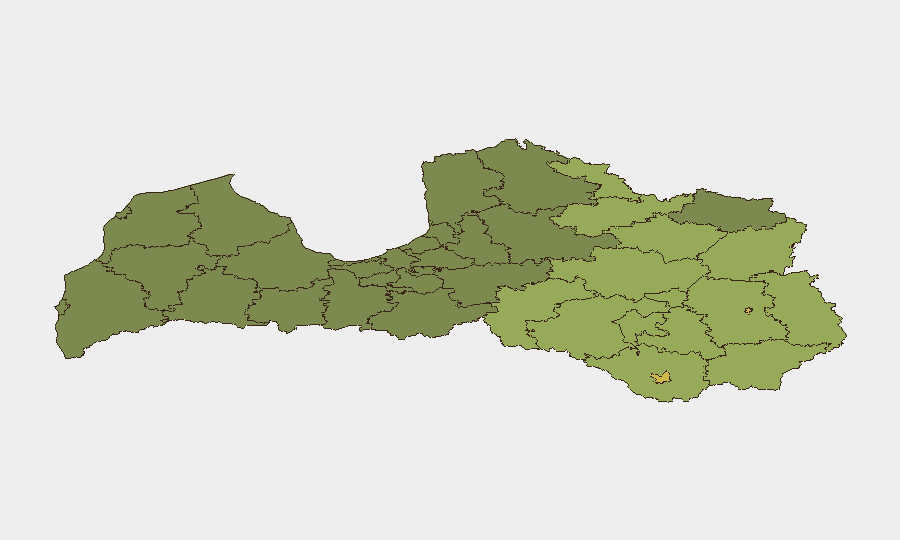
Rēzekne, Daugavpils, and their surrounding novads (districts) drive the sub-national ranking, with composite risk scores of 65–68. These areas are concentrated in Latvia's eastern border region with Russia and Belarus, where airspace monitoring remains elevated following drone incursions and where cumulative exposure to hybrid threats (cyber, border pressure, information operations) is highest. Risk in this corridor reflects both infrastructure vulnerability and proximity to Russian military activity; secondary-tier risk extends through Preiļu, Balvu, and Ludzas novads along the eastern frontier. The western and central regions of Latvia show substantially lower risk profiles.
How GeoBit Would Assist
Security teams operating in Latvia should deploy AOI Monitoring & Early Warning to track the Latvia–Belarus border corridor and eastern airspace sectors for further drone activity or border-control anomalies. Intel Sweep and multi-language OSINT (including Telegram, X, and local news feeds) provide continuous observation of hybrid-threat signals—cyber campaigns, information operations, and military posturing—ahead of formal announcements. Routing & Network Analysis can help corporate teams plan alternative travel and supply-chain routes should eastern border disruptions persist or expand.
7-Day Outlook
The IT-systems failure at the Latvia–Belarus border is expected to be resolved within 24–72 hours, but cross-border friction and heightened travel advisory are likely to remain in effect through the week. Cyber and airspace monitoring posture will persist as baseline operations; no significant new incidents are forecast, but the sustained multi-vector pressure environment means organizations should maintain operational awareness and contingency plans for infrastructure disruption or travel delays in the eastern border zone.
Highest-Risk Areas — Ranked
| # | State / Region | Risk |
|---|---|---|
| 1 | Rēzekne | 68 |
| 2 | Daugavpils | 65 |
| 3 | Rēzeknes novads | 58 |
| 4 | Ludzas novads | 55 |
| 5 | Balvu novads | 52 |
| 6 | Preiļu novads | 50 |
| 7 | Krāslavas novads | 48 |
| 8 | Jēkabpils novads | 47 |
| 9 | Augšdaugavas novads | 46 |
| 10 | Aizkraukles novads | 45 |
| 11 | Varakļānu novads | 44 |
| 12 | Līvānu novads | 43 |
Sources
Previous Daily Briefs
A new Latvia brief is written every day — each with its own risk map and downloadable CSV. Here's the last week; use the calendar to go further back.
📅 Browse every day by calendar →
Highlighted days have a brief. Tap a day for that day's map & analysis, or “csv” for that day's dataset ($5).
Atlas — our AI intelligence desk — emails them this snapshot personally. Nothing else, no list.