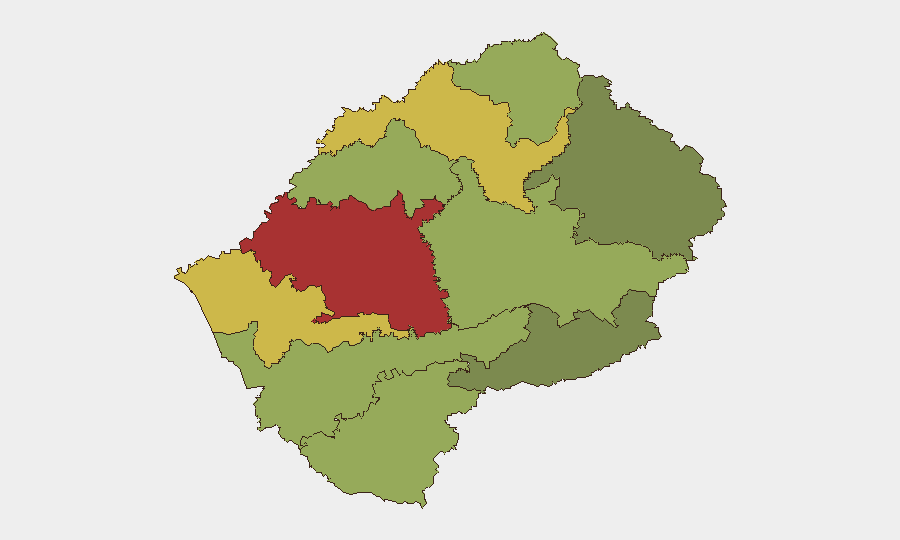
Situation Summary
Lesotho remains stable with no confirmed security incidents in the last 24–48 hours. The country ranks #149 globally (composite threat score 5) with no tracked events in the current window. Sub-national risk concentration in Maseru District and surrounding urban areas reflects endemic crime, spontaneous demonstration risk, and structural governance challenges rather than acute conflict or political instability. The operating environment for corporate personnel and assets is broadly permissive but requires baseline crime awareness and contingency planning in high-risk districts.
Key Developments
No discrete security, civil-unrest, conflict, infrastructure, crime, or travel-disruption incidents were confirmed in Lesotho during the last 24–48 hours. Open-web monitoring and travel-advisory sources indicate the domestic situation remains stable. No border, transport, or armed-violence developments were identifiable in current reporting. General crime and spontaneous-demonstration risk persist as baseline threats across urban centers, consistent with historical patterns documented since early 2026. Cross-border economic spillover from South African labor and protest activity continues to affect Lesotho's informal and formal sectors, though no direct security cascades into Lesotho were confirmed in the supplied sources.
Highest-Risk Areas
Maseru District (risk score 78) and Mafeteng District (risk score 65) account for the majority of measured sub-national threat concentration, driven by population density, informal-settlement crime, and police-resource constraints. Leribe, Berea, and Mohale's Hoek districts (scores 62–52) form a secondary risk belt where street crime, robbery, and spontaneous gatherings require standard corporate vigilance. Rural and highland districts (Thaba-Tseka, Quthing, Mokhotlong, Qacha's Nek) carry lower composite scores, reflecting lower population density and fewer documented incidents, though isolation and limited emergency response remain operational considerations. Corporate assets and personnel should concentrate protective measures in Maseru and secondary urban centers while maintaining basic security protocols nationwide.
How GeoBit Would Assist
Teams operating in Lesotho should use AOI Monitoring & Early Warning with persistent watch on Maseru District and key transport corridors to detect spontaneous demonstrations, crime clusters, or civil unrest before escalation. Intel Sweep and multi-language OSINT (X/Twitter, Telegram, local news feeds) will provide real-time early warning of political statements, labor actions, or border disruptions affecting supply chains or personnel movement. Routing & Network Analysis enables identification of alternative journey plans and safe corridors around known crime hotspots and protest-assembly zones, critical for duty-of-care compliance in higher-risk districts.
7-Day Outlook
No acute security drivers are forecast for the next seven days. Lesotho's risk profile will likely remain stable absent spillover from South African political or labor events. Teams should maintain standard crime-prevention and contingency protocols, monitor local news for unscheduled gatherings, and keep border-crossing and transport routes updated as regional economic conditions evolve.
Highest-Risk Areas — Ranked
| # | State / Region | Risk |
|---|---|---|
| 1 | Maseru District | 78 |
| 2 | Mafeteng District | 65 |
| 3 | Leribe District | 62 |
| 4 | Berea District | 58 |
| 5 | Mohale's Hoek District | 52 |
| 6 | Butha-Buthe District | 48 |
| 7 | Thaba-Tseka District | 45 |
| 8 | Quthing District | 42 |
| 9 | Mokhotlong District | 38 |
| 10 | Qacha's Nek District | 28 |
Sources
Previous Daily Briefs
A new Lesotho brief is written every day — each with its own risk map and downloadable CSV. Here's the last week; use the calendar to go further back.
📅 Browse every day by calendar →
Highlighted days have a brief. Tap a day for that day's map & analysis, or “csv” for that day's dataset ($5).
Atlas — our AI intelligence desk — emails them this snapshot personally. Nothing else, no list.