Situation Summary
Malta presents a composite threat score of 5 with no tracked discrete security events in the current window, indicating a stable baseline security environment. However, ongoing high-profile trials, energy infrastructure disruptions, and active organised crime investigations sustain moderate operational risk across the island's urban centres. The security picture reflects concentrated vulnerability in harbour-district and tourism-hub localities (Valletta, Sliema, St Julian's) where court activity, political scrutiny, and cross-border crime networks intersect.
Key Developments
- Valletta – Yorgen Fenech murder trial, 24th day (late July–early August 2026, continuing): Former chief of staff Keith Schembri testimony ongoing in Daphne Caruana Galizia assassination case. Risk of political tension and protest activity around court complexes if major rulings emerge.
- National – energy crisis with sustained power cuts (active in last days): Nationalist Party calling for no-confidence debate in Energy Minister Miriam Dalli; Prime Minister publicly maintains confidence. Risk of localised civil frustration, protests, and operational disruptions for businesses and travellers, especially during peak-demand hours.
- Ta' Giorni/St Julian's – police shooting case, officer recovery (court updates within last 48 hours): 74-year-old defendant pleaded not guilty to attempted murder of police officers; injured officer moved out of Intensive Therapy Unit, indicating recovery. Demonstrates active firearms violence and likely heightened police presence in area.
- Pietà – threat case involving senior political figures (recent court hearing, bail granted): Abdullah Buttigieg accused of sending threatening messages toward Prime Minister Robert Abela, MP Alex Borg, and former PM Joseph Muscat; bail granted. Indicates targeted threat behaviour and may trigger heightened security protocols around political offices and events.
- National – cross-border vehicle crime (Times of Malta front-page coverage, current): UK stolen vehicles being shipped into Malta via organised crime network. Implicates port security, customs enforcement, and Freeport operations.
- Naxxar – drug-trafficking enforcement (recent case, news cycle active): 60-year-old caught trafficking cocaine while violating court-ordered curfew. Reflects ongoing drug networks and court-monitoring gaps.
- National – indoor pyrotechnics law change (very recent enactment): Ban on indoor sparklers following Swiss tragedy; reflects heightened official sensitivity to fire and crowd-safety risks in venues, particularly nightlife districts.
Highest-Risk Areas
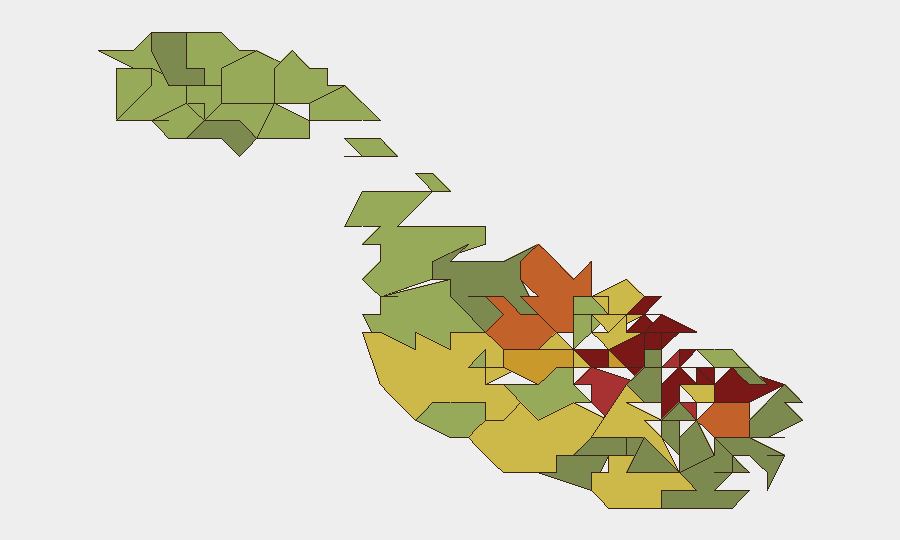
Valletta (risk 95), Sliema (92), and St Julian's (90) dominate the sub-national ranking and concentrate risk around court complexes, tourism infrastructure, and entertainment venues. These three localities are focal points for political trials, international arrivals, and organised social activity; high risk reflects exposure to court-driven security events, cross-border organised crime (particularly at ports and leisure precincts), and police response to serious violent incidents. Secondary urban clusters (Gżira, Hamrun, Paola, Msida) extend this pattern eastward and southward across the harbour area, indicating that risk is not dispersed but clustered in the urban core where maritime trade, judiciary operations, and high-density tourism intersect.
How GeoBit Would Assist
Security teams would deploy AOI Monitoring & Early Warning to track court complexes, political offices, and port facilities for emerging protest or threat activity; OSINT Fusion & Entity Extraction to correlate cross-border crime networks (stolen vehicles, drug trafficking) with Maltese law-enforcement operations; and Sentiment & Temporal Analysis on local news and social media to detect emerging civil frustration tied to energy crises or political trials before protest activity materialises. Network & Actor Analysis would map trafficking and organised-crime nodes linking Malta to external sources (UK vehicle theft, narcotics supply).
7-Day Outlook
The Fenech trial is expected to remain a focal point for political and media attention, with potential for heightened security protocols around Valletta courthouse if major testimony or rulings occur. Energy disruptions are likely to persist absent rapid infrastructure intervention, sustaining low-level civil friction. No imminent terrorism, mass casualty, or civil-unrest indicators are evident; risk trajectory remains stable unless trial outcomes or political fallout trigger escalation.
Highest-Risk Areas — Ranked
| # | State / Region | Risk |
|---|---|---|
| 1 | Valletta | 95 |
| 2 | Sliema | 92 |
| 3 | Saint Julian's | 90 |
| 4 | Gżira | 88 |
| 5 | Hamrun | 87 |
| 6 | Paola | 86 |
| 7 | Msida | 85 |
| 8 | Birkirkara | 84 |
| 9 | Birgu | 83 |
| 10 | Senglea | 82 |
| 11 | Cospicua | 81 |
| 12 | Żabbar | 80 |
Sources
Previous Daily Briefs
A new Malta brief is written every day — each with its own risk map and downloadable CSV. Here's the last week; use the calendar to go further back.
📅 Browse every day by calendar →
Highlighted days have a brief. Tap a day for that day's map & analysis, or “csv” for that day's dataset ($5).
Atlas — our AI intelligence desk — emails them this snapshot personally. Nothing else, no list.