Situation Summary
Montenegro remains in a low-risk, stable security environment as of 16 July 2026, with no reported civil unrest, political instability, terrorism activity, or infrastructure disruption in the last 24–48 hours. A fatal traffic accident on the Kotor–Nikšić coastal road on 14 July (21-year-old Serbian national killed, 16 injured) represents the only significant incident in recent reporting, classified as a transportation accident rather than a security event. Official advisories from Australian, German, and other governments confirm the overall threat picture remains calm, though endemic petty crime at tourist sites and occasional demonstrations in Podgorica warrant standard precautions. The composite threat score of 3 (global rank #178) reflects low baseline risk across the country.
Key Developments
- Lipci, Kotor–Nikšić magistralni put – 14 July 2026: A Serbian-registered passenger mini-bus carrying tourists veered off the coastal road, killing one 21-year-old female passenger and injuring 16 others. Local reporting describes the crash as a serious traffic accident ("teška saobraćajna nesreća") with no indication of deliberate act or security-related causation.
- Nationwide stability advisory update – 15 July 2026: Australian Smartraveller advisory reconfirmed Montenegro's overall security posture as stable, recommending normal safety precautions; no new civil unrest, conflict, or terrorism activity reported in the preceding 48 hours.
- Diplomatic and political activity noted – 15–16 July 2026: A security-risk platform daily brief recorded routine diplomatic and political activity only, with no verifiable security incidents, crime escalations, infrastructure disruptions, or travel-risk events confirmed in the last 24–48 hours.
- German MFA travel advisory status – mid-July update: German Foreign Office assessment notes occasional protests and demonstrations possible in Podgorica (potential traffic disruption only), common petty crime at tourist sites, and overall calm conditions; no recent escalations recorded.
- Karasovići/Debeli Brijeg border crossing (Croatia–Montenegro) – last 24–48 hours: Coastal border crossing operational 24/7 with no restrictions or disruptions affecting cross-border movement.
- Event signal: Deputy disapproval – 15 July 2026: A single tracked event relating to parliamentary deputy activity recorded; no civil unrest or institutional instability indicators present.
Highest-Risk Areas
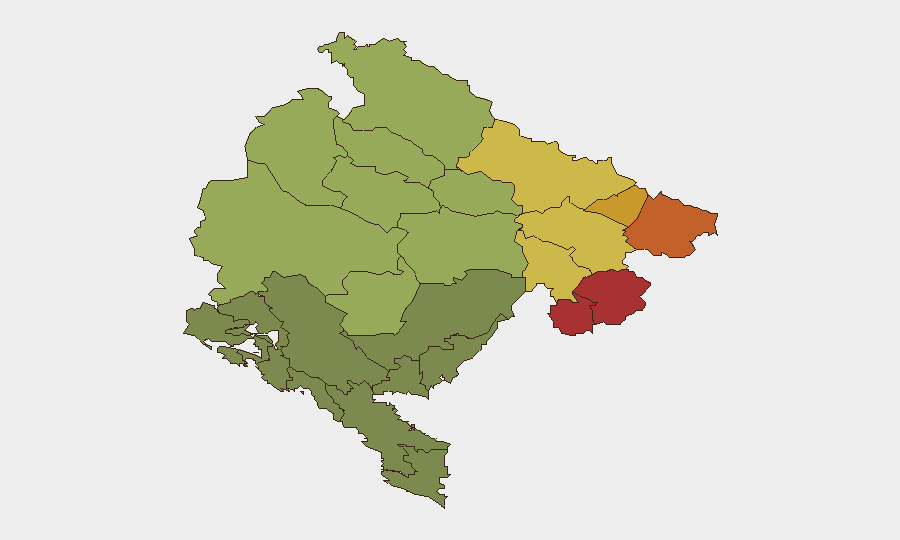
The northeastern municipalities of Plav (risk 78), Gusinje (76), Rožaje (74), and Petnjica (72) dominate the sub-national risk profile, collectively accounting for elevated threat scores relative to the national baseline. These border-proximate regions near Kosovo and Serbia typically experience higher risk due to legacy organized-crime networks, cross-border trafficking exposure, and weapons availability from regional conflicts. The secondary tier—Bijelo Polje, Berane, and Plužine—extends this pattern southward into central and eastern highlands. Coastal and western municipalities (Podgorica, Kotor, Budva) remain substantially lower-risk, though Podgorica records occasional protest activity. Corporate and personnel security planning should weight northeast exposure accordingly.
How GeoBit Would Assist
Teams with personnel or assets in Montenegro would employ AOI Monitoring & Early Warning on high-risk municipalities (particularly Plav, Gusinje, Rožaje) to detect emerging civil unrest, trafficking indicators, or cross-border incidents in near-real time. Intel Sweep and multi-language OSINT (X, Telegram, local news) would provide continuous sentiment and event tracking across political, security, and crime domains. Routing & Network Analysis would identify alternative transportation corridors (e.g., safer alternatives to the Kotor–Nikšić road during adverse conditions) and border-crossing operational status updates.
7-Day Outlook
No credible indicators suggest escalation in civil unrest, political instability, or security incidents over the next seven days. Summer tourism and border-crossing operations are expected to continue normally. Routine vigilance for petty crime in tourist zones and occasional Podgorica demonstrations remains warranted, but the threat trajectory is flat to downward.
Highest-Risk Areas — Ranked
| # | State / Region | Risk |
|---|---|---|
| 1 | Plav Municipality | 78 |
| 2 | Gusinje Municipality | 76 |
| 3 | Rožaje Municipality | 74 |
| 4 | Petnjica Municipality | 72 |
| 5 | Andrijevica Municipality | 68 |
| 6 | Bijelo Polje Municipality | 65 |
| 7 | Berane Municipality | 62 |
| 8 | Plužine Municipality | 58 |
| 9 | Pljevlja Municipality | 55 |
| 10 | Šavnik Municipality | 52 |
| 11 | Žabljak Municipality | 50 |
| 12 | Kolašin Municipality | 48 |
Sources
Previous Daily Briefs
A new Montenegro brief is written every day — each with its own risk map and downloadable CSV. Here's the last week; use the calendar to go further back.
📅 Browse every day by calendar →
Highlighted days have a brief. Tap a day for that day's map & analysis, or “csv” for that day's dataset ($5).
Atlas — our AI intelligence desk — emails them this snapshot personally. Nothing else, no list.