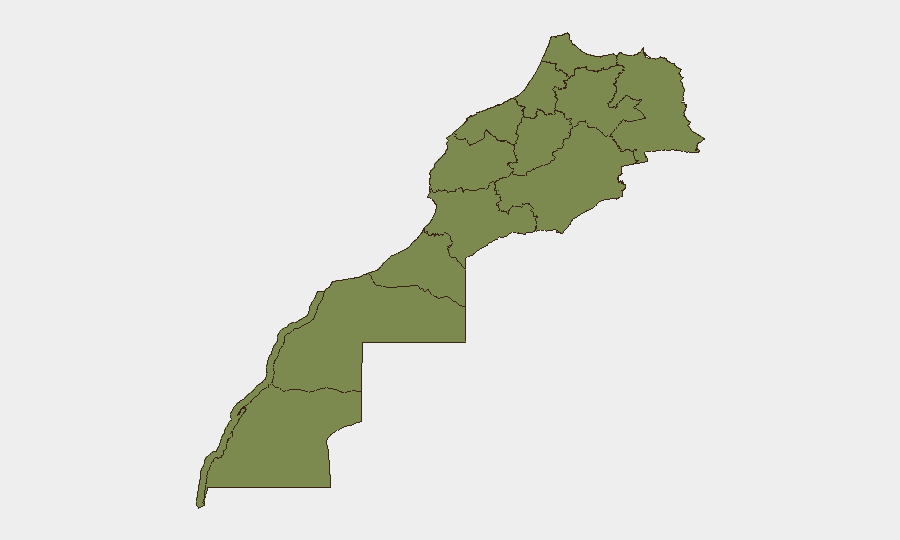
Situation Summary
Morocco remains at moderate global risk (rank #106, composite score 8) but faces an acute security spike in the northern border corridor due to a mass migrant surge toward Spanish enclaves. Since 31 July, tens of thousands of migrants have attempted irregular crossings into Ceuta and Melilla, triggering significant police and military responses, at least 18–19 reported fatalities, and widespread disruption to transport and trade routes. While most of Morocco is calm, the northern region is experiencing heightened volatility with potential for rapid escalation.
Key Developments
- Fnideq, near Ceuta border | 31 July–1 August 2026: Moroccan security forces arrested approximately 70 people following street clashes and violent incidents (attempted homicide, arson, property damage) linked to mass crossing attempts. Unrest followed tens of thousands of migrants attempting to enter Ceuta.
- Northern Ceuta/Melilla crossing corridor | 31 July–1 August 2026: Tens of thousands of migrants launched coordinated irregular crossing attempts across land and sea routes. Spanish authorities deployed additional military and police reinforcements; Moroccan forces deployed water cannon trucks and intensified border security operations. At least 18–19 deaths reported during crossing attempts.
- Road and transport disruption (northern corridor) | 31 July–1 August 2026: Police roadblocks and identity checkpoints established across northern Morocco are causing significant delays on vehicular routes. U.S. Embassy issued security alert warning of crowding, schedule disruptions, and cancellations affecting trains, buses, and ferries serving northern cities and ports.
- Coastal staging areas (Ceuta/Melilla approaches) | 31 July–1 August 2026: Localized confrontations reported between Moroccan security forces and migrant groups at irregular departure points. Police employed crowd-control measures (water cannon, dispersal tactics) to prevent mass border crossings, with risk of spontaneous protests and stone-throwing in affected zones.
- Government-level diplomatic tension | 31 July 2026: Morocco reduced relations with Madrid and imposed administrative sanctions against Spain; Spain simultaneously announced military mobilization in response to the crossing crisis, indicating escalating bilateral tension over border management.
Highest-Risk Areas
Tangier-Tetouan-Al Hoceima dominates the risk landscape (composite score 31.5), accounting for the vast majority of current threat activity due to its direct adjacency to Ceuta and Melilla and concentration of irregular crossing staging areas. The region's coastal towns—particularly Fnideq, Tangier, and Tetouan—are focal points for migrant congregation, police response, and spontaneous unrest. Casablanca-Settat (8.1) and Rabat-Salé-Kénitra (6.8) carry secondary risk due to their status as major transport and commercial hubs; disruption in the north may propagate downstream to national supply chains and public transport. All other regions remain at baseline risk levels (≤1.8).
How GeoBit Would Assist
Security teams should employ AOI Monitoring & Early Warning on northern border towns (Fnideq, Tangier, Tetouan) and crossing checkpoints to track police deployments, crowd movements, and incident onset in real time. Routing & Network Analysis capabilities enable identification of alternative transport corridors and supply-chain workarounds to bypass congested or restricted roads in the corridor. OSINT fusion and multi-language social-media intelligence (X, Telegram, YouTube) provide early signals of migrant mobilization, police operations, and diplomatic escalation before mainstream reporting.
7-Day Outlook
The migrant surge is likely to persist or recur in waves over the next week as long as underlying economic and security drivers in source regions remain unaddressed. Police and military presence will remain elevated in the northern corridor; expect continued transport delays, checkpoints, and localized confrontations. Bilateral Morocco–Spain tension may further constrain cooperation on border management, increasing risk of uncoordinated responses and secondary incidents.
Highest-Risk Areas — Ranked
| # | State / Region | Risk |
|---|---|---|
| 1 | Tangier-Tetouan-Al Hoceima | 31.5 |
| 2 | Casablanca-Settat | 8.1 |
| 3 | Rabat-Salé-Kénitra | 6.8 |
| 4 | Drâa-Tafilalet | 1.8 |
| 5 | Western Sahara | 1.5 |
| 6 | Laâyoune-Sakia El Hamra | 1.5 |
| 7 | Guelmim-Oued Noun | 1.5 |
| 8 | Dakhla-Oued Ed-Dahab | 1.5 |
| 9 | Béni Mellal-Khénifra | 1.5 |
| 10 | Fez-Meknes | 1.5 |
| 11 | Oriental | 1.5 |
| 12 | Marrakech-Safi | 1.5 |
Sources
Previous Daily Briefs
A new Morocco brief is written every day — each with its own risk map and downloadable CSV. Here's the last week; use the calendar to go further back.
📅 Browse every day by calendar →
Highlighted days have a brief. Tap a day for that day's map & analysis, or “csv” for that day's dataset ($5).
Atlas — our AI intelligence desk — emails them this snapshot personally. Nothing else, no list.