Situation Summary
Namibia remains a low-threat environment globally (ranked #114 with composite threat score 14) and has recorded no discrete security incidents during the reporting period. However, underlying governance grievances and labour tensions within the security sector warrant monitoring, particularly in the northern border regions where sub-national risk scores significantly exceed the national baseline. The security posture is stable but not static; periodic protests and sectoral labour activity indicate latent tensions that could generate disruptions if unresolved.
Key Developments
- Windhoek, 01 Sep 2026 – ||Khomanin Traditional Community staged a demonstration demanding ministerial response to a previously submitted petition on urban and rural development. Protest was peaceful but reflects persistent land and governance grievances within the capital.
- Katima Mulilo (Zambezi Region), 03–04 Sep 2026 – NAPUSAWU Secretary General Alex Taimo cited in reports on public security sector issues and labour commentary. No discrete incident reported, but signals ongoing union activity and potential sectoral tensions.
- Windhoek, 01–02 Sep 2026 – Continued coverage of ||Khomanin protest confirms multi-source political sensitivity regarding urban and rural development policy. Indicates sustained rather than episodic grievance activism.
- National, 03–05 Sep 2026 – Multiple reports referencing NAPUSAWU and security-sector commentary suggest broader public debate on conditions affecting public security and allied workers. Reflects latent industrial tensions within security apparatus.
- Sachona (Zambezi Region), 06 Sep 2026 – Vehicle overturned resulting in one fatality and six injuries. Primarily a traffic safety incident, but highlights poor road conditions and vehicle safety risks in rural areas relevant for overland travel planning.
Highest-Risk Areas
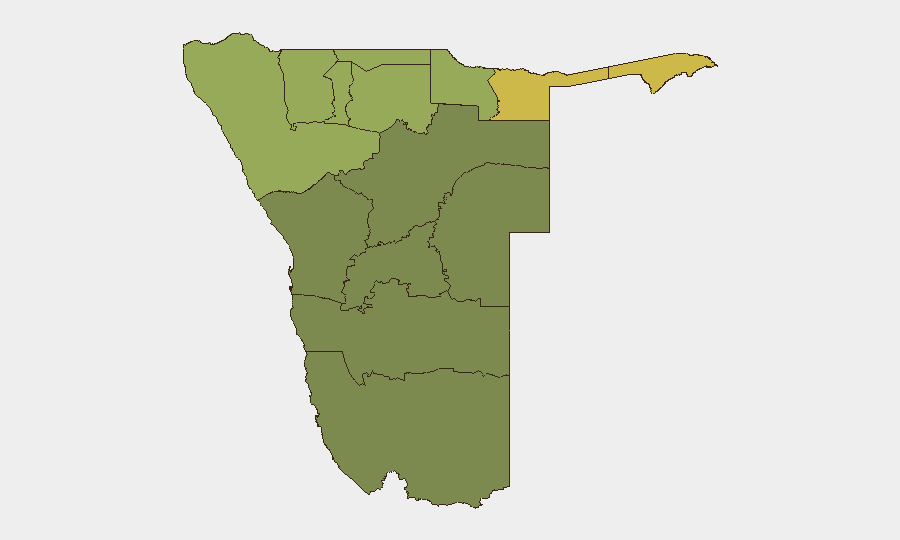
Zambezi Region (risk score 68), Kavango East (62), and Kavango West (58) drive the upper end of sub-national risk and together represent the primary concern for corporate operations and personnel. These northern border regions face elevated risk due to a combination of remote location, limited state presence, porous borders, and sporadic cross-border activity. Kunene Region (52) and Oshikoto (48) represent secondary clusters of concern. By contrast, central and southern regions including Windhoek's Khomas district show substantially lower risk profiles, though the capital's role as a governance and political focal point means that land and labour grievances surface there first. Northern operators should maintain heightened awareness and contingency planning; central and southern areas present minimal threat to standard corporate security postures.
How GeoBit Would Assist
Corporate security teams operating in Namibia should employ AOI Monitoring & Early Warning with persistent watch on Zambezi, Kavango East/West, and Kunene regions to detect cross-border activity, informal settlements, or protest mobilization. OSINT fusion and multi-language search capabilities enable tracking of labour union announcements, government policy responses, and grassroots social media activity that often precedes formal protests or strikes. Routing & Network Analysis supports duty-of-care travel planning for personnel transiting high-risk northern regions by identifying safer corridors and alternative routes around areas of elevated incident density.
7-Day Outlook
No major incidents are anticipated in the immediate term. The ||Khomanin protest and NAPUSAWU commentary are likely to continue as low-intensity political discourse unless government policy response is perceived as dismissive or inadequate. Road safety risks in Zambezi and other remote regions remain endemic; personnel travel in these areas should account for poor infrastructure and limited emergency services.
Highest-Risk Areas — Ranked
| # | State / Region | Risk |
|---|---|---|
| 1 | Zambezi | 68 |
| 2 | Kavango East | 62 |
| 3 | Kavango West | 58 |
| 4 | Kunene Region | 52 |
| 5 | Oshikoto | 48 |
| 6 | Ohangwena | 45 |
| 7 | Omusati | 42 |
| 8 | Oshana | 40 |
| 9 | Otjozondjupa | 35 |
| 10 | Erongo Region | 32 |
| 11 | Hardap | 28 |
| 12 | Omaheke | 25 |
Sources
Previous Weekly Briefs
A new Namibia brief is written every Monday, covering the week — each with its own risk map and downloadable CSV. Use the calendar to go further back.
- September 1, 2026
- August 30, 2026
- August 28, 2026
- August 25, 2026
- August 23, 2026
- August 21, 2026
- August 19, 2026
📅 Browse past briefs by calendar →
Highlighted days have a brief. Tap a day for that day's map & analysis, or “csv” for that day's dataset ($5).
Atlas — our AI intelligence desk — emails them this snapshot personally. Nothing else, no list.