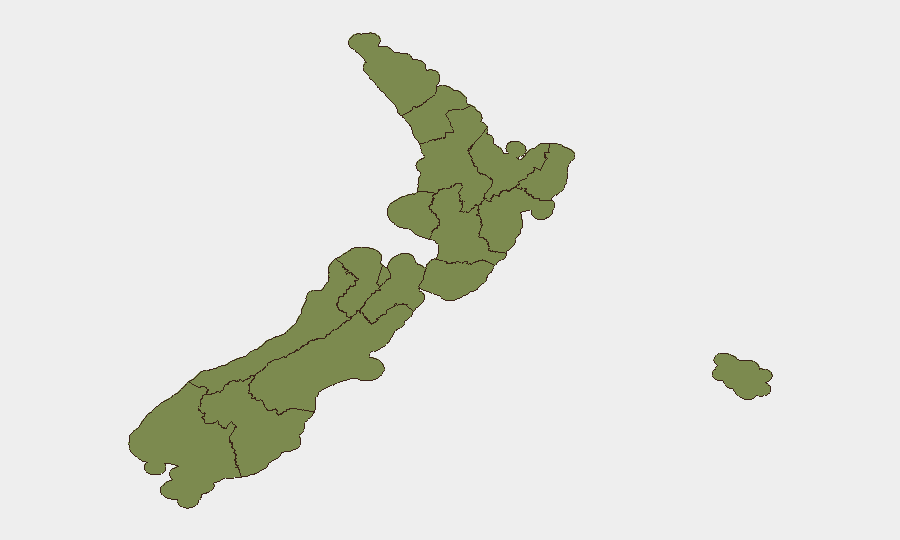
Situation Summary
New Zealand remains a relatively low-threat environment globally (rank #149; composite score 5), with no confirmed security, civil-unrest, crime, infrastructure, or travel incidents detected in the past 24–48 hours. The country's security posture is stable, though sub-national risk variation is marked, with Canterbury and Wellington significantly elevating the national profile. Routine business and institutional activity—including a successful Rocket Lab space launch on 27 June—continues without reported disruption.
Key Developments
- 27 June 2026 · Space Launch · Māhia Peninsula, Auckland region – Rocket Lab conducted a routine, successful orbital launch from Launch Complex 1 with no reported safety or security complications.
- Recent institutional and labour communications (25–26 June) – Public statements and labour notifications from government, hospital unions, schools, and industry bodies were recorded in the event feed; no escalation to disruption or unrest has been confirmed in open-source reporting.
- Isolated police action (25 June) – An arrest or detention event involving Parliament was logged; context and resolution status remain unclear from available open-source data and warrant internal institutional verification if relevant to duty-of-care operations.
- Company-level cybersecurity incident (25 June) – A New Zealand company-versus-intelligence investigation was flagged; specificity on sector, resolution timeline, and operational impact unavailable without direct institutional access.
No confirmed incidents of violence, rioting, infrastructure failure, transport disruption, or cross-border instability have been identified in the last 48 hours.
Highest-Risk Areas
Canterbury (risk 32.1) and Wellington (risk 21.7) together account for the majority of tracked threat events and composite risk. Canterbury's elevated score reflects its size, port activity (Lyttelton), and density of institutional/commercial targets; Wellington's score reflects the capital's concentration of government, media, financial, and diplomatic assets. Auckland (11.7) remains lower-risk despite population, suggesting either better incident prevention or lower event density in recent tracking windows. Waikato (6.3) and West Coast (4.6) carry minor residual risk; all other regions score below 3.5, indicating diffuse, low-magnitude threat profiles.
How GeoBit Would Assist
Intel Sweep and OSINT fusion provide continuous baseline monitoring of public statements, labour notifications, and institutional communications to detect early signals of escalation. AOI Monitoring & Early Warning with persistent watch zones around critical infrastructure in Canterbury (ports, utilities) and Wellington (government, diplomatic) enables real-time alerting if threat indicators sharpen. Network & Actor Analysis combined with Routing & Network Analysis allows security teams to map operational dependencies and identify alternative supply-chain or travel routes if Canterbury or Wellington incidents disrupt normal movement or logistics.
7-Day Outlook
No near-term destabilization is anticipated. Baseline labour and institutional dialogue will continue; security teams should maintain routine monitoring of Wellington and Canterbury institutional communications for any signals of escalation. The absence of confirmed incidents in the past 48 hours, combined with New Zealand's globally low threat rank, supports continuity of normal business-as-usual security postures, subject to standard precautions for port/maritime security in Canterbury and heightened situational awareness in the capital.
Highest-Risk Areas — Ranked
| # | State / Region | Risk |
|---|---|---|
| 1 | Canterbury | 32.1 |
| 2 | Wellington | 21.7 |
| 3 | Auckland | 11.7 |
| 4 | Waikato | 6.3 |
| 5 | West Coast | 4.6 |
| 6 | Northland | 3.8 |
| 7 | Chatham Islands | 2.9 |
| 8 | Gisborne | 2.9 |
| 9 | Marlborough | 2.9 |
| 10 | Southland | 2.9 |
| 11 | Otago | 2.9 |
| 12 | Taranaki | 2.1 |
Previous Daily Briefs
A new New Zealand brief is written every day — each with its own risk map and downloadable CSV. Here's the last week; use the calendar to go further back.
📅 Browse every day by calendar →
Highlighted days have a brief. Tap a day for that day's map & analysis, or “csv” for that day's dataset ($5).