Situation Summary
Nicaragua remains in a state of acute political instability following President Daniel Ortega's declaration on 21 July that the country will not hold democratic elections—a development condemned by the UN and international community on 22 July. Concurrent with authoritarian consolidation, baseline security threats persist: narcotics trafficking along northern borders and coastal corridors, conventional crime (armed robbery, sexual violence) concentrated in Masaya and surrounding municipalities, and police-government friction over operational autonomy. The composite national threat score of 23 reflects fragmented but persistent risks, with Managua Department carrying 65% of the detected threat load.
Key Developments
- Verifiable events within the last 24–48 hours remain limited in open sources. No discrete security incidents, crime events, or unrest have been reliably corroborated and dated to 24–25 July 2026 in available web feeds, social media, or official releases. The most recent documented events cluster on 21–23 July and are noted below as context.
- Political instability: Election abolition announced 21 July. Ortega declared Nicaragua will forgo democratic elections and work with the National Assembly to legally bar opposition participation. This announcement, made in Managua and broadcast nationally, signals consolidation of one-party authoritarian rule and increases risk of political repression and civil unrest in the medium term.
- International condemnation 22 July. UN High Commissioner for Human Rights Volker Türk and the Secretary-General's office issued statements condemning the election abolition and ongoing restrictions on civil liberties, signaling potential for further diplomatic isolation and secondary sanctions pressure on Nicaragua.
- National Assembly legislative process, 22–23 July. The ruling-party-controlled National Assembly began debate on legal mechanisms to bar opposition from future elections, with a vote planned for early August. This operationalizes Ortega's announcement and deepens institutional entrenchment of electoral exclusion.
- Drug seizures and border enforcement, mid-July. The Nicaraguan Army reported seizure of 132 cocaine packages (~7 km from Mechapa, Chinandega, near Honduras border) following an armed engagement, with two suspects detained and one fugitive. A separate ketamine case (100 vials seized in Chontales) led to preventive detention of five suspects from Rivas, underscoring ongoing narcotics-trafficking and enforcement activity.
- Crime arrests in Masaya, 14–20 July. Police conducted operations resulting in 13 arrests across Masaya department municipalities (Masaya city, Nindirí, Nandasmo, Niquinohomo, Tisma, Masatepe) for armed robbery, attempted femicide, drug supply, and sexual abuse, reflecting persistent organized and gender-based violence in the region.
Highest-Risk Areas
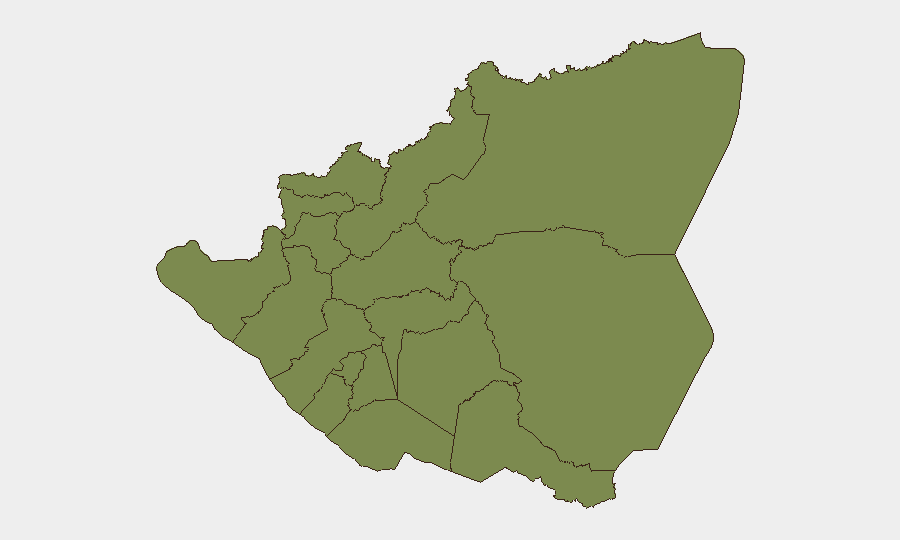
Managua Department (score 31.3) drives nearly two-thirds of national threat activity, reflecting its status as the capital, largest urban center, and seat of political institutions; risk here centers on political repression, police-state mechanisms, and urban crime. Carazo Department (16.9) ranks second, though specific recent events are sparse in open sources; historical context suggests localized gang and trafficking activity. All other departments fall below 2.0 in composite score, indicating either lower incident density, better security controls, or underreporting. Northern border departments (Chinandega, Nueva Segovia, Madriz) and Caribbean coastal zones remain key transit corridors for cocaine and precursor chemicals, sustaining baseline trafficking risk despite relatively low incident counts.
How GeoBit Would Assist
Organizations with personnel or assets in Nicaragua should deploy AOI Monitoring & Early Warning focused on Managua and Carazo to detect political violence, protest activity, or police operations in real time. Intel Sweep and OSINT fusion (X/Telegram, news feeds, radio SIGINT) provide 24–48 hour lead time on emerging unrest or security crackdowns. Routing & Network Analysis supports alternative journey and supply-chain planning around Chinandega and Pacific northwestern trafficking hotspots.
7-Day Outlook
The National Assembly's scheduled early-August vote on opposition-exclusion legislation will likely proceed without significant procedural delay, further entrenching authoritarian rule and raising risk of opposition mobilization or underground resistance. No imminent security incidents are forecast for the 25–31 July window based on current open-source signals, though political temperature will likely remain elevated. Border narcotics activity will persist at baseline levels; organizations should continue routine security hygiene in Managua and avoid unsecured travel in northern and Pacific coastal corridors.
Highest-Risk Areas — Ranked
| # | State / Region | Risk |
|---|---|---|
| 1 | Managua Department | 31.3 |
| 2 | Carazo Department | 16.9 |
| 3 | Estelí Department | 1.9 |
| 4 | Chontales Department | 1.3 |
| 5 | Rivas Department | 1.3 |
| 6 | Río San Juan Department | 1.3 |
| 7 | South Caribbean Coast | 1.3 |
| 8 | Chinandega Department | 1.3 |
| 9 | Nueva Segovia Department | 1.3 |
| 10 | Madriz Department | 1.3 |
| 11 | León Department | 1.3 |
| 12 | Masaya Department | 1.3 |
Sources
Previous Daily Briefs
A new Nicaragua brief is written every day — each with its own risk map and downloadable CSV. Here's the last week; use the calendar to go further back.
📅 Browse every day by calendar →
Highlighted days have a brief. Tap a day for that day's map & analysis, or “csv” for that day's dataset ($5).
Atlas — our AI intelligence desk — emails them this snapshot personally. Nothing else, no list.