Situation Summary
Pakistan remains at #15 globally in GeoBit's composite threat ranking (score 75), with insurgency as the primary driver and 838 tracked events in the assessment window. The country faces concurrent pressures: internal security fragmentation across multiple provinces, sustained cross-border militant activity, and elevated political tension following Pakistan's 10 June airstrikes into Afghanistan. Current trajectory shows no broad de-escalation; localized incidents continue, and border volatility introduces secondary risks to supply chains and personnel movement in frontier regions.
Key Developments
- Pakistan–Afghanistan border (Khost, Kunar, Paktika provinces), 10 June 2026 – Pakistan conducted airstrikes against militant hideouts, claiming 26 militants killed; Afghan Taliban officials reported 13 deaths including 11 children. Strikes targeted training facilities and ammunition caches linked to recent attacks on Pakistani territory, raising border-zone security risk and Islamabad–Kabul political tension.
- Punjab/National, 11 June 2026 – Multiple signals of domestic political and law-enforcement friction: public statements from prosecutors regarding police conduct, government rejection/disapproval statements, and continued small-arms combat involving security forces. Suggests internal institutional stress and possible breakdown in coordination between justice and security sectors.
- Multiple provinces, 9–11 June 2026 – Scattered events signal ongoing opposition to government fiscal policy and refugee-related appeals to parliament, alongside conventional military force deployments by police. No single catastrophic incident, but cumulative signal of fragmentation and reactive security posture.
Data caveat: Open-source reporting for Pakistan's interior (as distinct from cross-border activity) in the strict 24–48-hour window is sparse. GeoBit event feeds show 11 signals from 9–11 June, but few carry independently verified location/time details for incidents occurring within Pakistan proper during 10–11 June UTC. The cross-border strike is the singular well-sourced, recent, high-impact development with direct security implications for Pakistan-based personnel.
Highest-Risk Areas
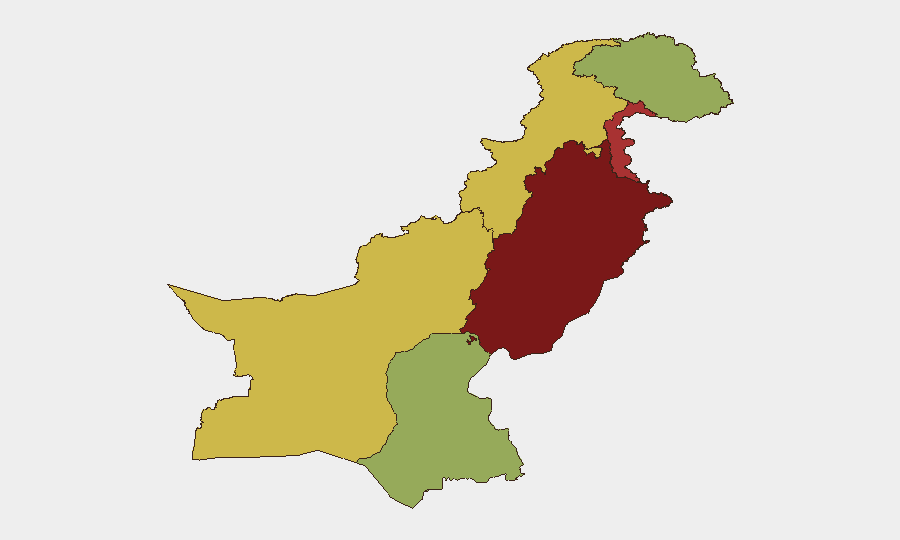
Punjab (82.7) and Azad Kashmir (78.5) lead the sub-national ranking, driven by entrenched insurgent networks and chronic small-arms violence; Khyber Pakhtunkhwa (68.6) remains elevated due to Taliban-affiliated groups and tribal militancy. Islamabad Capital Territory (65.8), despite being the seat of government, scores notably high—reflecting both political instability and the concentration of senior officials and diplomatic missions as potential targets. Balochistan (60.5) and Sindh (53.9), while ranked lower, carry distinct risks: Balochistan faces separatist insurgency and sectarian conflict, while Sindh experiences criminal networks and sectarian violence. The 10 June cross-border strike and resulting Afghan Taliban response increase risk in all border-adjacent provinces, particularly Khyber Pakhtunkhwa and Azad Kashmir.
How GeoBit Would Assist
Security and risk teams should employ AOI Monitoring & Early Warning on Punjab, Khyber Pakhtunkhwa, and the Pakistan–Afghanistan border corridor to detect upticks in militant activity and cross-border incursions in near-real time. Network & Actor Analysis paired with OSINT fusion (Intel Sweep, X/Twitter/Telegram monitoring, multi-language search) would track Pakistani security-sector fractures and militant command-and-control shifts in response to the airstrikes. Routing & Network Analysis and satellite imagery capabilities enable alternative-route planning and real-time asset positioning to avoid high-risk nodes during escalation phases.
7-Day Outlook
The cross-border strike is unlikely to produce immediate large-scale escalation, but expect 7–14 days of elevated Taliban retaliation probing, particularly in Kunar and Paktika–facing districts of Khyber Pakhtunkhwa. Domestic political friction signals suggest possible secondary disruptions to government continuity or law-enforcement coherence; monitor for resource-allocation or command disputes that could degrade security-force effectiveness in contested areas. No major shift in threat trajectory anticipated unless Afghan Taliban formally escalates or Punjab sees a coordinated insurgent campaign.
Highest-Risk Areas — Ranked
| # | State / Region | Risk |
|---|---|---|
| 1 | Punjab | 82.7 |
| 2 | Azad Kashmir | 78.5 |
| 3 | Khyber Pakhtunkhwa | 68.6 |
| 4 | Islamabad Capital Territory | 65.8 |
| 5 | Balochistan | 60.5 |
| 6 | Sindh | 53.9 |
| 7 | Gilgit-Baltistan | 52.9 |
Sources
Previous Daily Briefs
A new Pakistan brief is written every day — each with its own risk map and downloadable CSV. Here's the last week; use the calendar to go further back.
📅 Browse every day by calendar →
Highlighted days have a brief. Tap a day for that day's map & analysis, or “csv” for that day's dataset ($5).