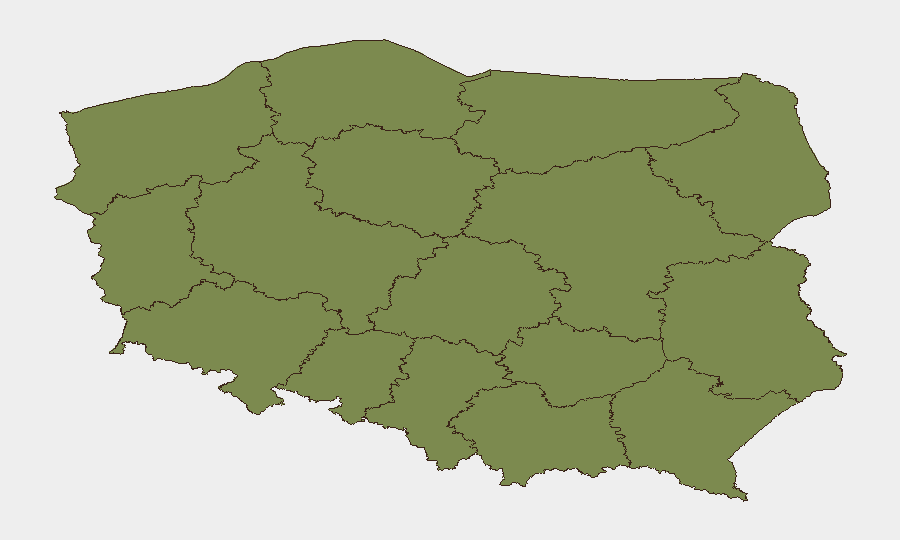
Situation Summary
Poland remains a relatively stable environment globally (rank #85; composite threat score 2.2) but faces a complex security landscape shaped by geopolitical tension, internal political friction, and emerging domestic extremism. Recent event signals spanning 2026-07-09 to 2026-07-11 indicate multiple vectors: civil-military friction, diplomatic strain (notably involving Venezuela and Ukraine), arrest activity, and at least one credible terrorism-plot investigation in the Olsztyn area. The threat picture is concentrated geographically, with Łódź Voivodeship accounting for disproportionate risk exposure (31.5, nearly 5× the next-highest region).
Key Developments
- Olsztyn area (date unverified from available sources) — Prosecutors reported arrests of Polish suspects allegedly preparing terrorist attacks; seized materials included pyrotechnic devices, firearms-training evidence, and instructions for improvised explosive devices and Molotov cocktails. This represents the most concrete domestic extremism indicator in the current reporting cycle.
- Warsaw, 2026-07-10 — A disapproval event was recorded, alongside a subsequent "reduce relations" signal involving the president and Polish entities on 2026-07-10. Specific context requires clarification, but the pattern suggests political or institutional friction at the national level.
- Poland (national), 2026-07-11 — Authorities issued a public statement in relation to Venezuela, indicating diplomatic activity or a statement of position. Concurrent arrest/detain signals involving military police and military personnel on 2026-07-11 suggest internal security or disciplinary action within the armed forces.
- Poland (national), 2026-07-09 — A conventional military force event involving Polish forces and civilians was recorded, alongside rejection and disapproval signals from Ukraine and the European Parliament. The absence of detailed context limits assessment, but the multi-actor disapproval pattern indicates a contentious incident.
- Poland (information domain) (timing unverified) — The Resilience Council flagged intensified Russian disinformation activity centered on the Volhynia historical issue, representing an information-space threat vector that may amplify domestic polarization.
- Poland (defense policy), week of 2026-07-07 — The defense minister announced resumption of U.S. troop rotations in the coming weeks following a pause, indicating continuity in NATO force posture.
Highest-Risk Areas
Łódź Voivodeship dominates the sub-national risk profile (31.5), representing approximately 28% of tracked national events despite being one of twelve regions monitored. Podlaskie (6.7) and Masovian (5.7) rank second and third but at significantly lower absolute levels, suggesting either acute Łódź-specific drivers—industrial labor, organized crime, or criminal networks—or concentrated reporting bias. The remaining nine regions cluster between 1.5 and 1.8, indicating dispersed, low-intensity risk. Security teams with assets or personnel in Łódź require elevated vigilance; teams in Podlaskie (bordering Belarus and Lithuania) and Masovian (Warsaw-centered) should monitor border and capital-region activity respectively.
How GeoBit Would Assist
GeoBit's AOI Monitoring & Early Warning capability would enable persistent watch over Łódź Voivodeship and Podlaskie border zones with automated alerting on extremism, crime, or civil unrest signals. Intel Sweep, X/Twitter OSINT, and multi-language search would disambiguate the 2026-07-09/10/11 event signals and track Russian disinformation narratives around Volhynia in real time. Network & Actor Analysis combined with conflict mapping would clarify military-police interactions and political friction flagged in the arrest and presidential signals.
7-Day Outlook
The terrorism investigation in Olsztyn will likely drive heightened police and security-force activity in the Warmian-Masurian region over the coming days, with potential spillover arrests elsewhere. Diplomatic messaging and internal military discipline actions suggest Poland is managing multiple institutional and external pressures simultaneously; escalation is not imminent, but volatility in political signaling should be monitored. The information-warfare threat (disinformation, Volhynia narratives) will persist as a lower-order but persistent vector.
Highest-Risk Areas — Ranked
| # | State / Region | Risk |
|---|---|---|
| 1 | Łódź Voivodeship | 31.5 |
| 2 | Podlaskie Voivodeship | 6.7 |
| 3 | Masovian Voivodeship | 5.7 |
| 4 | Subcarpathian Voivodeship | 1.8 |
| 5 | Opole Voivodeship | 1.7 |
| 6 | Holy Cross Voivodeship | 1.7 |
| 7 | Lesser Poland Voivodeship | 1.7 |
| 8 | Warmian-Masurian Voivodeship | 1.6 |
| 9 | Lower Silesian Voivodeship | 1.6 |
| 10 | Lublin Voivodeship | 1.5 |
| 11 | West Pomeranian Voivodeship | 1.5 |
| 12 | Lubusz Voivodeship | 1.5 |
Sources
Previous Daily Briefs
A new Poland brief is written every day — each with its own risk map and downloadable CSV. Here's the last week; use the calendar to go further back.
📅 Browse every day by calendar →
Highlighted days have a brief. Tap a day for that day's map & analysis, or “csv” for that day's dataset ($5).
Atlas — our AI intelligence desk — emails them this snapshot personally. Nothing else, no list.