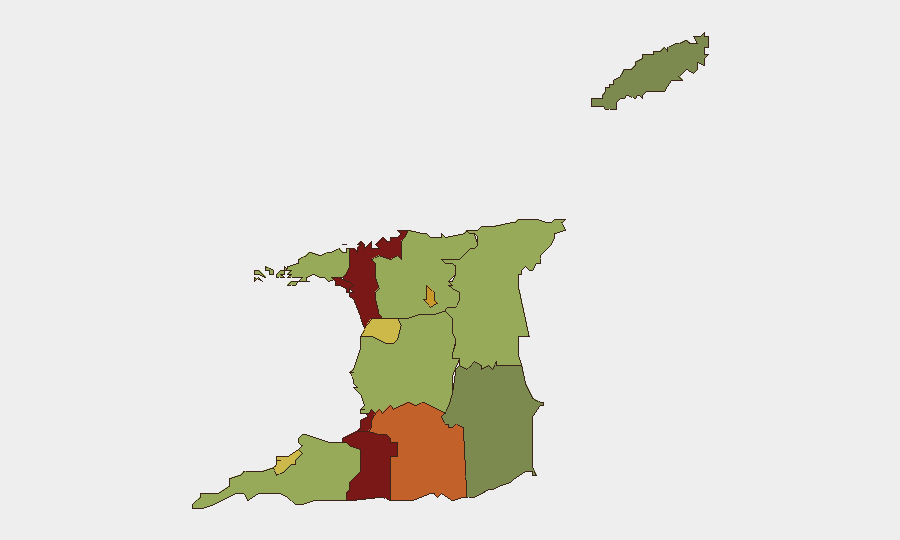
Situation Summary
Trinidad and Tobago remains a composite threat level #69 globally (score 17/100), with no major security incidents identified in open sources over the last 24–48 hours. Gang-related violence, narcotics trafficking, and property crime remain structural drivers of risk, concentrated in specific urban corridors. The recent earthquake tremor detected from Venezuelan seismic activity poses limited direct threat but underscores regional exposure; no casualties or infrastructure damage in Trinidad and Tobago have been reported.
Key Developments
- 2026-06-27 · Seismic Activity (Venezuela-Border Region): A magnitude 7.3 earthquake near Venezuela was felt across Trinidad and Tobago; no confirmed damage or casualties reported on-island as of publication. Undated social-media reports; timestamp and impact assessment pending confirmation.
- No confirmed new ground-level security incidents (gang violence, trafficking, protests, or civil unrest) have been reliably dated to the 24–48 hours prior to this brief. Open-source reporting remains limited for this period.
Note: Regional policy developments (Canada–CARICOM security ministerial, Caribbean–EU environmental police network planning) involve Trinidad and Tobago at institutional level but do not constitute on-ground operational changes within the last 48 hours.
Highest-Risk Areas
San Juan-Laventille (risk 95) and Port of Spain (risk 88) remain the dominant risk centers, driven by gang territorial competition, illicit drug distribution, and armed robbery. Penal-Debe (82) and San Fernando (80) follow, reflecting spillover violence and trafficking-related activity across the central and southern peninsular regions. These four zones account for the bulk of reported homicides, shootings, and organized crime operations nationally. Mid-tier risk areas (Arima, Chaguanas, Point Fortin) show sustained activity but lower incident density; northern and southwestern regions (Diego Martin, Sangre Grande, Couva-Tabaquite-Talparo) remain comparatively lower-risk but warrant monitoring for seasonal trafficking fluctuations.
How GeoBit Would Assist
Security and duty-of-care teams would deploy AOI Monitoring & Early Warning on San Juan-Laventille, Port of Spain, and Penal-Debe to detect emerging violence patterns, roadblocks, or protest activity in real time. Intel Sweep and X/Twitter & Telegram OSINT paired with sentiment analysis would surface gang communications, threats, or operational planning affecting corporate facilities and personnel movement. Routing & Network Analysis would enable real-time alternative-route planning for personnel and asset movement around active hot zones, particularly during peak crime hours or identified conflict escalations.
7-Day Outlook
No imminent major escalation is anticipated in the immediate term; however, mid-week and weekend patterns historically show elevated gang activity and street-level violence in Port of Spain and San Juan-Laventille. The Venezuelan earthquake warrants continued monitoring of border-region stability and any secondary seismic events. Corporate teams should maintain heightened situational awareness in the top-risk zones and rely on pre-positioned AOI monitoring and OSINT feeds for early warning of localized disruptions.
Next Update: 2026-06-28 (daily cycle)
Contact: GeoBit Security Analysis Team
Highest-Risk Areas — Ranked
| # | State / Region | Risk |
|---|---|---|
| 1 | San Juan-Laventille | 95 |
| 2 | Port of Spain | 88 |
| 3 | Penal-Debe | 82 |
| 4 | San Fernando | 80 |
| 5 | Princes Town | 75 |
| 6 | Arima | 72 |
| 7 | Chaguanas | 68 |
| 8 | Point Fortin | 65 |
| 9 | Diego Martin | 58 |
| 10 | Siparia | 55 |
| 11 | Couva-Tabaquite-Talparo | 52 |
| 12 | Sangre Grande | 48 |
Sources
Previous Daily Briefs
A new Trinidad and Tobago brief is written every day — each with its own risk map and downloadable CSV. Here's the last week; use the calendar to go further back.
📅 Browse every day by calendar →
Highlighted days have a brief. Tap a day for that day's map & analysis, or “csv” for that day's dataset ($5).