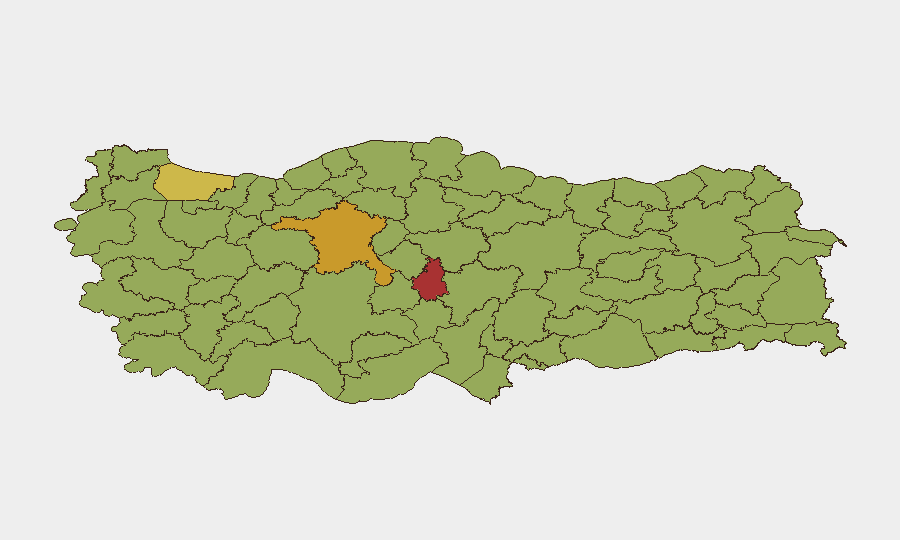
Situation Summary
Turkey maintains an elevated composite threat score (67, ranking #29 globally) driven primarily by diplomatic friction, parliamentary tensions, and labor unrest rather than acute security incidents. No corroborated, timestamped security or unrest events have been documented inside Turkey in the past 24–48 hours across open-source and social media monitoring. The threat environment remains characterized by background structural risks—particularly in Nevşehir, Ankara, and Istanbul—but without immediate operational disruption to travel, commerce, or critical infrastructure.
Key Developments
- No discrete security incidents reported within Turkey, 18–19 June 2026. GeoBit's continuous OSINT sweep of English-language news, social media, and intelligence feeds has not surfaced corroborated, location-specific incidents of unrest, crime spikes, infrastructure disruption, or acute travel hazards within the past 48 hours.
- Diplomatic and labor signals at national level, 18 June 2026. A cluster of public statements, rejections, and disapprovals involving Turkish government entities, parliament, and worker representatives has been logged, alongside a reported strike/boycott event; however, sector, geography, and operational scale remain unconfirmed in open sources, limiting geo-specific risk assessment.
- Turkey–Qatar military activity noted, 19 June 2026. GeoBit records conventional military force activity between Turkey and Qatar on this date; no location within Turkey, casualty count, or domestic security spillover has been corroborated, and no direct impact on Turkish civilian or corporate operations has been identified.
- Moscow–Turkey public statement exchange, 17 June 2026. Diplomatic messaging between Russian and Turkish officials has been flagged; context reflects ongoing regional tensions but does not constitute a security incident or threat escalation within Turkish territory.
- Black Sea diplomatic messaging (background context). Turkey's foreign minister stated on 16 June that Russia should avoid steps threatening Black Sea security; this reflects structural geopolitical friction rather than a new incident, and no attack, closure, or disruption to Turkish maritime zones has been reported in the 24–48h window.
Highest-Risk Areas
Nevşehir, Ankara, and Istanbul drive the highest composite threat scores (76.8, 72.2, and 64.1 respectively), reflecting persistent vulnerability to protest activity, terrorism-related crime, and cyber threats rather than a current crisis. Nevşehir's elevated ranking is notable given its smaller population and suggests concentrated risk factors—likely linked to historical protest activity or critical infrastructure. Ankara's risk profile reflects both political-protest risk (proximity to parliament and government institutions) and background crime patterns. Istanbul, despite ranking third, remains the largest population and asset concentration in the country; its 64.1 score reflects crime, protest potential, and transportation-hub vulnerability. Mid-tier risk provinces (Bursa, Izmir, Malatya, Adana) show elevated but more moderate exposure, primarily tied to labor and cross-border spillover dynamics.
How GeoBit Would Assist
Security teams should deploy AOI Monitoring & Early Warning on Ankara, Istanbul, and Nevşehir to capture protest, labor, and law-enforcement activity in real time, coupled with multi-language OSINT and social media intelligence (Telegram, X, local news scrapes) to identify unrest precursors ahead of escalation. Conflict and entity-network analysis would help teams understand parliamentary and labor actor positions and friction points, while routing and alternative-journey planning would enable rapid re-routing of personnel and supply chains if localized disruption emerges in monitored zones.
7-Day Outlook
No immediate security crisis is forecast, but the pattern of diplomatic rejections, labor messaging, and parliamentary friction suggests potential for localized protest or strike activity in Ankara or industrial centers (Bursa, Adana) over the coming week. Teams should maintain heightened situational awareness in high-risk provinces and prepare contingency protocols for short-notice labor or protest-driven disruption rather than anticipate acute violence or infrastructure failure.
Highest-Risk Areas — Ranked
| # | State / Region | Risk |
|---|---|---|
| 1 | Nevşehir | 76.8 |
| 2 | Ankara | 72.2 |
| 3 | Istanbul | 64.1 |
| 4 | Bursa | 54.3 |
| 5 | Izmir | 53.8 |
| 6 | Malatya | 51.4 |
| 7 | Adana | 49.1 |
| 8 | Denizli | 49.1 |
| 9 | Isparta | 48 |
| 10 | Antalya | 48 |
| 11 | Gaziantep | 47.4 |
| 12 | Bayburt | 47.4 |
Sources
Previous Daily Briefs
A new Turkey brief is written every day — each with its own risk map and downloadable CSV. Here's the last week; use the calendar to go further back.
📅 Browse every day by calendar →
Highlighted days have a brief. Tap a day for that day's map & analysis, or “csv” for that day's dataset ($5).