Situation Summary
Tuvalu remains a low-threat environment (global rank #177, composite score 3) with no verified security, crime, civil-unrest, or infrastructure incidents reported in the last 24–48 hours. The nation's security posture is shaped by regional geopolitical currents—particularly recent Chinese military activity in adjacent Pacific waters and ongoing Australian defence engagement in the region—rather than domestic instability. Current policy focus centers on maritime security, climate resilience, and transnational crime prevention as part of a finalised National Security Policy framework.
Key Developments
- No corroborated incidents in Tuvalu, 19–20 July 2026. Open-source monitoring, regional media, and social platforms confirm no acute security, crime, political, infrastructure, or travel-risk events within the last 24–48 hours. The absence of incident reporting reflects underlying stability.
- Geopolitical backdrop: Chinese SLBM test (6 July 2026). A Chinese submarine-launched ballistic missile test detonated in waters between Tuvalu and Kiribati, prompting regional security discussions but occurring outside the current reporting window. This event informs the broader strategic context for Australian and regional defence posturing.
- Policy-level security engagement (15 July 2026, Funafuti). Tuvalu's government called for strengthened UN support to address Pacific security threats, emphasizing maritime, cyber, and climate dimensions. This reflects policy-setting rather than response to acute domestic threats.
- National Security Policy finalisation (early July 2026). Tuvalu completed a comprehensive security policy addressing maritime conservation, transnational crime, cyber threats, and energy security—establishing the institutional framework for threat management across priority domains.
- Regional defence alignment. Australian defence engagement with Tuvalu continues as part of broader Pacific security architecture, though no specific operational incidents or deployment changes are reported in the last 48 hours.
Highest-Risk Areas
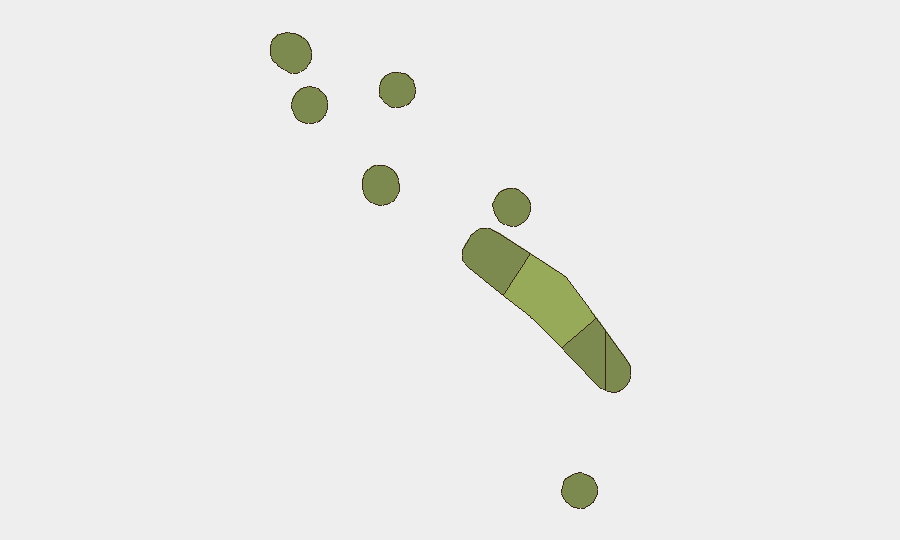
Funafuti (composite risk 45) dominates the sub-national ranking, reflecting its status as the capital, administrative centre, and primary port of entry—concentrating population, infrastructure, and potential exposure to transnational maritime crime and cyber threats. Vaitupu (risk 28) and Nui (risk 25) follow, likely reflecting smaller populations, limited state presence, and maritime exposure. The steep risk gradient from Funafuti to outer islands reflects infrastructure centralisation and governance reach rather than acute localized instability. Corporate and humanitarian operations should prioritise Funafuti-based contingency planning and maritime-route vetting, while recognising that Tuvalu's overall threat environment remains contained and manageable.
How GeoBit Would Assist
Security teams with personnel or assets in Tuvalu would leverage AOI Monitoring & Early Warning to sustain persistent watch over Funafuti and maritime approaches, detecting shifts in governance, transnational activity, or climate-driven displacement before they escalate. Maritime & Aviation Tracking combined with Network & Actor Analysis would map transnational crime networks, people-smuggling routes, and foreign military activity in adjacent waters. OSINT fusion across Telegram, X, and regional media would provide early signal of political instability, labour unrest, or infrastructure disruption affecting duty-of-care operations.
7-Day Outlook
No acute incidents are forecast for the next 7 days. Tuvalu's security trajectory remains stable, with risk concentrated on long-term climate and maritime domains rather than imminent civil, criminal, or political crises. Continued monitoring of Australian defence posture and Chinese regional activity is warranted to detect any shifts that could affect broader Pacific stability or Tuvalu's operating environment.
Highest-Risk Areas — Ranked
| # | State / Region | Risk |
|---|---|---|
| 1 | Funafuti | 45 |
| 2 | Vaitupu | 28 |
| 3 | Nui | 25 |
| 4 | Nukufetau | 22 |
| 5 | Niutao | 20 |
| 6 | Nanumanga | 18 |
| 7 | Nanumea | 15 |
| 8 | Nukulaelae | 12 |
Sources
Previous Daily Briefs
A new Tuvalu brief is written every day — each with its own risk map and downloadable CSV. Here's the last week; use the calendar to go further back.
📅 Browse every day by calendar →
Highlighted days have a brief. Tap a day for that day's map & analysis, or “csv” for that day's dataset ($5).
Atlas — our AI intelligence desk — emails them this snapshot personally. Nothing else, no list.