Situation Summary
Uruguay maintains a low and stable overall security posture with no verified significant incidents, civil unrest, infrastructure disruption, or travel risks reported in the last 24–48 hours. Routine urban crime (theft, robbery) persists at baseline levels in Montevideo and Canelones departments, but recent judicial and labor-sector activity—including a judge's detention on 20 June and ongoing union investigations—has not triggered public-order disruptions or institutional crises. National infrastructure, transport, and utilities remain fully operational. The country's composite threat score of 14 places it outside the global top-risk ranking, reflecting the absence of acute security drivers.
Key Developments
- Montevideo & Canelones (20–21 June) — Urban crime remains at baseline with no unusual spikes in theft or robbery; normal operational environment confirmed in both high-risk departments.
- National judiciary (20 June) — A judge was detained and processed through standard legal channels; no associated protests, institutional disruption, or public-order impact reported through 21 June.
- National labor sector (up to 21 June) — Union-related investigations continue through administrative and legal processes without producing strikes, demonstrations, or operational disruptions.
- National infrastructure & utilities (20–21 June) — Airports, ports, major roads, power grids, and telecom networks all operating normally with no blockages, outages, or service failures.
- **FIFA World Cup 2026 — Uruguay national team (mid-June, *outside Uruguay*)** — Extensive security checks (sniffer dogs, metal detectors, luggage searches) conducted on arrival in the United States and during stops in Mexico; overnight airspace delay in Mexico noted. No domestic security, political, or travel impact inside Uruguay reported.
Highest-Risk Areas
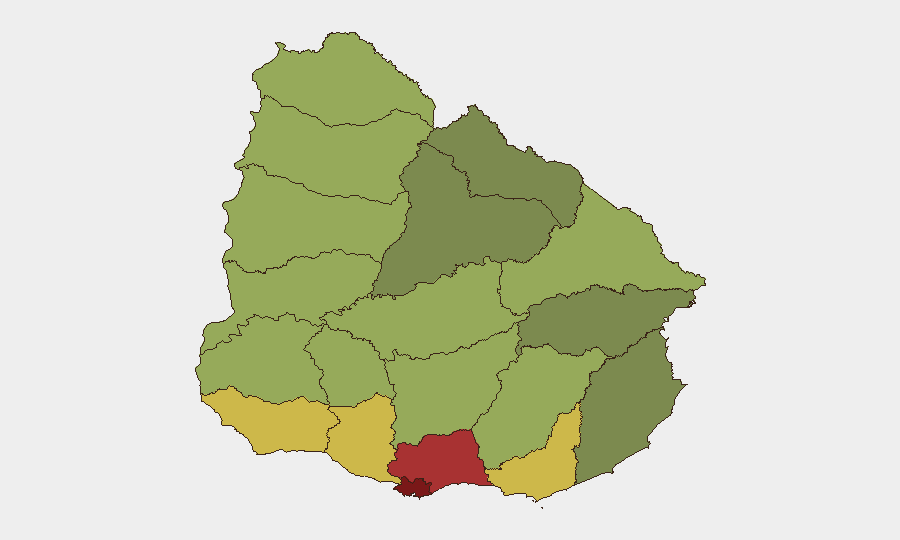
Montevideo (risk 92) and Canelones (risk 78) drive the country's sub-national risk profile, reflecting their status as high-density urban centers where baseline theft, robbery, and gang-related activity are concentrated. Maldonado (68), San José (64), and Colonia (62) follow, likely reflecting tourist-destination vulnerabilities and secondary urban crime dynamics. Interior departments (Soriano, Río Negro, Salto, Artigas, Paysandú, Florida, Flores) show progressively lower risk scores (50–58), consistent with lower population density and reduced exposure to organized crime networks. Risk concentration in Montevideo and Canelones reflects structural crime patterns rather than acute instability.
How GeoBit Would Assist
Security teams managing personnel or assets in Uruguay would deploy AOI Monitoring & Early Warning on Montevideo and Canelones to track emerging civil unrest, labor actions, or crime-pattern shifts in real time. Intel Sweep and OSINT fusion (X/Twitter, local news, social media sentiment & temporal analysis) provide 24-hour visibility into judicial, labor, and security developments before they escalate to operational risk. Routing & Network Analysis supports safer journey planning for staff traveling between high-risk urban zones and lower-risk interior departments, while Entity & Actor Network Analysis helps identify organized crime or gang activity that may affect supply chains or personnel movement.
7-Day Outlook
The security environment is expected to remain stable through the near term, with no indicators of escalating civil unrest, labor strikes, or infrastructure disruption. Routine urban crime will likely persist at baseline in Montevideo and Canelones; personnel in lower-risk interior departments face minimal acute risk. Continued monitoring of judicial and union developments is warranted to flag any downstream institutional or labor actions, though current trajectories suggest limited disruption probability.
Report Confidence: High (corroborated by 21 June country brief, wire monitoring, and absence of contradicting major-news or social-media signals).
Highest-Risk Areas — Ranked
| # | State / Region | Risk |
|---|---|---|
| 1 | Montevideo | 92 |
| 2 | Canelones | 78 |
| 3 | Maldonado | 68 |
| 4 | San José | 64 |
| 5 | Colonia | 62 |
| 6 | Soriano | 58 |
| 7 | Río Negro | 56 |
| 8 | Salto | 54 |
| 9 | Artigas | 52 |
| 10 | Paysandú | 50 |
| 11 | Florida | 48 |
| 12 | Flores | 46 |
Sources
Previous Daily Briefs
A new Uruguay brief is written every day — each with its own risk map and downloadable CSV. Here's the last week; use the calendar to go further back.
📅 Browse every day by calendar →
Highlighted days have a brief. Tap a day for that day's map & analysis, or “csv” for that day's dataset ($5).