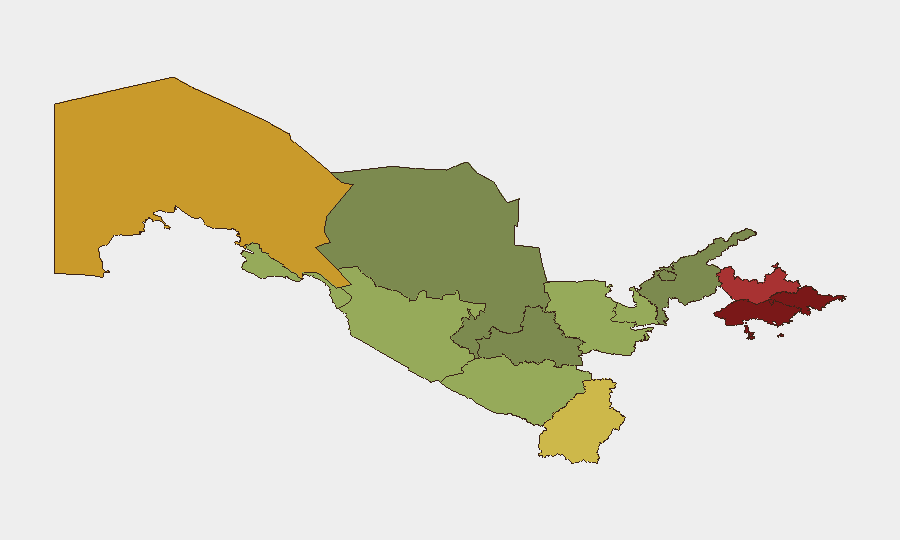
Situation Summary
Uzbekistan presents a composite threat score of 3 with no tracked discrete security events in the last 24–48 hours on open sources. The country's overall risk profile is shaped by persistent border-security challenges with Afghanistan, low-level human-rights concerns, and routine narcotics interdiction; however, no major civil unrest, terrorism incidents, or acute destabilizing events are currently reported. The security environment remains sub-acute but geographically concentrated in the Fergana Valley region.
Key Developments
No verifiable security, unrest, crime, or political incidents meeting 24–48 hour reporting standards have been identified in open-source intelligence for Uzbekistan as of 22 June 2026.
Note: The most recent corroborated incidents fall outside the current reporting window:
- Karshi, Qashqadaryo region (5 June, reported 18 June): Activist Javokhir Muminov arrested on extortion charges; alleged police ill-treatment reported to lawyer on 10 June.
- Afghanistan–Uzbekistan border (undated, recent Facebook post): State Security Service reported seizure of approximately 38 kg of narcotics and multiple arrests; operational date unconfirmed.
Highest-Risk Areas
The Fergana Valley corridor—Andijan (88), Fergana (82), and Namangan (78) regions—drives national risk rankings and reflects endemic cross-border narcotics trafficking, residual Islamist militant activity in neighboring Tajikistan and Afghanistan, and tighter state-security enforcement. Karakalpakstan (72) represents secondary risk, primarily tied to economic stress and water-scarcity tensions. Southern regions (Surxondaryo, Qashqadaryo) face sporadic organized-crime and trafficking pressures. Central and western zones (Samarqand, Navoiy, Xorazm, Bukhara) remain comparatively lower-risk but warrant routine monitoring for secondary effects of regional instability.
How GeoBit Would Assist
Corporate security and duty-of-care teams with personnel or assets in Uzbekistan should employ AOI Monitoring & Early Warning to track the Fergana Valley and key urban centers (Tashkent, Bukhara, Samarqand) for acute signals; OSINT fusion and multi-language search to monitor local and diaspora social media, radio SIGINT, and closed-source regional wires for trafficking, law-enforcement operations, and political developments; and Routing & Network Analysis to identify secure alternative travel corridors and pre-position contingency routes in higher-risk regions. Risk & Threat Assessment workflows support periodic staff-movement authorizations and site-hardening decisions in Fergana Valley postings.
7-Day Outlook
No major deterioration is anticipated over the next seven days absent a triggering cross-border incident or major narcotics operation. Routine border enforcement, anti-terrorism operations, and organized-crime interdiction will likely continue. Monitoring should focus on possible spill-over effects from regional developments in Afghanistan and Tajikistan, which periodically generate secondary security pressures within Uzbekistan's border zones.
Highest-Risk Areas — Ranked
| # | State / Region | Risk |
|---|---|---|
| 1 | Andijan Region | 88 |
| 2 | Fergana Region | 82 |
| 3 | Namangan Region | 78 |
| 4 | Republic of Karakalpakstan | 72 |
| 5 | Surxondaryo Region | 65 |
| 6 | Qashqadaryo Region | 58 |
| 7 | Sirdaryo Region | 55 |
| 8 | Jizzakh Region | 48 |
| 9 | Xorazm Region | 45 |
| 10 | Bukhara Region | 42 |
| 11 | Navoiy Region | 38 |
| 12 | Samarqand Region | 35 |
Sources
Previous Daily Briefs
A new Uzbekistan brief is written every day — each with its own risk map and downloadable CSV. Here's the last week; use the calendar to go further back.
📅 Browse every day by calendar →
Highlighted days have a brief. Tap a day for that day's map & analysis, or “csv” for that day's dataset ($5).