Situation Summary
Albania remains a low-threat environment globally (rank #139, composite score 5), but faces a sharp localized political and civil-unrest crisis driven by 38+ days of continuous anti-government protests centered on coastal land privatization and organized-crime allegations. The protest movement has expanded to a national scale, framed around resistance to a high-profile Kushner-linked resort project and broader grievances over corruption and oligarchic capture. Risk is heavily concentrated in Elbasan County (score 31.8) and Vlorë County (13.7), with secondary risk in Tirana; other regions remain stable. The combination of sustained mass mobilization, formal corruption investigations, and high-profile international business involvement creates reputational, operational, and safety risks for organizations with personnel or assets in affected coastal and urban zones.
Key Developments
- Tirana & nationwide (11–12 July): Large-scale anti-government protests continued across multiple cities, with demonstrators citing corruption, land-grabbing, and the Trump/Kushner resort deal; protest organizers describe the movement as a "national uprising" and pledge to sustain daily demonstrations until land deals are reversed.
- Coastal Albania / prosecutors (11 July): An arrest warrant was issued for Miami-based businessman Artur Shehu on charges of cocaine trafficking into Europe and money laundering through falsified Albanian property deeds linked to the planned resort project, directly implicating organized crime in the disputed land transactions.
- Tirana / parliamentary level (11 July): Official parliament and government bodies issued public rejections and administrative sanctions against government officials; the Speaker of Parliament and other figures issued critical public statements, signaling internal political fracture over the resort deal and corruption allegations.
- National social-media messaging (11–12 July): Protest participants amplified slogans including "Albania is not for sale" and "Nature is not for sale," indicating organized campaign messaging and sustained grassroots coordination across multiple platforms.
- Political dissent (12 July): Ministry-level political dissent was registered, and the Prime Minister faced public demands for action; this signals deepening institutional discord over the government's handling of the crisis.
Highest-Risk Areas
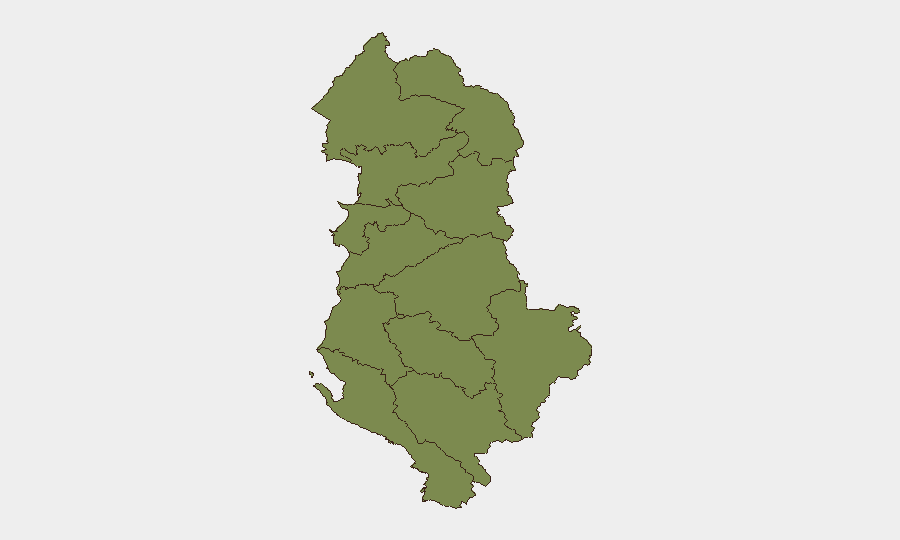
Elbasan County dominates the sub-national risk profile (31.8), driven by the concentration of protest activity, organized-crime investigation infrastructure, and political instability signals. Vlorë County (13.7)—home to the disputed coastal development site—presents secondary risk tied directly to the land-fraud allegations and ongoing civil unrest in adjacent zones. Tirana County (9.8) remains elevated due to sustained mass demonstrations and institutional political dissent at the national level. Other counties show minimal risk (1.8–2.5), indicating that security concerns are tightly geographically bounded to the protest corridor and coastal development zone.
How GeoBit Would Assist
Security teams should deploy AOI Monitoring & Early Warning on Tirana, Elbasan, and Vlorë counties to track protest density, timing, and route patterns in real time, with automated alerts for escalation signals. Intel Sweep and X/Telegram OSINT will capture organizer messaging, protest coordination, and claims circulating on social media to provide early warning of flash demonstrations or blockades. Entity extraction and network analysis of the Artur Shehu case and associated business networks will map corruption and organized-crime links to assets or supply chains.
7-Day Outlook
Protests are likely to continue at present intensity; organizers have framed the movement as indefinite, and no government concessions have been announced. The parallel criminal investigation into land fraud may accelerate formal charges or arrests, potentially escalating political tensions further. Organizations with operations on the coast or in Tirana should prepare contingency staffing and transport plans; travel to Elbasan and Vlorë should be reassessed for non-essential personnel.
Highest-Risk Areas — Ranked
| # | State / Region | Risk |
|---|---|---|
| 1 | Elbasan County | 31.8 |
| 2 | Vlorë County | 13.7 |
| 3 | Tirana County | 9.8 |
| 4 | Berat County | 2.5 |
| 5 | Durrës County | 1.8 |
| 6 | Shkodër County | 1.8 |
| 7 | Kukës County | 1.8 |
| 8 | Lezhë County | 1.8 |
| 9 | Dibër County | 1.8 |
| 10 | Fier County | 1.8 |
| 11 | Korçë County | 1.8 |
| 12 | Gjirokastër County | 1.8 |
Sources
Previous Daily Briefs
A new Albania brief is written every day — each with its own risk map and downloadable CSV. Here's the last week; use the calendar to go further back.
📅 Browse every day by calendar →
Highlighted days have a brief. Tap a day for that day's map & analysis, or “csv” for that day's dataset ($5).
Atlas — our AI intelligence desk — emails them this snapshot personally. Nothing else, no list.