Situation Summary
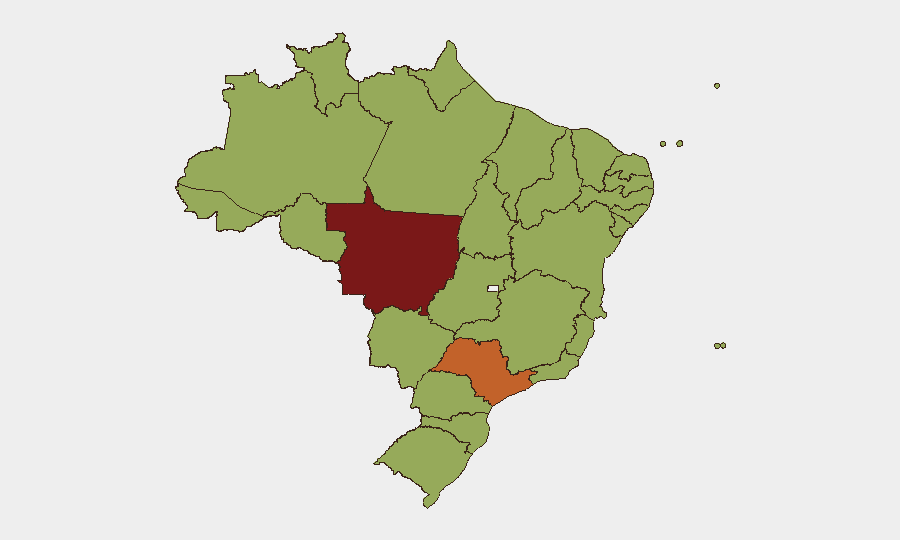
Brazil remains the 34th-highest-threat country globally (composite score 79), with insurgency and criminal violence as primary drivers across 530 tracked events. Sub-national risk is heavily concentrated in Mato Grosso (85.3) and São Paulo (75.3), reflecting both organized-crime activity and state-capacity constraints. The security picture shows persistent violent-crime pressure in major urban centers, emerging targeting of affluent residential areas, and ongoing armed-group operations in satellite cities around Brasília. Current trajectory indicates sustained rather than rapidly escalating risk, though localized operations and criminal activity continue to generate acute incidents.
Key Developments
- Samambaia, Sol Nascente, Pedregal, and Santa Maria (Federal District) – 12 July, evening: Military Police conducted coordinated operations across four Brasília satellite cities, resulting in four arrests and seizure of four firearms plus 1,500+ rounds of ammunition. Operations targeted armed groups and indicate sustained law-enforcement pressure in the DF periphery.
- Rio de Janeiro favela complexes (Complexo da Maré, Complexo da Penha) – ongoing, current advisory window (13–14 July): Travel guidance explicitly designates these areas as no-go zones due to very high violent-crime rates and frequent large-scale police operations involving heavy weapons and unpredictable gunfire. Transit risk remains acute.
- Rio de Janeiro and São Paulo nightlife areas – recent incidents (current advisory, 13–14 July window): Confirmed uptick in spiked food and drink attacks targeting victims for forced ATM withdrawal, representing a discrete criminal-targeting pattern in hospitality venues in both cities.
- Northeastern coastal waters and Amazon River lodges – mid-July 2026 (current): Pirate attacks and armed robberies against ships and remote tourist infrastructure continue, directly threatening maritime and ecotourism operations in these regions.
- Major urban centers nationwide (Rio, São Paulo, Recife, Salvador, Fortaleza, Belém, Manaus) – ongoing (current advisory): Armed robbery, carjacking, home invasion, and mass-shooting incidents remain frequent; wealthy residential areas and foreigners' properties are explicitly targeted during periods of resident absence.
- Brazilian Military vs. Criminal Actors (national) – 15 July: Conventional military-force engagement signal recorded, indicating active armed-group confrontation at national scale requiring tracking.
- Police Alert (national) – 15 July: Law-enforcement alert issued; specific trigger and geography require monitoring for operational context.
Highest-Risk Areas
Mato Grosso (85.3) and São Paulo (75.3) dominate the risk landscape, driven by organized-crime territorial control, drug-trafficking infrastructure, and law-enforcement operations against armed groups. Rio de Janeiro (58.3) ranks third but shows acute localized risk in favela complexes where gang violence and police confrontation create unpredictable hazard zones. The remaining top-10 states cluster in the 55–57 range, reflecting widespread but less intense criminal activity, indicating risk is concentrated rather than nationally uniform. Northern and northeastern states show elevated maritime and remote-area vulnerabilities (piracy, armed robbery in low-governance zones).
How GeoBit Would Assist
Intel Sweep and OSINT fusion across Brazilian criminal networks, military communications, and police operations would track emerging gang movements and enforcement actions. AOI Monitoring with alerting on highest-risk states (Mato Grosso, São Paulo, Rio de Janeiro) and specific no-go neighborhoods (favelas, satellite cities) would provide early warning of escalating violence or new operational patterns. Routing and Network Analysis would support duty-of-care teams in identifying safer transit corridors and identifying venues/times to avoid in major cities. Entity extraction and sentiment analysis on police, military, and criminal-actor communications would flag tactical shifts before they affect ground security.
7-Day Outlook
Armed-group activity in the DF periphery and ongoing police enforcement suggest sustained low-to-moderate operational tempo over the next week, with localized spikes likely in Mato Grosso, São Paulo, and Rio favelas. Criminal targeting of affluent areas and foreign nationals will remain consistent, particularly around residential properties and nightlife venues. No immediate national-scale escalation is forecast, but the frequency of police operations and multi-actor engagements supports elevated vigilance in highest-risk zones.
Highest-Risk Areas — Ranked
| # | State / Region | Risk |
|---|---|---|
| 1 | Mato Grosso | 85.3 |
| 2 | São Paulo | 75.3 |
| 3 | Rio de Janeiro | 58.3 |
| 4 | Alagoas | 57.1 |
| 5 | Maranhão | 56.9 |
| 6 | Rio Grande do Sul | 56.2 |
| 7 | Pernambuco | 56.2 |
| 8 | Bahia | 56.2 |
| 9 | Minas Gerais | 56 |
| 10 | Amazonas | 55.8 |
| 11 | Paraná | 55.7 |
| 12 | Santa Catarina | 55.7 |
Sources
Previous Daily Briefs
A new Brazil brief is written every day — each with its own risk map and downloadable CSV. Here's the last week; use the calendar to go further back.
📅 Browse every day by calendar →
Highlighted days have a brief. Tap a day for that day's map & analysis, or “csv” for that day's dataset ($5).
Atlas — our AI intelligence desk — emails them this snapshot personally. Nothing else, no list.