Situation Summary
Bulgaria remains a low-tier global security risk (composite score 5/100) with no active large-scale civil unrest, terror attacks, or political instability currently documented. However, the last 24–48 hours show elevated activity in organized crime enforcement, public-order operations, and road safety incidents across major urban centers. The threat landscape is characterized by routine criminal activity, corruption investigations, and elevated traffic enforcement rather than systematic security deterioration.
Key Developments
- Burgas, water utility corruption arrests (August 3–4): Anti-organized-crime officers detained 10+ individuals including the director of ViK Burgas (regional water authority) following a specialized operation targeting alleged corruption at critical infrastructure. Heightened law-enforcement presence and potential service disruptions should be monitored.
- Sofia city center, organized car-racing arrests (August 4): Three individuals arrested for organizing a dangerous car race in central Sofia; reflects elevated traffic enforcement and public-order policing in the capital's downtown zone.
- Sofia, micromobility enforcement operation (August 4): 43 electric-scooter riders cited during an 8-hour police operation, indicating heightened roadside checks and compliance enforcement that may affect urban mobility patterns.
- National road accidents (last 24 hours): 30–37 injured and 5 fatalities reported across Bulgaria's highway and urban road network, underscoring persistent summer-season traffic-safety risk.
- Kalotina border crossing (Serbia–Bulgaria, last 48 hours): Significant inbound passenger-vehicle congestion reported; Bulgaria and Serbia announced a new "Kalotina 2" checkpoint agreement to expand capacity. Short-term transit delays likely.
- Pernik region, illegal weapons arsenal (recent): Police discovered firearms, ammunition, and explosives; three detained. Investigation traced to March theft in Blagoevgrad; reflects persistent illegal-weapons circulation in western regions.
- Ongoing bomb-threat pattern (July–early August background): While core incidents were mid-July, bomb threats by email continue to target ministries, courts, and public buildings across Sofia, Varna, and Burgas, prompting evacuations. No explosives have been found; threat credibility remains low but operational disruption is significant.
Highest-Risk Areas
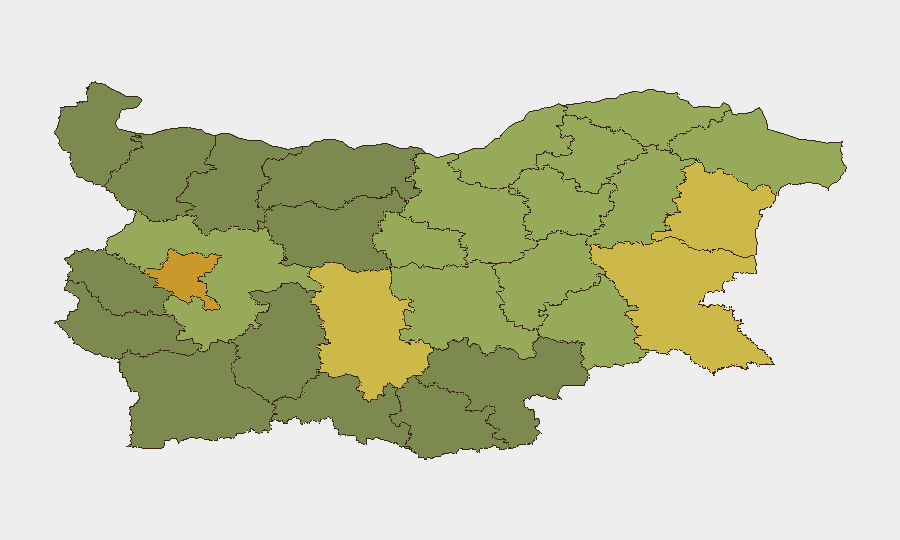
Sofia-City (risk 72), Plovdiv (68), and Varna (65) drive the national risk profile, driven by concentration of organized-crime enforcement activity, corruption investigations, and urban public-order incidents. Burgas (62) has registered significant corruption enforcement at critical infrastructure. These four cities account for concentrated policing operations, border activity (Varna, Burgas ports), and recurring bomb threats, creating compounding operational disruption. Mid-tier regional centers (Sofia province, Ruse, Stara Zagora) show moderate risk primarily from road-safety and routine crime patterns rather than organized threats.
How GeoBit Would Assist
Teams with personnel or assets in Bulgaria should employ AOI Monitoring & Early Warning on Sofia-City, Burgas, and Plovdiv to track ongoing corruption and public-order operations in real time. Multi-language OSINT Fusion across Bulgarian news portals (Dnes.bg, Sega, Fakti.bg, BNT) and X/Telegram OSINT will surface emerging enforcement actions, protests, or threat signals ahead of mainstream Western coverage. Routing & Network Analysis can identify alternative travel corridors around Kalotina border delays and road-accident hotspots, critical for duty-of-care teams managing employee mobility.
7-Day Outlook
No major deterioration is expected in the near term. Summer-season road-safety risk will likely remain elevated through August, and organized-crime enforcement operations may continue in urban centers and critical infrastructure sectors. Border crossing congestion at Kalotina should normalize as checkpoint expansion progresses, and low-credibility bomb threats are expected to persist at public institutions but pose minimal kinetic risk.
Highest-Risk Areas — Ranked
| # | State / Region | Risk |
|---|---|---|
| 1 | Sofia-City | 72 |
| 2 | Plovdiv | 68 |
| 3 | Varna | 65 |
| 4 | Burgas | 62 |
| 5 | Sofia | 58 |
| 6 | Ruse | 55 |
| 7 | Stara Zagora | 52 |
| 8 | Sliven | 50 |
| 9 | Shumen | 48 |
| 10 | Razgrad | 47 |
| 11 | Yambol | 45 |
| 12 | Dobrich | 44 |
Sources
Previous Daily Briefs
A new Bulgaria brief is written every day — each with its own risk map and downloadable CSV. Here's the last week; use the calendar to go further back.
📅 Browse every day by calendar →
Highlighted days have a brief. Tap a day for that day's map & analysis, or “csv” for that day's dataset ($5).
Atlas — our AI intelligence desk — emails them this snapshot personally. Nothing else, no list.