Situation Summary
Canada's composite threat score of 5 places it at #129 globally, but sub-national disparities are pronounced: Ontario and Nunavut account for the majority of tracked risk, while cyber threats have intensified sharply across all provinces in the past 48 hours. Three concurrent threat vectors—criminal cyber infrastructure, state-linked sanctions enforcement, and emerging civil unrest in northern regions—are creating compounded operational and data-security challenges for corporate and institutional presence. The trajectory suggests sustained elevated cyber pressure and fragmentary civil-order risks, particularly in high-population and resource-extraction zones.
Key Developments
- 20 Jun, National (Canada-wide) – Canadian Crime Stoppers Association disclosed a security incident at P3 Global Intel cloud platform; extent of informant data compromise unknown, but criminal marketplaces have reportedly advertised millions of confidential tips and contact details, raising operational security and informant-safety risks across law-enforcement partnerships and corporate tip lines.
- 20 Jun, Ottawa, Ontario – Canadian authorities arrested 23-year-old Jacob Butler (aka "Kimwolf") in connection with operation of the Kimwolf Internet-of-Things botnet; the infrastructure enslaved millions of devices and executed large distributed denial-of-service attacks over six months, with U.S. law-enforcement coordination indicating coordinated cross-border cyber-criminal prosecution.
- 20 Jun, Canada-wide (cyber) – FortiGuard Labs analysis reports 379% increase in global ransomware activity with over 370 Canadian organizations hit by extortion attacks in a recent reporting window; generative AI is being exploited by criminal actors, and Canadian entities are being disproportionately targeted relative to historical patterns.
- 20 Jun, Canada-wide (cyber governance) – Canadian Centre for Cyber Security is actively issuing real-time security bulletins on vulnerabilities and ongoing attacks against Canadian organizations and is urging incident reporting directly to the Cyber Centre for coordinated response; this signals sustained operational tempo of threat-actor activity and growing incident frequency.
- 20–21 Jun, Nunavut & Northern Canada – Political dissent events involving Inuit groups and government, combined with "occupy territory" and "reject" statements, are generating elevated civil-order risk signals in Nunavut (risk score 22.1, second-highest nationally); concurrent unconventional-violence and disapproval events in Toronto add to Ontario's leading risk ranking (31.5).
- Background context (6 Nov 2025, updated in current federal notices) – Global Affairs Canada added 11 entities and 13 individuals to Russia sanctions list, including cyber and drone-infrastructure operators; compliance and counter-party-risk implications remain live for Canadian firms in shipping, energy, and dual-use technology sectors into mid-2026.
Highest-Risk Areas
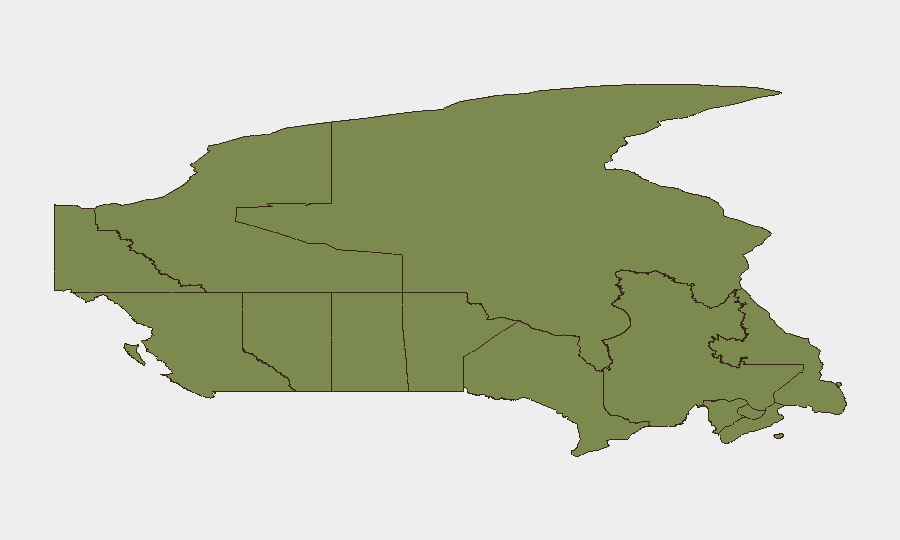
Ontario's composite risk of 31.5 reflects dense population, critical infrastructure concentration, and recent unconventional-violence signals in Toronto; cyber-attack frequency is disproportionately high in the Greater Toronto Area and Ottawa (federal capital and tech hub). Nunavut's risk score of 22.1—second-highest in the country—is driven by political dissent and territorial claims involving Inuit governance, resource-extraction disputes, and emerging civil unrest, compounded by geographic remoteness and limited emergency-response infrastructure. Quebec (11.3) and British Columbia (10.6) remain elevated due to cyber targeting and mixed political activity; Atlantic and prairie provinces show materially lower threat profiles.
How GeoBit Would Assist
Corporate security teams should deploy AOI Monitoring & Early Warning focused on Ontario, Nunavut, and Quebec to detect escalation in political dissent, labor action, and cyber-incident clustering in real time. OSINT Fusion & Corroboration (X/Twitter, Telegram, email intercepts) combined with Network & Actor Analysis would isolate criminal-cyber infrastructure, botnet operators, and ransomware-group activity targeting Canadian entities. Risk & Threat Assessment modules linked to Cyber and Crime domain search would provide organizations with early indication of sector-specific targeting patterns and vulnerability windows.
7-Day Outlook
Ransomware and cyber-extortion attacks are expected to sustain or escalate given the 379% global increase and AI-enabled scaling. Political tensions in Nunavut and concurrent labor disputes may generate localized civil unrest or facility-access disruptions. Crime Stoppers and P3 platform compromises will likely trigger cascading incidents as compromised informant data is exploited, increasing reputational and operational risk for partner organizations.
Highest-Risk Areas — Ranked
| # | State / Region | Risk |
|---|---|---|
| 1 | Ontario | 31.5 |
| 2 | Nunavut | 22.1 |
| 3 | Quebec | 11.3 |
| 4 | British Columbia | 10.6 |
| 5 | Alberta | 9.7 |
| 6 | Manitoba | 3.9 |
| 7 | New Brunswick | 2.7 |
| 8 | Saskatchewan | 2.4 |
| 9 | Northwest Territories | 1.8 |
| 10 | Yukon | 1.7 |
| 11 | Newfoundland and Labrador | 1.7 |
| 12 | Prince Edward Island | 1.5 |
Sources
Previous Daily Briefs
A new Canada brief is written every day — each with its own risk map and downloadable CSV. Here's the last week; use the calendar to go further back.
📅 Browse every day by calendar →
Highlighted days have a brief. Tap a day for that day's map & analysis, or “csv” for that day's dataset ($5).