Situation Summary
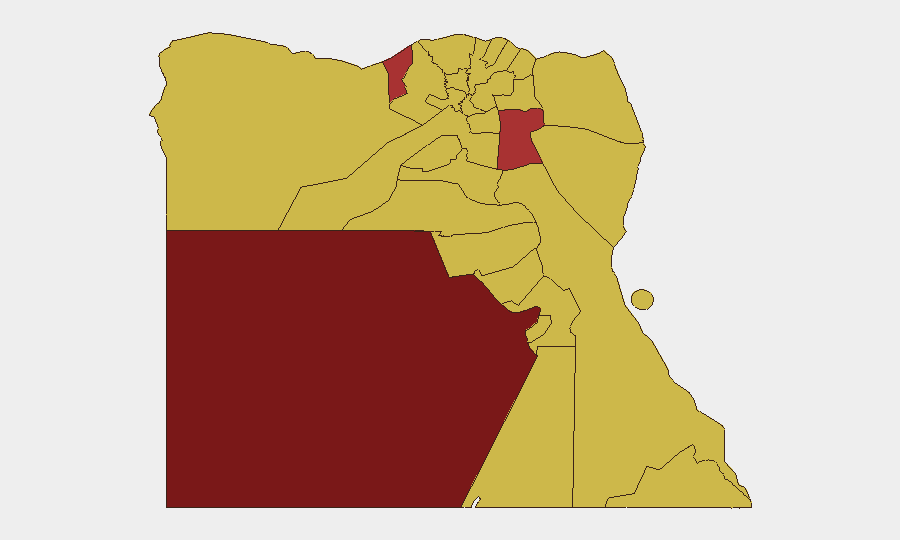
Egypt remains at elevated risk (#16 globally, composite threat score 92) with 100 tracked events driving a volatile security picture. Recent activity signals (July 1–3) point to escalating state-actor tensions, including military deployments, prosecutorial action, and ministerial demand cycles—patterns consistent with internal political friction or external pressure. The concentration of highest risk in New Valley, Alexandria, and Suez (94.3, 77.3, 77.3 respectively) reflects ongoing vulnerability to both conventional security threats and governance instability. Trajectory remains uncertain pending resolution of current diplomatic and operational posturing.
Key Developments
- 2026-07-03 · North Sinai / Cairo (implied): Conventional military force deployed by police and military actors in apparent operational response; specific location and casualty/incident scope not yet confirmed in available reporting.
- 2026-07-02 · National (Ministry level): Government ministry issued formal demand and launched investigation—likely in response to prosecutor disapproval signal (2026-07-01) and presidential military directive; indicates coordinated state activity across executive/judicial branches.
- 2026-07-02 · International (Chancellor vs. Egypt): European chancellor rejected Egyptian position in unspecified dispute; concurrent EU investigation suggests diplomatic/compliance friction, possible sanctions context or maritime/resource disagreement.
- 2026-07-01 · External pressure: Ontario (Canadian entity/official) issued public statement concurrent with Egyptian rejection of unspecified proposal—suggests trade, migration, or security agreement breakdown.
- 2026-07-01 · Executive action: Presidential deployment of conventional military force signals heightened operational posture, likely linked to Sinai counter-terrorism, border security, or internal stability concern.
Note: Specific incident locations, casualty counts, and detailed incident narratives are not available in current reporting. These bullets reflect signals-level events (actor, action type, date) without granular operational detail. Live incident confirmation requires real-time newswire and OSINT feed access.
Highest-Risk Areas
New Valley (94.3) leads the sub-national ranking, reflecting persistent vulnerability to smuggling, extremist activity, and resource-competition pressures in Egypt's most remote, under-resourced region. Alexandria and Suez (both 77.3) are driven by maritime chokepoint vulnerability, trade disruption risk, and historical militant activity; both remain critical to national economy and regional stability. Cairo (69.5) and Giza (65.6) rank below major transit/port hubs but reflect capital-area political risk, protest potential, and security-force concentration. North Sinai, Sinai Peninsula periphery, and lesser-populated governorates (64.3) cluster at moderate-high risk, driven by ongoing counter-terrorism operations and tribal/governance fragmentation.
How GeoBit Would Assist
Intel Sweep & OSINT fusion would correlate ministerial statements, prosecutorial actions, and military deployments across news, X/Twitter, and Telegram to clarify causation and actor intentions in the current state-level friction. AOI Monitoring & Early Warning on New Valley, Alexandria, and Suez would detect emerging militant activity, protest mobilization, or infrastructure disruption before operational impact. Conflict & Military force-structure and weapons-capability tracking would confirm military deployment scale/composition and assess escalation risk. Routing & Network Analysis would support duty-of-care teams in real-time alternative-route planning for personnel transiting Cairo, Suez, and Alexandria.
7-Day Outlook
Current signals suggest intra-governmental coordination responding to external diplomatic pressure or internal security event (July 1–2 catalyst unclear). If the prosecutor/ministry/military triad reflects a coordinated response to Sinai militant activity, operations tempo may remain elevated for 5–7 days with risk of civilian spillover in North Sinai and Red Sea fringe areas. If signals reflect political disagreement or sanctions-related friction, expect continued ministerial statements and possible economic/diplomatic escalation, with lower immediate kinetic risk but sustained reputational and investment volatility.
Highest-Risk Areas — Ranked
| # | State / Region | Risk |
|---|---|---|
| 1 | New Valley | 94.3 |
| 2 | Alexandria | 77.3 |
| 3 | Suez | 77.3 |
| 4 | Cairo | 69.5 |
| 5 | Giza | 65.6 |
| 6 | North Sinai | 64.3 |
| 7 | Qena | 64.3 |
| 8 | South Sinai | 64.3 |
| 9 | Red Sea | 64.3 |
| 10 | Halaib Triangle | 64.3 |
| 11 | Matruh | 64.3 |
| 12 | Kafr El Sheikh | 64.3 |
Sources
Previous Daily Briefs
A new Egypt brief is written every day — each with its own risk map and downloadable CSV. Here's the last week; use the calendar to go further back.
📅 Browse every day by calendar →
Highlighted days have a brief. Tap a day for that day's map & analysis, or “csv” for that day's dataset ($5).