Situation Summary
Greece faces elevated near-term security risk driven by a sharp spike in politically motivated violence and ongoing organized-crime enforcement activity. The firebombing attacks in Thessaloniki on 2 July targeting governing-party members represent a significant escalation in domestic extremism, resulting in one fatality and prompting active counter-terrorism mobilization. Infrastructure vulnerabilities (residential collapse in Athens, seismic stress in the southern Aegean) and persistent cyber-espionage threats against political figures compound the operational environment. The security posture remains reactive but organized; trajectory over the next 48–72 hours will depend on arrest outcomes and political responses to the Thessaloniki incidents.
Key Developments
- Thessaloniki – Firebombing attacks on ruling-party residences (2 July, 04:00–04:45 local): Three coordinated incendiary attacks using improvised gas-canister devices targeted homes of New Democracy party members and affiliates. One 70-year-old resident died from severe burns; three others injured, including ND candidate Afroditi Nestora. Police located a suspect's scooter and launched active counter-terrorism investigation.
- Thessaloniki – Counter-terrorism operations ongoing (2 July): Greek security services examining recovered vehicle evidence, surveillance footage, and witness statements; case classified as politically motivated terrorism by Prime Minister's office.
- Athens (Petralona) – Residential building collapse (2 July): Four-story apartment block collapsed; search-and-rescue operations underway for potential trapped occupants; infrastructure safety concerns flagged for the neighborhood.
- Nationwide – Criminal gang dismantled (2 July): Greek authorities announced successful operation against organized-crime syndicate linked to explosions, arson, extortion, and attempted murder; ongoing investigation into gang's operational footprint and victims.
- Eastern Mediterranean – Magnitude 5.4 earthquake near Kasos Island (2 July): Seismic event 28 km east of Kasos; no major damage reported, but prompted building and transport-infrastructure inspections across southern Aegean region.
- Government cyber-security incident (2 July, reported): National Security Advisor Thanos Dokos was compromised in video-call social engineering by Russian impersonators posing as Ukrainian officials; raises institutional information-security vulnerabilities.
- Pegasus spyware campaign (reported 2 July, context: 2022–2023 infections): Former Greek MEP Stelios Kouloglou's phone infected with Pegasus during European Parliament spyware-investigation committee work; renewed media and EU attention underscores persistent state-level targeting of Greek political figures.
Highest-Risk Areas
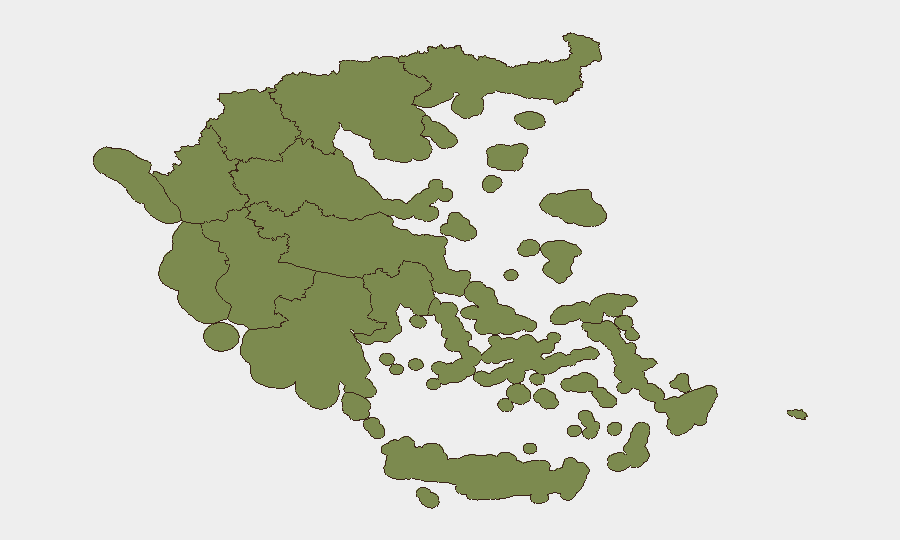
Central Greece (composite risk 31.8) and Attica (19) account for the overwhelming majority of tracked threat events and drive the national ranking. Thessaloniki's concentration of firebombing, counter-terrorism activity, and gang-dismantling operations situates Central Greece as the immediate flashpoint. Attica (Greater Athens) faces compounded pressure from infrastructure failures (building collapse), political violence spillover risk, and organized-crime enforcement. Eastern Macedonia and Thrace (4.7) retain lower but sustained risk from cross-border tensions historically; remaining regions show minimal current activity.
How GeoBit Would Assist
Security teams should deploy AOI Monitoring & Early Warning on Thessaloniki and central Athens to track protest activity, police operations, and potential secondary incidents; simultaneously activate Intel Sweep and X/Telegram OSINT to detect coordination signals, manifestos, or statements claiming responsibility for the firebombing. Conflict & Military and Network & Actor Analysis capabilities would map extremist-cell structure and affiliations, while Routing & Network Analysis supports alternate-route planning for staff transiting Thessaloniki given active counter-terrorism sweeps.
7-Day Outlook
Expect continued heightened police presence and checkpoint activity in Thessaloniki and Athens over 3–5 days pending suspect arrests. Political rhetoric will likely intensify; secondary protests or copycat violence remain possible if arrests are slow or perceived as ineffectual. Seismic aftershocks and infrastructure inspections may cause intermittent transport delays in the southern Aegean.
Highest-Risk Areas — Ranked
| # | State / Region | Risk |
|---|---|---|
| 1 | Central Greece | 31.8 |
| 2 | Attica | 19 |
| 3 | Central Macedonia | 6.2 |
| 4 | Eastern Macedonia and Thrace | 4.7 |
| 5 | Western Greece | 2 |
| 6 | South Aegean | 2 |
| 7 | Western Macedonia | 1.8 |
| 8 | Peloponnese Region | 1.8 |
| 9 | Thessaly | 1.8 |
| 10 | Autonomous Monastic State of the Holy Mountain | 1.8 |
| 11 | Northern Aegean | 1.8 |
| 12 | Crete | 1.8 |
Sources
Previous Daily Briefs
A new Greece brief is written every day — each with its own risk map and downloadable CSV. Here's the last week; use the calendar to go further back.
📅 Browse every day by calendar →
Highlighted days have a brief. Tap a day for that day's map & analysis, or “csv” for that day's dataset ($5).