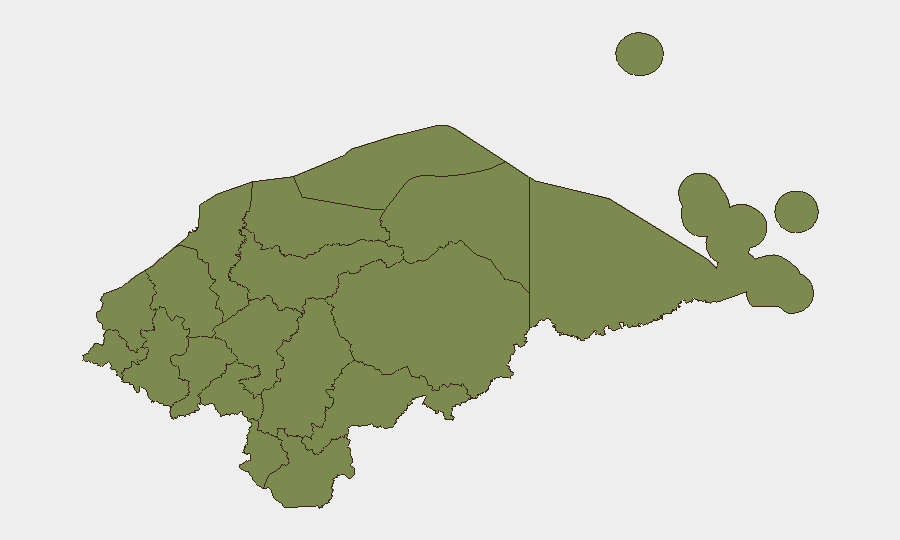
Situation Summary
Honduras maintains a stable overall security posture as of 2 July 2026, with no confirmed acute incidents (armed clashes, roadblocks, major crime events, or civil unrest) reported in the last 24–48 hours across national monitoring feeds. The country's composite threat score (30/122) places it at mid-range global risk, driven predominantly by concentrated gang and organized-crime activity in specific departments rather than nationwide instability. Near-term conditions are expected to remain stable with no evidence-driven expectation of major escalation into early July.
Key Developments
No discrete acute security incidents were corroborated in Honduras during the 24–48-hour window preceding this brief (30 June – 2 July 2026). Multi-source monitoring of Honduran national media, social platforms, and incident feeds recorded no verified roadblocks, armed confrontations, infrastructure disruptions, or civil-unrest events requiring immediate duty-of-care alert. Routine criminal activity and extortion remain endemic to high-risk departments but have not escalated to acute crisis levels in the current reporting window.
Highest-Risk Areas
Olancho department dominates Honduras's sub-national threat profile (risk score 31.5), accounting for the majority of tracked security events and reflecting entrenched gang territorial control and trafficking operations. Francisco Morazán (score 14.6), which includes the capital Tegucigalpa, ranks second and concentrates urban crime, extortion, and organized-crime activity typical of major Central American urban centers. The remaining ten departments show minimal differentiation (scores 1.5–2.7), indicating that security risk in Honduras is highly concentrated geographically rather than dispersed nationwide. Corporate and NGO personnel should assume elevated baseline risk in Olancho and Tegucigalpa metro areas and apply proportionate monitoring and movement protocols in those zones, while other regions present routine vigilance-level exposure.
How GeoBit Would Assist
Security teams with personnel or assets in Honduras should employ AOI Monitoring & Early Warning to establish persistent watch over Olancho and Francisco Morazán departments, enabling real-time alerting if localized incidents or roadblocks emerge. Intel Sweep and multi-language OSINT fusion can track gang territorial claims, extortion networks, and organized-crime activity across social platforms, Telegram, and local news feeds to anticipate pressure on supply chains or movement corridors. Routing & Network Analysis supports duty-of-care teams in identifying and validating alternative routes around known high-risk zones and criminal chokepoints, particularly for inter-city travel and logistics operations.
7-Day Outlook
No escalation is forecast for the 7–14 July window based on current intelligence and near-term stability signals. Routine criminal activity—extortion, gang rivalry, and trafficking—will persist in endemic zones, but no major incident, civil unrest, or infrastructure disruption is anticipated to alter the baseline risk picture. Organizations should maintain standard monitoring cadence and assume no change to current departmental risk rankings absent new corroborated reporting.
Report Date: 2 July 2026 | Data Window: 24–48 hours prior | Confidence: Routine/Stable
Highest-Risk Areas — Ranked
| # | State / Region | Risk |
|---|---|---|
| 1 | Olancho | 31.5 |
| 2 | Francisco Morazán | 14.6 |
| 3 | Bay Islands | 2.7 |
| 4 | El Paraíso | 1.5 |
| 5 | Copán | 1.5 |
| 6 | Ocotepeque | 1.5 |
| 7 | Cortés | 1.5 |
| 8 | Yoro | 1.5 |
| 9 | Santa Bárbara | 1.5 |
| 10 | Lempira | 1.5 |
| 11 | Intibucá | 1.5 |
| 12 | Comayagua | 1.5 |
Sources
Previous Daily Briefs
A new Honduras brief is written every day — each with its own risk map and downloadable CSV. Here's the last week; use the calendar to go further back.
📅 Browse every day by calendar →
Highlighted days have a brief. Tap a day for that day's map & analysis, or “csv” for that day's dataset ($5).