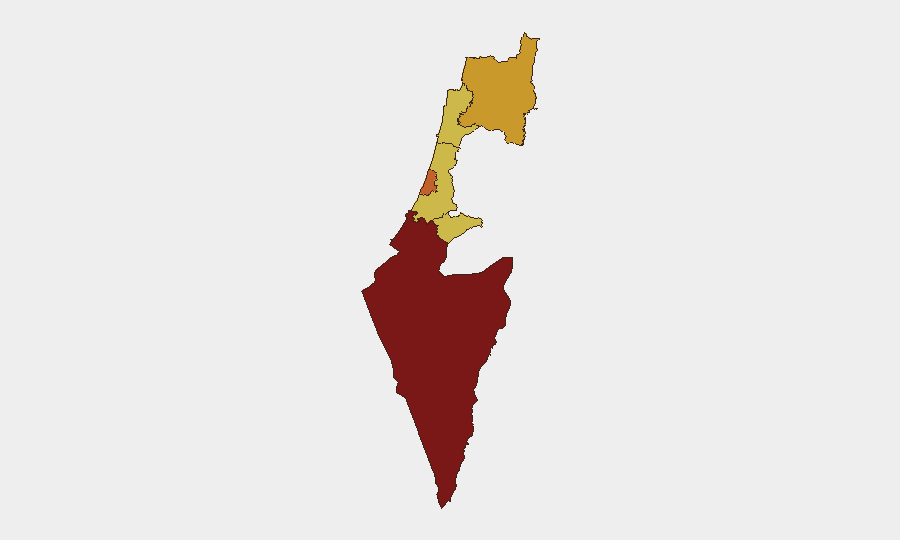
Situation Summary
Israel remains the world's highest-risk country (composite threat score 100) with 601 tracked events, driven by active military exchanges with Iran and ongoing operations in Gaza and along the Lebanon border. The past 48 hours have registered direct conventional military activity between Israel and Iran, ceasefire violations on the Lebanon–Israel frontier, and continued ground operations in the South District, alongside deteriorating diplomatic relations with Syria, Iraq, Yemen, and Egypt. Internal political friction—including reported government investigations and cabinet disagreement over US–Iran agreements—adds institutional instability to an already elevated external threat environment.
Key Developments
- North District / Lebanon border (Metula, Kiryat Shmona sector) – 2026-06-18: Ongoing cross-border fire and limited IDF airstrikes into south Lebanon; sporadic rocket launches toward northern Israel reported as ceasefire violations by Lebanese and Iranian officials. Hezbollah-linked positions remain engaged with reduced but active intensity.
- Iran–Israel military exchange – 2026-06-17: Confirmed conventional military force activity recorded bidirectionally; Israeli air defenses placed on heightened alert with open-source trackers noting short-notice airspace and routing risks over central and southern Israel.
- South District / Gaza border – 2026-06-18: IDF ground raids and weapons-depot operations against remaining Hamas cells continuing; elevated rocket-alert posture maintained in border communities with low-intensity but persistent incidents affecting movement and logistics.
- Regional diplomatic isolation – 2026-06-17: Israel recorded relation reductions with Syria, Palestine, Iraq, Yemen, and Lebanon (formal demand); Egypt rejected aspects of evolving US–Iran–Israel frameworks. Cumulative effect complicates overflight, shipping, and cross-border planning for Israeli-linked operations.
- Internal government investigation – 2026-06-18: Israeli government body initiated new investigative action against Israeli entity or individuals (corruption or security-related); flagged as potential catalyst for short-notice demonstrations or institutional disruption if details surface.
- Jerusalem & Tel Aviv – 2026-06-17–18: Diplomatic-monitoring feeds report internal financial and political friction; increased protest-watching and political-instability monitoring in major urban centers, though no large-scale street unrest confirmed in current 24–48h window.
Highest-Risk Areas
South District (risk 100) remains the primary driver—active IDF–Hamas ground operations and sustained rocket posture. Tel Aviv District (74.1) and North District (72.7) rank second and third, respectively: Tel Aviv faces broader airspace volatility and internal political instability; the North faces direct cross-border Hezbollah fire and infrastructure risk within range of Lebanese weapons systems. Haifa, Center, and Jerusalem Districts (70.7–70) are elevated due to proximity to threat zones and national-level diplomatic/political friction affecting all population centers.
How GeoBit Would Assist
Corporate security and duty-of-care teams should use GeoBit's AOI Monitoring & Early Warning to track persistent threats in South, North, and Tel Aviv Districts with short-notice alerting on ceasefire violations or airspace closures. Routing & Network Analysis capabilities enable real-time alternative-journey planning around active fire zones and diplomatic chokepoints. OSINT Fusion (multi-language feeds, X/Telegram monitoring, and radio SIGINT) provides continuous corroboration of Israeli government statements, Lebanese accusations, and Iranian military claims—critical for distinguishing tactical posturing from escalation.
7-Day Outlook
Cross-border activity along the Lebanon frontier is likely to remain at reduced-but-active levels unless either side signals escalation; South District operations may persist as IDF concludes remaining raid phases. Internal Israeli political friction and regional diplomatic isolation create secondary risks of short-notice civil unrest or administrative disruption that could compound travel and business continuity challenges. Airspace and shipping volatility should be assumed ongoing through the 7-day horizon pending formal ceasefire or diplomatic reset.
Highest-Risk Areas — Ranked
| # | State / Region | Risk |
|---|---|---|
| 1 | South District | 100 |
| 2 | Tel-Aviv District | 74.1 |
| 3 | North District | 72.7 |
| 4 | Haifa District | 70.7 |
| 5 | Center District | 70.4 |
| 6 | Jerusalem District | 70 |
Sources
Previous Daily Briefs
A new Israel brief is written every day — each with its own risk map and downloadable CSV. Here's the last week; use the calendar to go further back.
📅 Browse every day by calendar →
Highlighted days have a brief. Tap a day for that day's map & analysis, or “csv” for that day's dataset ($5).