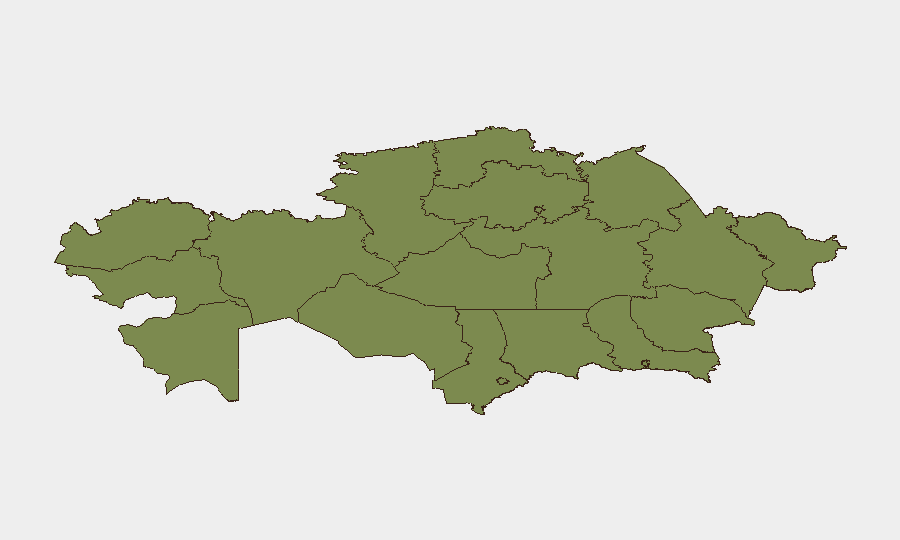
Situation Summary
Kazakhstan remains broadly stable with no reported terrorism, civil unrest, or major violent crime in the past 48 hours. The country faces asymmetric economic and infrastructure pressure from external actors—primarily drone strikes affecting energy exports and Russian border friction—rather than domestic instability. Astana dominates the sub-national risk profile at a significant differential (31.3 vs. 1.3 across all other regions), warranting focused attention on the capital and its critical infrastructure.
Key Developments
- Russia–Kazakhstan border (ongoing through 2026-08-02): Tightened fuel and customs controls continue to create logistics delays at transit points; no enforcement incidents reported in the last 48 hours.
- Tengiz oil field & export routes (as of 2026-07-28): Drone strikes on tanker loading operations have slowed Kazakh crude output and cut export flows—an energy and economic risk tied to external attacks rather than domestic unrest.
- Astana–Omsk air corridor (status as of 2026-08-02): Vietjet Qazaqstan maintains flight suspensions on the route due to ongoing drone activity in Russian airspace, affecting regional travel and logistics connectivity.
- Wildfire cluster (recent, locations TBD): Multiple wildfire incidents reported across Kazakhstan (reference IDs 1030000, 1030002, 1030001, 1029515, 1029541); extent and affected regions require spatial confirmation.
- Flood event (recent, location TBD): One flood incident reported (reference ID 1104049); impact scope pending clarification.
- Disapprove & Reject signals (2026-07-31 to 2026-08-02): Diplomatic tension between Kazakhstan and Russia reflected in event signaling (disapproval statement, Russian rejection); no direct security escalation confirmed, but reflects geopolitical friction.
Highest-Risk Areas
Astana's composite risk score (31.3) significantly exceeds all other regions (1.3 each), indicating that capital-tier threats—political instability, infrastructure targeting, cyber operations, or concentration of high-value assets—dominate the national profile. All remaining regions show uniform low risk, suggesting either genuine parity in baseline security conditions or data-collection gaps in peripheral areas. Security teams should treat Astana as the strategic focus and flag any uptick in peripheral regions as a potential early-warning signal of either real escalation or improved monitoring.
How GeoBit Would Assist
Teams operating in Kazakhstan should deploy AOI Monitoring & Early Warning on Astana and energy-export chokepoints (Tengiz, Caspian shipping) to detect emerging threats ahead of operational impact. Intelligence & OSINT (X/Telegram feeds, multi-language search, sentiment analysis) will track Russian-Kazakh diplomatic friction and cross-border enforcement trends in real time. GIS & Spatial Analysis and Satellite & Imagery analysis should be tasked to confirm wildfire and flood extent and assess secondary risks to supply chains, power infrastructure, or populated areas.
7-Day Outlook
Kazakhstan is unlikely to experience a sharp domestic security deterioration in the next week; however, external pressure—Russian border friction, drone strikes on energy exports, and geopolitical signaling—will continue to create friction for commerce and logistics. Wildfire and flood events may amplify localized disruption and should be monitored for cascading effects on critical infrastructure or population movements.
Highest-Risk Areas — Ranked
| # | State / Region | Risk |
|---|---|---|
| 1 | Astana | 31.3 |
| 2 | Turkistan Region | 1.3 |
| 3 | Almaty Region | 1.3 |
| 4 | East Kazakhstan Region | 1.3 |
| 5 | Abay Region | 1.3 |
| 6 | Jetisu Region | 1.3 |
| 7 | West Kazakhstan Region | 1.3 |
| 8 | Atyrau Region | 1.3 |
| 9 | Mangystau Region | 1.3 |
| 10 | Aqtöbe region | 1.3 |
| 11 | Pavlodar Region | 1.3 |
| 12 | Kostanay Region | 1.3 |
Sources
Previous Daily Briefs
A new Kazakhstan brief is written every day — each with its own risk map and downloadable CSV. Here's the last week; use the calendar to go further back.
📅 Browse every day by calendar →
Highlighted days have a brief. Tap a day for that day's map & analysis, or “csv” for that day's dataset ($5).
Atlas — our AI intelligence desk — emails them this snapshot personally. Nothing else, no list.