Situation Summary
Libya remains at composite threat rank #25 globally (score 63) with 62 tracked events, reflecting persistent fragmentation across security, governance, and rule-of-law domains. Recent signals indicate continued detention-related violence, inter-agency friction between executive and legislative branches, and localized military activity in eastern regions. The threat environment is characterized by chronic instability rather than acute escalation, though prison conditions and migrant-related human-rights concerns have surfaced in public statements from international bodies (UNHCR) and regional actors (Egypt).
Key Developments
- Tripoli – 22 Jun 2026 – Multiple arrest/detention incidents reported; authorities detaining prisoners amid documented physical-assault allegations within prison facilities (sources: event signals citing prison-vs-prisoner and prison-vs-Libyan physical-assault events; UNHCR public statement same date).
- Benghazi – 21 Jun 2026 – Conventional military force activity documented; specific tactical nature and casualties not yet confirmed in open reporting (source: event signal).
- Tripoli – 22 Jun 2026 – Executive-legislative friction escalated; government rejected position advanced by House of Representatives legislator, signaling continued institutional gridlock on unspecified matter (source: event signal "Authorities vs Legislator – Reject").
- Inter-regional – 22 Jun 2026 – International Criminal Court and Italian authorities coordinating on arrest/detain matter involving non-Libyan nationals; precise legal or security rationale not yet detailed in accessible sources (source: event signal).
- Libya–Iraq nexus – 21 Jun 2026 – Iraqi authorities initiated investigation touching on Libya; scope and nature of inquiry not confirmed in current open sources.
- National – 22 Jun 2026 – Government issued public statement regarding detainee status or conditions, aligning with elevated international scrutiny on migrant and prisoner welfare (source: event signal "Libya vs Detainee – Public Statement").
Note: Detailed incident-level confirmation (casualty figures, specific locations beyond city level, tactical details) for 21–22 June events is currently limited in accessible open sources. Security teams should cross-check with real-time embassy alerts, NGO operational updates, and regional media archives for field-level specificity.
Highest-Risk Areas
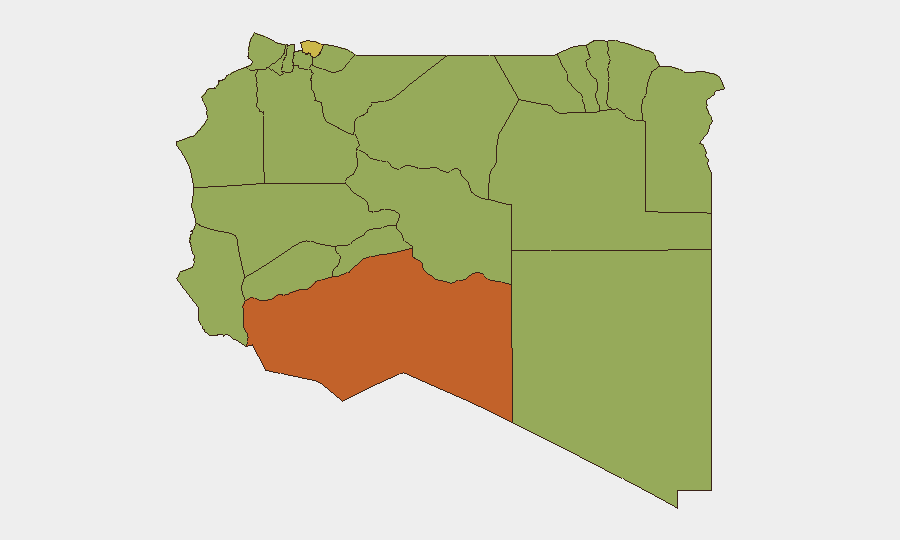
Murzuq (risk 74) and Tripoli (risk 63) dominate the sub-national ranking, reflecting entrenched armed-group presence, criminal enterprise (smuggling, trafficking), and concentrations of state and international facilities respectively. Tripoli's dual role as capital and major migrant hub amplifies detention, trafficking, and political-instability risk; Murzuq, as a southern smuggling nexus and militia stronghold, presents chronic kidnap, armed-group activity, and supply-chain disruption hazards. Secondary clusters along the Tunisian (Nalut, Az Zawiya, Nuqat al Khams) and Niger/Chad borders (Ghat, Kufra, Wadi al Shatii) reflect cross-border militant activity, weapons flows, and human-trafficking corridors. Interior regions (Wadi al Hayaa) show elevated risk linked to resource competition and nomadic-community tensions.
How GeoBit Would Assist
Security teams operating in or responsible for Libya should prioritize AOI Monitoring & Early Warning focused on Tripoli, Murzuq, and key border crossings to detect roadblocks, checkpoints, and armed-group repositioning in near real-time. OSINT Fusion & Corroboration (multi-language social-media tracking, regional media scanning, and entity extraction) enables rapid vetting of prison, migrant-welfare, and military incidents to separate credible threats from noise. Routing & Network Analysis allows security and supply-chain teams to model alternative corridors and chokepoint avoidance, especially for international staff and cargo movement into Tripoli and southern regions.
7-Day Outlook
No major escalation is anticipated in the immediate 7-day window, but detention-related incidents, inter-agency friction, and low-level armed activity in eastern and southern zones will likely persist. Migrant-welfare and rule-of-law pressure from international actors (UNHCR, ICC, Egypt) may drive further government statements and localized security responses. Teams should maintain heightened vigilance around Tripoli installations, border regions, and prisons, and establish rapid-communication protocols with local contacts and embassy security advisories.
Highest-Risk Areas — Ranked
| # | State / Region | Risk |
|---|---|---|
| 1 | Murzuq | 74 |
| 2 | Tripoli | 63 |
| 3 | Wadi al Hayaa | 46.2 |
| 4 | Nalut | 44 |
| 5 | Ghat | 44 |
| 6 | Baladiyah Surman | 44 |
| 7 | Az Zawiya District | 44 |
| 8 | Wadi al Shatii | 44 |
| 9 | Kufra | 44 |
| 10 | Nuqat al Khams | 44 |
| 11 | Jafara | 44 |
| 12 | Murqub | 44 |
Sources
Previous Daily Briefs
A new Libya brief is written every day — each with its own risk map and downloadable CSV. Here's the last week; use the calendar to go further back.
📅 Browse every day by calendar →
Highlighted days have a brief. Tap a day for that day's map & analysis, or “csv” for that day's dataset ($5).