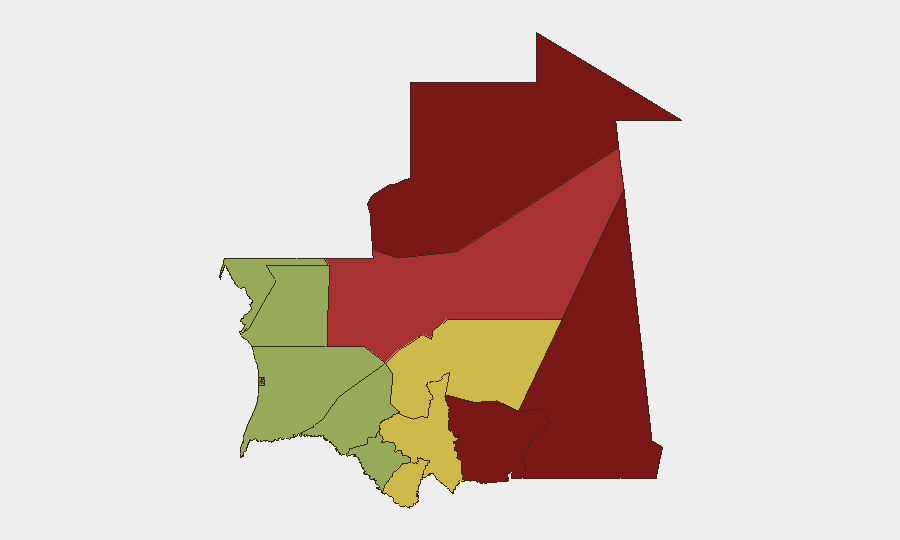
Situation Summary
Mauritania's overall security posture remains stable at the national level, with no major terrorist incidents or armed violence reported in the past 48 hours; however, localized political tensions and judicial actions against opposition figures have intensified in Nouakchott and Nouadhibou. The northeastern regions—particularly Tiris Zemmour, Hodh Ech Chargui, and Hodh El Gharbi—remain significantly elevated due to persistent cross-border militant pressure from Mali and ungoverned space. Currency depreciation and ongoing cyber-threat activity add medium-term economic and infrastructure vulnerabilities.
Key Developments
- Road accident injuring Tiris Zemmour governor (Atar–Akjoujt corridor, Inchiri/Tiris Zemmour – 24 July 2026): Wali Idrissa Demba Koureira and his driver sustained minor injuries in a traffic accident on the Nouakchott–Atar highway. While not a security attack, the incident underscores poor road conditions on a critical intercity route.
- Judicial sanctions against opposition MPs (Nouakchott Court of Appeal – 23–24 July 2026): MPs Mariem Cheikh and Kamo Achour were banned from political and civil rights for five years and sentenced to two years' imprisonment. This action signals continued judicial pressure on opposition voices and carries moderate risk of triggering localized protest activity.
- Alleged attempted vehicle attack on opposition activist (Nouadhibou – 23–24 July 2026): IRA leader and MP Biram Ould Dah Ould Abeid reported being targeted in a ramming incident allegedly involving police-associated personnel. If confirmed, this represents a serious escalation in state–opposition friction and potential flashpoint for civil unrest in Nouadhibou.
- Currency depreciation statement (Nouakchott – 24 July 2026): IMF resident representative Younes Zouhar attributed ouguiya weakness to global factors rather than domestic policy, but sustained depreciation may fuel socio-economic discontent and protest pressure.
- Cyber-threat detection (nationwide – 24 July 2026): PAFIID program reported 10,000+ cyber-security threats detected in H1 2026, with 470 confirmed and neutralized. This signals ongoing infrastructure and corporate IT vulnerabilities across Mauritania.
- No major armed incidents (national – last 48 hours): Cross-reference with regional Sahel monitors confirms absence of terrorist attacks, armed clashes, or large-scale sabotage inside Mauritania since 23 July.
Highest-Risk Areas
Tiris Zemmour (risk 95) and Hodh Ech Chargui (risk 85) account for the majority of sub-national threat concentration, driven by proximity to Mali, ungoverned space, and persistent militant-group presence. Hodh El Gharbi (80) and Adrar (78) remain secondary concern zones along the same northeast corridor. These four regions present elevated risks for kidnapping, ambush, and cross-border militant infiltration; travel and asset exposure in these areas requires enhanced security protocols and real-time situational awareness.
How GeoBit Would Assist
Security teams would employ AOI Monitoring & Early Warning (persistent watch on Tiris Zemmour, Hodh Ech Chargui, and Nouadhibou) coupled with Intel Sweep and OSINT fusion (tracking opposition movements, judicial calendars, and police-force activities) to generate advance warning of protest or escalation cycles. Network & Actor Analysis and Routing & Network Analysis would support alternative-route planning for personnel traveling the Nouakchott–Atar corridor and northeastern access roads, while Cyber-threat tracking would inform IT-security posture for corporate and upstream operations.
7-Day Outlook
Political tensions between the government and opposition are likely to sustain at current elevated levels, with additional judicial actions or protest activity possible in Nouakchott and Nouadhibou over the next week. No imminent national-security deterioration is forecast, but Northeast border volatility will persist; localized road and travel delays should be anticipated, and cyber-threat volume is expected to remain elevated across corporate and financial networks.
Highest-Risk Areas — Ranked
| # | State / Region | Risk |
|---|---|---|
| 1 | Tiris Zemmour | 95 |
| 2 | Hodh Ech Chargui | 85 |
| 3 | Hodh El Gharbi | 80 |
| 4 | Adrar | 78 |
| 5 | Tagant | 68 |
| 6 | Guidimaka | 65 |
| 7 | Assaba | 62 |
| 8 | Gorgol | 58 |
| 9 | Trarza | 55 |
| 10 | Inchiri | 52 |
| 11 | Brakna | 48 |
| 12 | Dakhlet Nouadhibou | 45 |
Sources
Previous Daily Briefs
A new Mauritania brief is written every day — each with its own risk map and downloadable CSV. Here's the last week; use the calendar to go further back.
📅 Browse every day by calendar →
Highlighted days have a brief. Tap a day for that day's map & analysis, or “csv” for that day's dataset ($5).
Atlas — our AI intelligence desk — emails them this snapshot personally. Nothing else, no list.