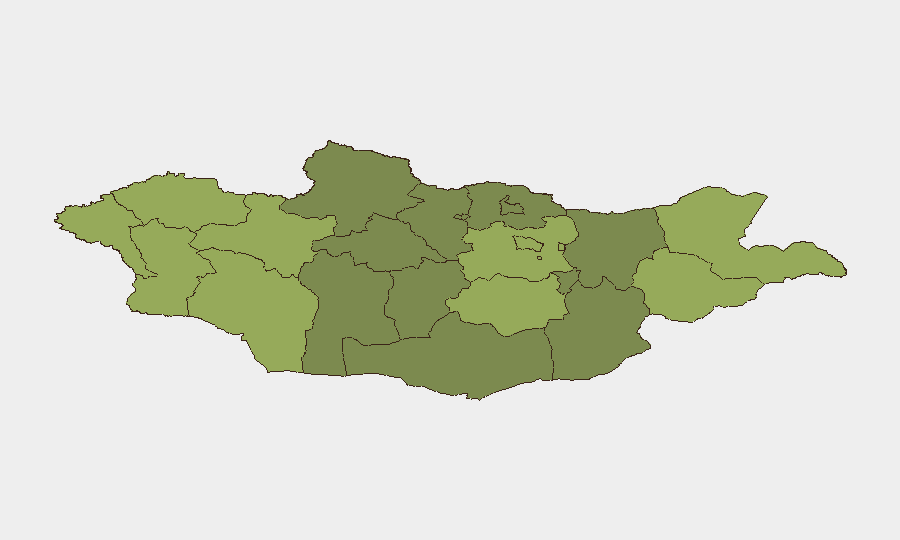
Situation Summary
Mongolia remains a low-threat environment globally (composite score 4) with no tracked security events in the current monitoring window, though a single violent incident against foreign nationals has emerged in the last 48 hours. Border regions in the east and west—particularly Dornod, Sükhbaatar, and Uvs—carry elevated risk profiles (scores 50–58), driven by remoteness, limited state capacity, and cross-border exposure rather than active conflict. The capital, Ulaanbaatar, and central provinces show moderate but manageable risk (42–45). Overall trajectory remains stable with localized vulnerability to opportunistic crime in remote areas and sporadic incidents affecting transient populations.
Key Developments
- Northern Mongolia, remote campsite (night of 21–22 July 2026): A group of Israeli tourists was assaulted by an assailant armed with an axe; one victim sustained a fractured jaw and was evacuated for medical treatment. The remaining group departed Mongolia with official assistance. The incident was reported across multiple sources and documented in Mongolia-focused executive briefing material.
- Same incident, hate-crime indicators: The assailant allegedly shouted antisemitic slurs and "Heil Hitler" while attacking; Mongolian officials issued public condemnation. Notably, victims declined to file a formal police complaint, limiting official investigative record and accountability mechanisms.
- No additional discrete security incidents reported in the 24–48 hour window. Flood warnings, commodity-price movements, and governance-related reporting exist in broader Mongolia coverage but fall outside the current acute-incident threshold.
Highest-Risk Areas
Dornod and Sükhbaatar (risk scores 58 and 55) dominate the risk landscape, both located in remote northeastern Mongolia with limited law-enforcement presence and proximity to Russian and Chinese borders. Uvs, Khovd, and Bayan-Ölgii in the west (scores 52, 50, 48) present similar profiles: isolation, transient populations (herders, hunters, mountaineers), and minimal state oversight. Ulaanbaatar (45) remains comparatively safer but still carries moderate risk typical of growing Central Asian capitals. The elevation of border and mountain regions reflects vulnerability to crime, accident, and limited rescue/medical infrastructure rather than organized conflict or political instability. Organizations with personnel or assets in Dornod, Sükhbaatar, or western provinces should prioritize contingency planning for medical evacuation, communication redundancy, and incident reporting independent of local authorities.
How GeoBit Would Assist
Security teams operating in Mongolia would benefit from AOI Monitoring & Early Warning on high-risk provinces (particularly Dornod, Sükhbaatar, Uvs) to detect emerging crime, accident, or incident patterns before they escalate. Intel Sweep combined with multi-language OSINT and social-media intelligence (X, Telegram, local sources) would provide real-time awareness of incidents affecting foreign nationals or expatriate communities. Routing & Network Analysis can identify safer alternative travel corridors within and between provinces, especially for personnel transiting remote areas. Risk & Threat Assessment tools allow duty-of-care teams to model exposure scenarios and refine emergency-response protocols.
7-Day Outlook
No escalation in nationwide threat level is anticipated. However, the 21–22 July incident signals that remote areas and transient populations (tourists, climbers) face residual vulnerability to opportunistic violence and xenophobic targeting. Organizations should assume similar incidents may recur in isolated regions and ensure personnel are briefed on local reporting, evacuation protocols, and communication channels independent of police filing.
Highest-Risk Areas — Ranked
| # | State / Region | Risk |
|---|---|---|
| 1 | Dornod | 58 |
| 2 | Sükhbaatar | 55 |
| 3 | Uvs | 52 |
| 4 | Khovd | 50 |
| 5 | Bayan-Ölgii | 48 |
| 6 | Govi-Altai | 46 |
| 7 | Ulaanbaatar | 45 |
| 8 | Zavkhan | 44 |
| 9 | Töv | 42 |
| 10 | Dundgovi | 40 |
| 11 | Darkhan-Uul | 38 |
| 12 | Ömnögovi | 37 |
Sources
Previous Daily Briefs
A new Mongolia brief is written every day — each with its own risk map and downloadable CSV. Here's the last week; use the calendar to go further back.
📅 Browse every day by calendar →
Highlighted days have a brief. Tap a day for that day's map & analysis, or “csv” for that day's dataset ($5).
Atlas — our AI intelligence desk — emails them this snapshot personally. Nothing else, no list.