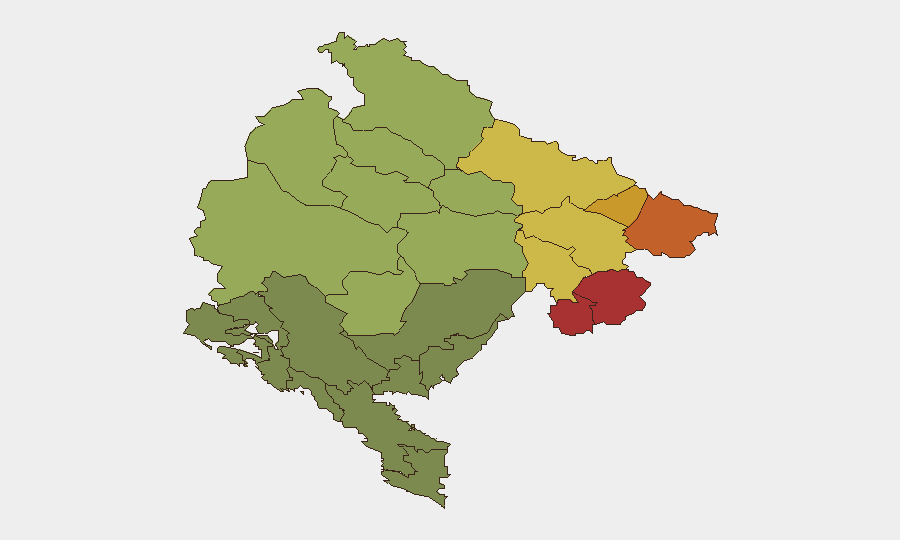
Situation Summary
Montenegro remains a low-threat environment globally (#179 in composite ranking) with no confirmed security incidents in the last 24–48 hours. However, structural risk remains elevated in the northern border regions (Plav, Gusinje, Rožaje municipalities), where historical trafficking, organized crime networks, and cross-border activity have created persistent vulnerabilities. The country maintains a stable security posture overall, with standard precautions sufficient for most business and travel activity.
Key Developments
- No verified security, civil-unrest, crime, political-instability, infrastructure, or travel-risk incidents were confirmed in Montenegro during the 24–48 hours preceding 2026-07-18, based on cross-checked open-source intelligence, national travel advisories, and risk platform monitoring.
- A public statement from Montenegrin police (2026-07-18) is recorded in the GeoBit event signal feed; content and specificity have not yet been disclosed in available open-source channels.
- Australian Smartraveller and German Foreign Office travel advisories both remain at baseline ("exercise normal safety precautions" / "calm situation") with no new alerts or incident reports as of mid-July 2026.
Highest-Risk Areas
The northern municipalities—Plav (#1, risk 78), Gusinje (#2, 76), Rožaje (#3, 74), Petnjica (#4, 72), and Andrijevica (#5, 68)—account for the majority of sub-national risk. These areas sit on or near international borders and historically function as transit corridors for human trafficking, migrant smuggling, and organized crime. While no ground-level incidents were reported in the last 48 hours, the structural persistence of these networks and socioeconomic factors (unemployment, limited governance capacity) sustain elevated baseline risk. Central and southern municipalities (Podgorica, Budva, coastal zones) remain lower-risk but are not exempt from occasional protest activity or petty crime.
How GeoBit Would Assist
Security teams with personnel or assets in Montenegro should employ AOI Monitoring & Early Warning on the northern municipalities (Plav, Gusinje, Rožaje) to detect emergent trafficking, cross-border incidents, or organized-crime activity before they escalate. Intel Sweep and multi-language OSINT (including Telegram and regional news channels) provide early signals of criminal activity, migrant movements, or police operations in these high-risk zones. Routing & Network Analysis and GIS & Spatial Analysis can inform safer travel corridors and real-time route alternatives for personnel transiting the north or crossing into neighboring regions.
7-Day Outlook
No imminent security triggers are visible in the immediate forecast. The country is expected to remain at baseline operational security posture through late July, with standard duty-of-care measures sufficient. Persistent monitoring of the northern border region remains prudent given structural risk, but no specific incident or escalation is anticipated in the next seven days.
Distribution: Corporate Security, Risk Management, Duty-of-Care Teams
Next Update: 2026-07-19
Classification: Unclassified
Highest-Risk Areas — Ranked
| # | State / Region | Risk |
|---|---|---|
| 1 | Plav Municipality | 78 |
| 2 | Gusinje Municipality | 76 |
| 3 | Rožaje Municipality | 74 |
| 4 | Petnjica Municipality | 72 |
| 5 | Andrijevica Municipality | 68 |
| 6 | Bijelo Polje Municipality | 65 |
| 7 | Berane Municipality | 62 |
| 8 | Plužine Municipality | 58 |
| 9 | Pljevlja Municipality | 55 |
| 10 | Šavnik Municipality | 52 |
| 11 | Žabljak Municipality | 50 |
| 12 | Kolašin Municipality | 48 |
Sources
Previous Daily Briefs
A new Montenegro brief is written every day — each with its own risk map and downloadable CSV. Here's the last week; use the calendar to go further back.
📅 Browse every day by calendar →
Highlighted days have a brief. Tap a day for that day's map & analysis, or “csv” for that day's dataset ($5).
Atlas — our AI intelligence desk — emails them this snapshot personally. Nothing else, no list.