Situation Summary
Nicaragua's security environment remains constrained by political instability and governance-driven restrictions rather than acute violence or civil unrest in the immediate 24–48-hour window. No major protests, infrastructure failures, or criminal incidents have been confirmed in the last 48 hours; open-source reporting shows no discrete new security events on 28–29 July. The underlying risk profile—driven by political repression, electoral manipulation, civil-society restrictions, and selective law enforcement—persists structurally, with Managua Department significantly elevated above all other regions.
Key Developments
- No major verified incidents reported 28–29 July. Open-source and social-media monitoring show no confirmed protests, riots, attacks, infrastructure failures, or travel disruptions in Nicaragua in the last 48 hours.
- Diplomatic tension signals logged (28–29 July). GeoBit event feeds flagged multiple "Reduce Relations" signals involving Nicaragua, Colombia, Cuba, and internal government friction; however, these reflect diplomatic friction rather than operational security incidents on the ground.
- Political environment remains restrictive. Structural barriers on civil liberties, opposition participation, and election access continue; the National Assembly is expected to vote on opposition electoral exclusion in early August, but no discrete new measure was enacted or enforced on 28–29 July.
- Managua remains risk epicenter. The capital's composite risk score (31.3) is 24× higher than all other departments, reflecting concentration of political decision-making, law-enforcement presence, and past civil unrest; routine security considerations apply but no imminent spike is flagged.
- No acute criminal or terror incidents confirmed. Mining-zone pressures, indigenous-land disputes, and gang presence in peripheral areas remain chronic; no new outbreaks have been reported in the specified window.
Highest-Risk Areas
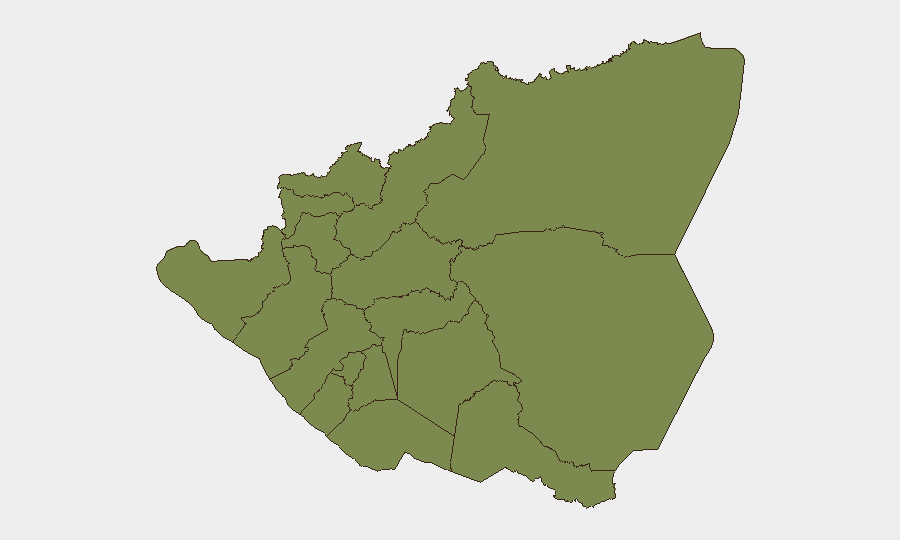
Managua Department dominates the risk landscape (31.3 vs. 1.3 for all other tracked regions), reflecting its role as the political, administrative, and commercial center. Risk concentration in the capital is driven by law-enforcement activity, political repression, and historical protest sites rather than active mass unrest as of 28–29 July. All other departments—including the Caribbean coasts, border regions, and interior zones—carry uniform baseline risk (1.3), suggesting either lower reporting/monitoring or more dispersed, lower-profile activity. Teams with personnel or assets in provincial areas should not assume safety on the basis of lower scores; rather, the ranking indicates that Managua warrants priority monitoring and pre-positioned contingency planning.
How GeoBit Would Assist
Security teams should deploy Intel Sweep and OSINT fusion (multi-language feeds, X/Telegram monitoring, sentiment analysis) to detect early signals of renewed protest or official crackdowns before they escalate. AOI (Area-of-Interest) Monitoring & Early Warning on Managua—combined with satellite/imagery analysis of key government buildings, protest sites, and transportation hubs—provides 24/7 watch and alert triggering if activity spikes. Network & Actor Analysis can track regime officials, opposition figures, and security-force movements to anticipate policy changes or enforcement operations affecting corporate operations or staff movement.
7-Day Outlook
No acute security event is predicted in the next 7 days based on current open-source signals and event trends. The electoral exclusion vote in early August may trigger localized demonstration or statement activity, but large-scale unrest is not forecast. Structural constraints on civil liberty, migration, and business will persist; routine duty-of-care protocols (staff briefing, movement avoidance of sensitive sites, contingency routing) remain standard for Managua-based operations.
Highest-Risk Areas — Ranked
| # | State / Region | Risk |
|---|---|---|
| 1 | Managua Department | 31.3 |
| 2 | Carazo Department | 1.3 |
| 3 | Chontales Department | 1.3 |
| 4 | Rivas Department | 1.3 |
| 5 | Río San Juan Department | 1.3 |
| 6 | South Caribbean Coast | 1.3 |
| 7 | Chinandega Department | 1.3 |
| 8 | Nueva Segovia Department | 1.3 |
| 9 | Madriz Department | 1.3 |
| 10 | Estelí Department | 1.3 |
| 11 | León Department | 1.3 |
| 12 | Masaya Department | 1.3 |
Sources
Previous Daily Briefs
A new Nicaragua brief is written every day — each with its own risk map and downloadable CSV. Here's the last week; use the calendar to go further back.
📅 Browse every day by calendar →
Highlighted days have a brief. Tap a day for that day's map & analysis, or “csv” for that day's dataset ($5).
Atlas — our AI intelligence desk — emails them this snapshot personally. Nothing else, no list.