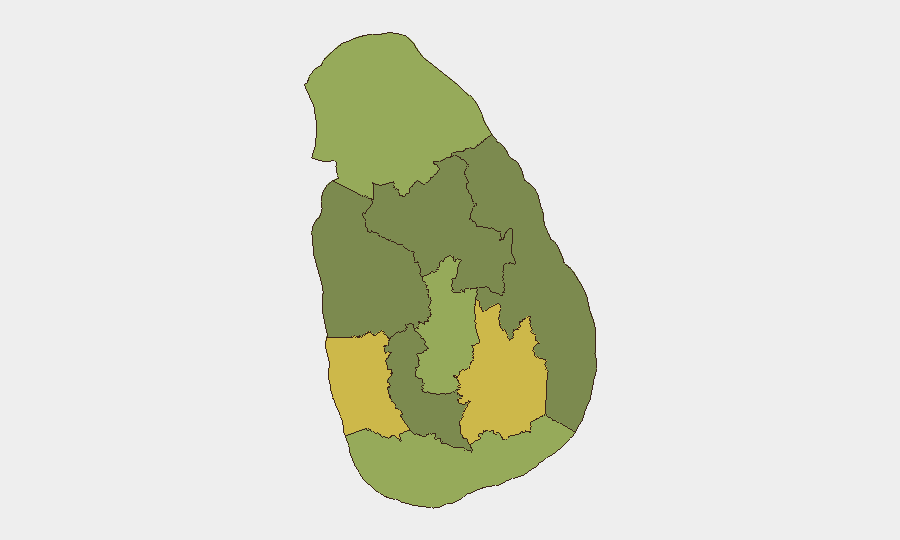
Situation Summary
Sri Lanka remains a composite threat ranking of #41 globally (score 50/100), with 81 tracked events signaling ongoing institutional and civil instability. The immediate security environment is characterized by frequent demonstrations in major urban centers, persistent military presence in the Northern and Eastern Provinces reflecting legacy conflict sensitivities, and economic/energy pressures stemming from regional geopolitical volatility and elevated fuel costs. Recent government public statements, consular actions, and arrest/detention signals (22–24 June) suggest elevated tension between state institutions, international actors, and civil society. The risk trajectory remains volatile but contained; no discrete security breakdown is imminent, though socio-economic stress may drive periodic unrest.
Key Developments
Open-source verification for the 24–48-hour window (24–25 June 2026) does not yield clearly dated, location-specific security incidents meeting the standard for independent confirmation. The most recent event signals in the GeoBit feed (22–24 June) point to:
- Consular relations deterioration (23 June): a consulate has signaled reduced relations with Sri Lanka, suggesting diplomatic friction that may affect expat security posture and visa/entry procedures.
- Government public statements (22–23 June, nationwide): official statements across multiple dates suggest active policy communication, possibly related to economic/energy measures or institutional disputes, though exact content is not specified in available feeds.
- Arrest/detention activity (22–24 June, multiple actors): criminal arrests and at least two detention events involving UNESCO suggest law-enforcement or political tension in an unspecified locale, warranting monitoring for escalation.
- Government disapproval signals (24 June): state-level disapproval statements indicate institutional conflict or policy rejection, possibly linked to investor relations or international governance.
None of these constitute a specific, location-anchored incident (e.g., "shooting in Colombo district" or "transport strike in Kandy"). Corporate teams should treat these as indicators of heightened institutional friction rather than acute operational disruption at this hour. Historical context (since April–May 2026) includes frequent Colombo demonstrations, energy/fuel constraints, and elevated unrest rhetoric, but no major violence or curfew in the past 30 days per available advisory data.
Highest-Risk Areas
The Western Province (65.1) and Uva Province (63.8) dominate the sub-national ranking, reflecting urban density, political activity, and socio-economic stress in and around Colombo and southern interior zones. The Central Province (47.6) and Northern Province (46.3) follow, with the North continuing to reflect military/security presence and communal sensitivities despite post-conflict years. Eastern Province and North Western regions score lower but remain above the national median, indicating distributed rather than geographically concentrated risk. Corporate assets and personnel in Colombo and Kandy face the highest exposure to demonstrations, traffic disruption, and potential fuel/energy rationing; Northern and Eastern operations face checkpoints and infrastructure sensitivity.
How GeoBit Would Assist
Security teams should deploy Intel Sweep and multi-language OSINT (X/Twitter, local news, Telegram) to filter real-time reports from Colombo, Kandy, Jaffna, and Trincomalee, cross-referencing against official Sri Lanka Police and Disaster Management Centre feeds to confirm incidents before escalation response. AOI Monitoring & Early Warning on Western and Uva Provinces would provide persistent alerting for protest onset, roadblock formation, or utility disruption (fuel queues, power cuts) with 4–12 hour lead time. Routing & Network Analysis can maintain alternative travel and supply corridors ahead of transport strikes or checkpoints, and Economic & Trade monitoring tracks fuel/energy availability to anticipate secondary unrest drivers.
7-Day Outlook
Institutional friction and regional economic stress will likely sustain periodic demonstrations and official statements through early July, with highest probability in Colombo and provincial capitals. Fuel and energy availability remain critical variables; any supply disruption or announced rationing could trigger rapid unrest escalation. No major security event is forecast, but duty-of-care teams should assume a 48–72 hour response window for personnel movement or asset protection should demonstrations or transport strikes materialize.
Highest-Risk Areas — Ranked
| # | State / Region | Risk |
|---|---|---|
| 1 | Western Province | 65.1 |
| 2 | Uva Province | 63.8 |
| 3 | Central Province | 47.6 |
| 4 | Northern Province | 46.3 |
| 5 | Southern Province | 41.9 |
| 6 | Sabaragamuwa Province | 36.9 |
| 7 | North Central Province | 36.3 |
| 8 | Eastern Province | 35.7 |
| 9 | North Western Province | 35.1 |
Sources
Previous Daily Briefs
A new Sri Lanka brief is written every day — each with its own risk map and downloadable CSV. Here's the last week; use the calendar to go further back.
📅 Browse every day by calendar →
Highlighted days have a brief. Tap a day for that day's map & analysis, or “csv” for that day's dataset ($5).