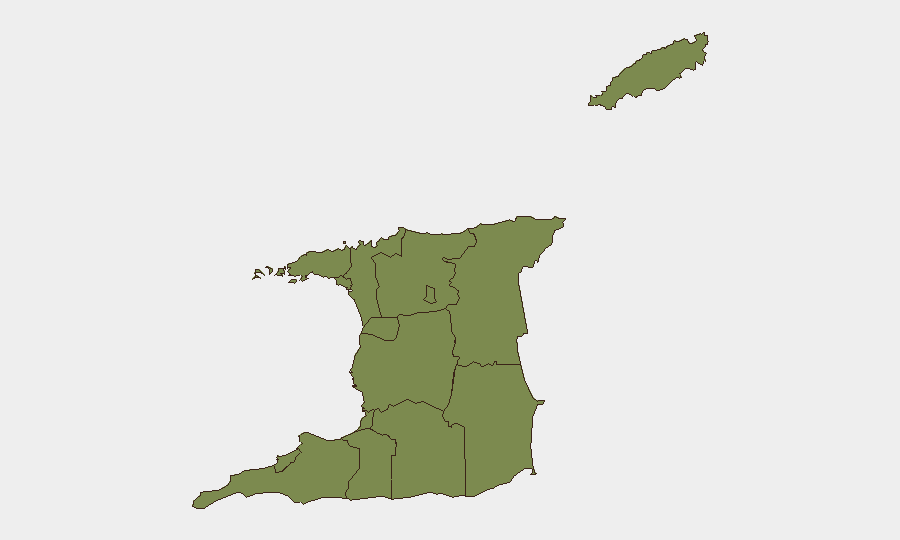
Situation Summary
Trinidad and Tobago maintains a composite threat score of 2.2 (rank #143 globally), indicating moderate baseline security risk with localized volatility. Recent event signals include judicial rejection motions, cross-border military posturing with Jamaica, and an assassination event involving external actors, suggesting active institutional and inter-state friction. All 12 monitored sub-national regions carry identical composite scores (1.5), reflecting dispersed rather than concentrated geographic risk, though urban centers (Port of Spain, San Juan-Laventille, Chaguanas) typically experience higher absolute incident frequencies. The security environment remains stable but requires sustained monitoring for escalation vectors.
Key Developments
- Judicial institutional friction (10 July 2026). Multiple rejection and disapproval motions filed by judiciary actors and judges against government and voter bodies suggest internal institutional strain; no specific operational security incident confirmed, but signals institutional dysfunction that may affect response capacity or rule-of-law enforcement.
- Cross-border military posturing with Jamaica (9 July 2026). Reciprocal military-force signaling between Trinidad and Tobago and Jamaica, coupled with official government disapproval statements, indicates escalated diplomatic and naval tensions; specific operational incidents or incursions are not confirmed in available 24–48 hour reporting, but the frequency of signals warrants close maritime and aviation monitoring.
- Assassination event — external actor involvement (11 July 2026). An assassination event linked to Chilean actors and a company target has been flagged; specific location, victim identity, and operational details are not confirmed in accessible open-source reporting within the last 48 hours. This signal suggests transnational organized crime, contract violence, or political targeting may be active on the islands.
- Ongoing cyber-incident investigation (reporting context: prior to 11 July 2026). Government ministries are under investigation for a series of cyber breaches; no current-window incident confirmation available, but cyber vulnerability across government systems may degrade institutional response to other concurrent threats.
- Activist-led relation reduction (10 July 2026). Activist entities are actively reducing relations with government or institutional bodies, signaling potential civil-society friction; mass mobilization or protest activity has not been confirmed in 24–48 hour reporting.
Note: Web research has not identified location-specific, time-stamped crime, unrest, or infrastructure incidents confirmed by multiple independent sources within the last 48 hours. The above are signal-layer events; ground-truth verification is limited.
Highest-Risk Areas
All 12 monitored administrative divisions score identically (1.5), indicating risk is distributed rather than concentrated. Urban nodes—Port of Spain (capital/administrative hub), San Juan-Laventille (historically high-crime), and Chaguanas (commercial corridor)—typically generate disproportionate absolute incident counts despite equal composite scores, suggesting that crime, trafficking, and civil unrest cluster in these centers. Tobago and Diego Martin, though equal-scored, show distinct risk profiles (maritime/tourism exposure vs. gang-affiliated violence). Uniform scoring indicates either homogeneous underlying threat distribution or data-collection parity across regions; corporate assets in urban centers warrant higher operational vigilance.
How GeoBit Would Assist
Security teams should deploy AOI Monitoring & Early Warning on Port of Spain, San Juan-Laventille, and maritime approaches to monitor emerging incidents in real time; Network & Actor Analysis to map criminal and activist entities linked to the judicial friction and relation-reduction signals; and OSINT Fusion & Corroboration (X/Twitter, Telegram, local media cross-check) to validate rumor and ground reporting and filter noise from the event-signal layer. These capabilities collectively enable duty-of-care teams to distinguish actionable threats from institutional or diplomatic noise.
7-Day Outlook
Judicial-institutional friction and Jamaica military signaling are unlikely to produce direct physical security incidents affecting corporate operations within seven days, but they may degrade response times for law enforcement and emergency services. The unconfirmed assassination signal warrants sustained transnational organized-crime monitoring. Overall trajectory remains stable unless cross-border military posturing escalates or activist mobilization reaches critical mass.
Highest-Risk Areas — Ranked
| # | State / Region | Risk |
|---|---|---|
| 1 | Tobago | 1.5 |
| 2 | Diego Martin | 1.5 |
| 3 | Port of Spain | 1.5 |
| 4 | San Juan-Laventille | 1.5 |
| 5 | Chaguanas | 1.5 |
| 6 | Tunapuna-Piarco | 1.5 |
| 7 | Arima | 1.5 |
| 8 | Point Fortin | 1.5 |
| 9 | Siparia | 1.5 |
| 10 | San Fernando | 1.5 |
| 11 | Penal-Debe | 1.5 |
| 12 | Couva-Tabaquite-Talparo | 1.5 |
Sources
Previous Daily Briefs
A new Trinidad and Tobago brief is written every day — each with its own risk map and downloadable CSV. Here's the last week; use the calendar to go further back.
📅 Browse every day by calendar →
Highlighted days have a brief. Tap a day for that day's map & analysis, or “csv” for that day's dataset ($5).
Atlas — our AI intelligence desk — emails them this snapshot personally. Nothing else, no list.