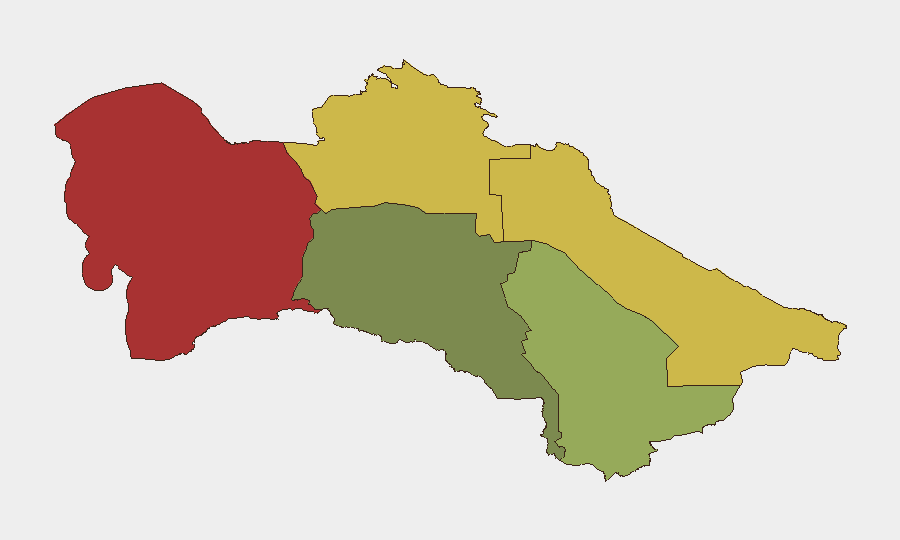
Situation Summary
Turkmenistan remains in a stable security baseline with no verifiable incidents reported in the last 24–48 hours. The country continues routine diplomatic and economic activity, including a presidential visit to Azerbaijan on 22 June and preparation for the OGT 2026 energy conference. The sub-national risk profile is uneven, with Balkan and Lebap regions carrying elevated composite scores relative to Ashgabat City, reflecting structural vulnerabilities rather than acute crisis.
Key Developments
- Baku, Azerbaijan – 22 June 2026 – President Serdar Berdimuhamedov held an expanded bilateral meeting with Azerbaijani President Ilham Aliyev focusing on regional cooperation. No security incidents or unrest reported in connection with the visit.
- Ashgabat / Regional – 21–22 June 2026 – International energy-service firms (including Schlumberger/SLB) announced participation in OGT 2026 oil and gas investment conference. No parallel reporting of demonstrations, infrastructure disruption, or security concerns.
- No discrete security incidents – Open-source monitoring across English, Russian, and local social channels detected no corroborated reports of protests, armed clashes, terror attacks, cyberattacks, or sudden changes to travel restrictions or emergency protocols in the last 24–48 hours.
- Information environment constraint – Turkmenistan's limited independent media and low transparency mean localized incidents may not surface in monitored channels; however, events of national or international significance typically generate regional media or social-platform traces, which are absent from current monitoring.
Highest-Risk Areas
Balkan Region (risk 78) and Lebap Region (risk 68) drive the country's subnational risk profile and warrant focused monitoring. Both regions score substantially higher than the capital, Ashgabat (18), reflecting historical vulnerabilities including border proximity (Balkan shares a maritime boundary with Kazakhstan and Uzbekistan; Lebap borders Uzbekistan), underdeveloped infrastructure, and limited state capacity in remote areas. Mary and Ahal regions present moderate elevation (42 and 35 respectively), though both remain below the two leading risk areas. Ashgabat City's significantly lower score reflects concentrated state presence and international visibility.
How GeoBit Would Assist
Security teams operating in Turkmenistan should employ AOI (Area-of-Interest) Monitoring & Early Warning on Balkan and Lebap regions to detect incidents with alert thresholds calibrated to the information environment; multi-language OSINT (X/Twitter, Telegram, Russian-language news) to surface localized events that may not appear in English media; and Routing & Network Analysis to model alternative movement corridors in event of sudden border restrictions or infrastructure disruption. Baseline regime-stability and border-dispute search would anchor a quarterly deep-dive on governance shifts and cross-border activity.
7-Day Outlook
No escalation indicators are evident in the current reporting window. The diplomatic agenda (bilateral meetings, energy-sector events) is proceeding routinely. Near-term risk is primarily structural—border volatility, weak subnational governance in the north, and the inherent information deficit—rather than acute; however, persistent monitoring of Balkan and Lebap remains essential for early detection of cross-border incidents, criminal activity, or resource-driven unrest that may not immediately surface in open sources.
Highest-Risk Areas — Ranked
| # | State / Region | Risk |
|---|---|---|
| 1 | Balkan Region | 78 |
| 2 | Lebap Region | 68 |
| 3 | Dashoguz Region | 62 |
| 4 | Mary Region | 42 |
| 5 | Ahal Region | 35 |
| 6 | Ashgabat City | 18 |
Previous Daily Briefs
A new Turkmenistan brief is written every day — each with its own risk map and downloadable CSV. Here's the last week; use the calendar to go further back.
📅 Browse every day by calendar →
Highlighted days have a brief. Tap a day for that day's map & analysis, or “csv” for that day's dataset ($5).