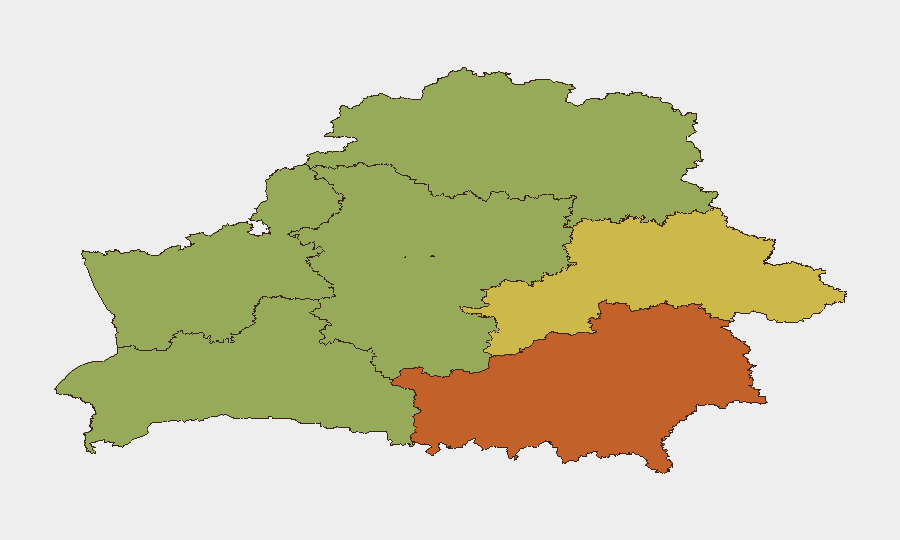
Situation Summary
Belarus remains a secondary-tier global security concern (composite threat score 23, rank #null globally) with no major on-ground incidents confirmed in the last 24–48 hours. Risk profile is shaped by cross-border military dynamics—Russian drone transits through Belarusian airspace, alleged involvement in Russian strike-drone operations, and heightened border militarization with Ukraine—rather than internal instability or civil unrest. Political-security risk is being amplified through state messaging around alleged opposition terror plots targeting EU partners, signaling ongoing intelligence warfare and propaganda use as tools of regime positioning.
Key Developments
- Minsk, 30 July 2026 – Belarus Foreign Ministry and former KGB operative Roman Protasevich issued coordinated statements claiming Belarusian intelligence warned Polish authorities on 23 July of a planned terror attack on children of exiled opposition leader Sviatlana Tsikhanouskaya. The narrative was refreshed and amplified on 30 July, positioning Belarus as a counter-terrorism partner to EU states while targeting opposition activist Denis Dashkevich. This represents active intelligence-political messaging rather than a new security incident.
- National, 30 July 2026 (reported) – Belarus halted use of drone control repeaters for Russian strike operations following a Ukrainian ultimatum, according to Polish media. This signals a tactical shift in Belarusian support to Russian UAV campaigns, likely in response to Ukrainian pressure and cross-border strike risk.
- Belarus–Ukraine border areas, late July 2026 (ongoing) – Territorial defense exercises and heightened military posture continue near the Ukraine border, as documented in 27 July situational reviews still circulating in the current reporting cycle, indicating sustained militarization.
- Belarusian airspace, 20–26 July 2026 (reported 27 July) – Ukrainian monitoring detected 18 Russian drones transiting Belarusian airspace over a six-day period, with Belarusian Air Force intercept attempts but no confirmed shoot-downs. Pattern reflects continued use of Belarus as a corridor for Russian UAV operations.
- Cross-border travel advisory, 30 July 2026 – Belarus Security Council secretary Alexander Volfovich publicly urged Belarusian citizens to avoid travel to Russia, citing the recent drone strike on a bus at Krasny Kamen checkpoint (Bryansk region, Russia). This represents official escalation of travel-risk warnings for cross-border routes.
Highest-Risk Areas
Homyel Region (risk 75) and Minsk (risk 68) dominate the sub-national ranking, reflecting proximity to Russian border, military activity, and national-level intelligence operations respectively. Mahilyow Region (62) and Brest Region (55) follow, likely driven by similar border-proximity and military-infrastructure exposure. Eastern and southern regions face heightened risk from drone transits and cross-border strike spillover, while Minsk's elevation reflects political volatility, opposition activity, and concentration of state security apparatus.
How GeoBit Would Assist
Teams with Belarus operations should deploy AOI Monitoring & Early Warning on Homyel and border-zone checkpoints to track cross-border military activity, drone patterns, and traffic disruptions in near-real time. OSINT fusion and multi-language Telegram/X monitoring would provide early detection of state-security actions, opposition incidents, or travel-advisory changes. Routing & Network Analysis capabilities enable rapid identification of alternative supply and personnel routes if cross-border corridors are disrupted by military activity.
7-Day Outlook
No major escalation in on-ground Belarus security is anticipated in the near term; risk remains externalized (Russian drone use, Ukrainian pressure, cross-border incidents). State messaging around opposition terror plots will likely persist as a tool of political signaling toward the EU. Border militarization and drone-transit patterns are expected to stabilize at elevated but non-crisis levels absent new Ukrainian or Russian military action.
Highest-Risk Areas — Ranked
| # | State / Region | Risk |
|---|---|---|
| 1 | Homyel Region | 75 |
| 2 | Minsk | 68 |
| 3 | Mahilyow Region | 62 |
| 4 | Brest Region | 55 |
| 5 | Hrodna Region | 52 |
| 6 | Minsk Region | 48 |
| 7 | Vitsebsk Region | 45 |
Sources
Previous Daily Briefs
A new Belarus brief is written every day — each with its own risk map and downloadable CSV. Here's the last week; use the calendar to go further back.
📅 Browse every day by calendar →
Highlighted days have a brief. Tap a day for that day's map & analysis, or “csv” for that day's dataset ($5).
Atlas — our AI intelligence desk — emails them this snapshot personally. Nothing else, no list.