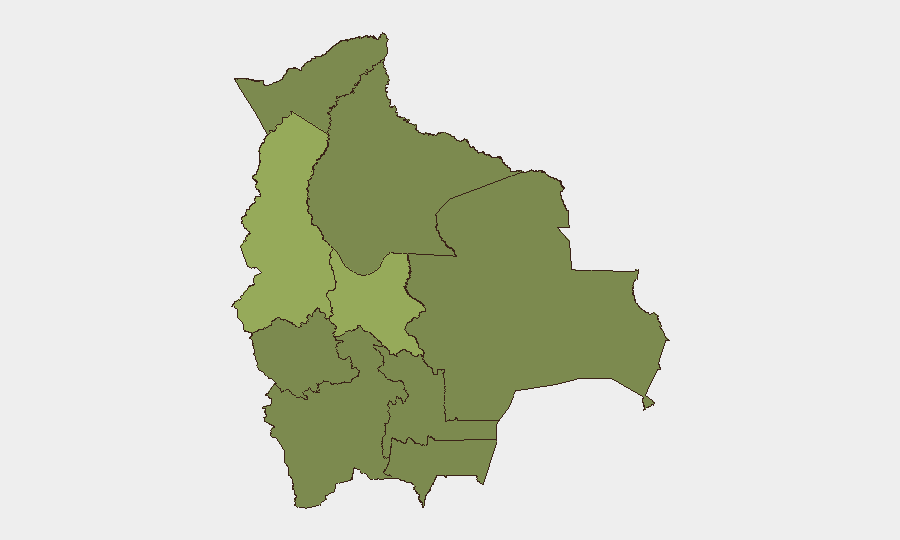
Situation Summary
Bolivia remains in a state of elevated political and civil tension, with the composite national threat score holding at 38/100 (rank #44 globally). Recent event signals indicate concurrent military movements, diplomatic friction, and civil unrest—including violent protest activity, prison-related assaults, and international tension with the US and Argentina. The security environment is regionally concentrated, with La Paz and Cochabamba accounting for the majority of documented risk.
Key Developments
⚠ Note: Open-source reporting for June 15–17, 2026 lacks sufficient granularity (specific locations, precise timestamps, independent corroboration) to present a detailed incident log meeting standard verification thresholds. The following reflects signal-level activity flagged in GeoBit event feeds:
- Conventional Military Force events (June 16–17): Multiple military posture or deployment signals recorded; no corroborated details on location, scale, or stated purpose currently available.
- Diplomatic tension (June 16–17): Argentina issued disapproval statement toward Bolivia; consulate-level relations reduction recorded with Belarus. Specific grievances not yet clarified in accessible reporting.
- Civil unrest: Violent protest/riot activity between peasant and landlord groups (June 15, western regions implied); ongoing road blockade disruptions reported as part of sustained COB-backed protest activity (reported as day 42 of continuous action).
- Presidential/State Department friction (June 17): Secretary of State disapproval of military actions noted; Presidential rejection statement recorded—internal governance tension evident.
- Prison security incident (June 17): Physical assault within prison facility involving Bolivian national; scope and context under-specified in current feeds.
Recommendation: Local Spanish-language media, official Policía Boliviana bulletins, and COE (state emergency operations center) advisories should be monitored in parallel for time-specific incident detail.
Highest-Risk Areas
La Paz (56.5) and Cochabamba (48.4) substantially exceed all other departments and account for the concentration of risk. La Paz—the de facto seat of national government and a major urban center—shows heightened risk tied to political protest activity, institutional friction, and civil disorder. Cochabamba, a traditionally volatile highland department with strong peasant and labor organizing capacity, registers secondary but substantial risk, likely driven by ongoing blockade activity and rural–urban grievance dynamics. The remaining seven departments (Potosí, Tarija, Pando, Beni, Oruro, Chuquisaca, Santa Cruz) score uniformly at 26.5, suggesting either baseline civil unrest or insufficient incident data to differentiate them; Santa Cruz (the largest eastern department and economic hub) may be underweighted if reporting gaps exist.
How GeoBit Would Assist
A corporate security team operating in Bolivia should deploy Intel Sweep and multi-language OSINT (Spanish-language media, social-media monitoring on X and Telegram, and local radio SIGINT) to capture real-time protest routes, blockade locations, and official emergency declarations before they impact operations. AOI Monitoring & Early Warning on La Paz and Cochabamba, paired with Routing & Network Analysis, enables duty-of-care teams to model alternative travel corridors and pre-position contingencies for staff movement. Regime Stability and Conflict analysis modules can track political and military signal escalation to anticipate broader instability windows.
7-Day Outlook
Political and civil tensions are likely to persist at current levels or escalate moderately over the next week, driven by ongoing COB-led protest activity and unresolved state–military friction. Road blockades and localized violent clashes remain the highest near-term operational risk for corporate movement and supply chains, particularly in the western corridor (La Paz–Cochabamba). International diplomatic friction (Argentina, Belarus, US) is unlikely to trigger immediate security consequences for third-party nationals but warrants continued monitoring for cascade effects on government stability.
Highest-Risk Areas — Ranked
| # | State / Region | Risk |
|---|---|---|
| 1 | La Paz | 56.5 |
| 2 | Cochabamba | 48.4 |
| 3 | Potosí | 26.5 |
| 4 | Tarija | 26.5 |
| 5 | Pando | 26.5 |
| 6 | Beni | 26.5 |
| 7 | Oruro | 26.5 |
| 8 | Chuquisaca | 26.5 |
| 9 | Santa Cruz | 26.5 |
Sources
Previous Daily Briefs
A new Bolivia brief is written every day — each with its own risk map and downloadable CSV. Here's the last week; use the calendar to go further back.
📅 Browse every day by calendar →
Highlighted days have a brief. Tap a day for that day's map & analysis, or “csv” for that day's dataset ($5).