Situation Summary
Brazil remains a mid-tier global security concern (rank #42, composite score 48) with 1,608 tracked events, characterized by persistent organized-crime activity in peripheral urban zones, acute political-judicial tension following Supreme Court restrictions on ex-President Bolsonaro, and emerging economic friction with the United States over tariffs. The security picture is fragmented: high-intensity criminal violence concentrates in Mato Grosso and São Paulo, while political instability and trade disputes create secondary risks to business confidence and potential for labor/sectoral unrest. The near-term trajectory reflects a period of elevated elite political contestation and localized law-enforcement escalation, without broad systemic breakdown.
Key Developments
- Rio de Janeiro, Vargem Pequena (07-18, morning local): BOPE special operations raid in César Maia community resulted in nine arrests and seizure of four rifles, signaling sustained organized-crime presence and heightened police operations in Rio's West Zone peripheral neighborhoods.
- Brasília (07-17): Supreme Court Justice Alexandre de Moraes imposed a 30-day suspension of in-person visits to ex-President Bolsonaro under house arrest, tightening restrictions following alleged breach of social-media conditions; reflects deepening judicial-political confrontation ahead of elections.
- National (07-16/18): Government convened emergency ministerial meeting and authorized 13.3 billion reais in extraordinary rural credit to offset impact of newly announced 25% U.S. tariffs on Brazilian imports; retaliatory measures against U.S. audiovisual and pharmaceutical sectors are under preparation.
- Brasília (07-17): Supreme Court blocked application of recently enacted law that would reduce penalties for January 2023 coup-attempt participants, pending constitutionality review; widens political-judicial divide.
- National (active 07-17): Bill 4,675/2025 ("Gatekeeper Bill") advancing through Congress to designate large digital platforms as systemically relevant and impose regulatory obligations; has implications for information-space management and political mobilization.
Highest-Risk Areas
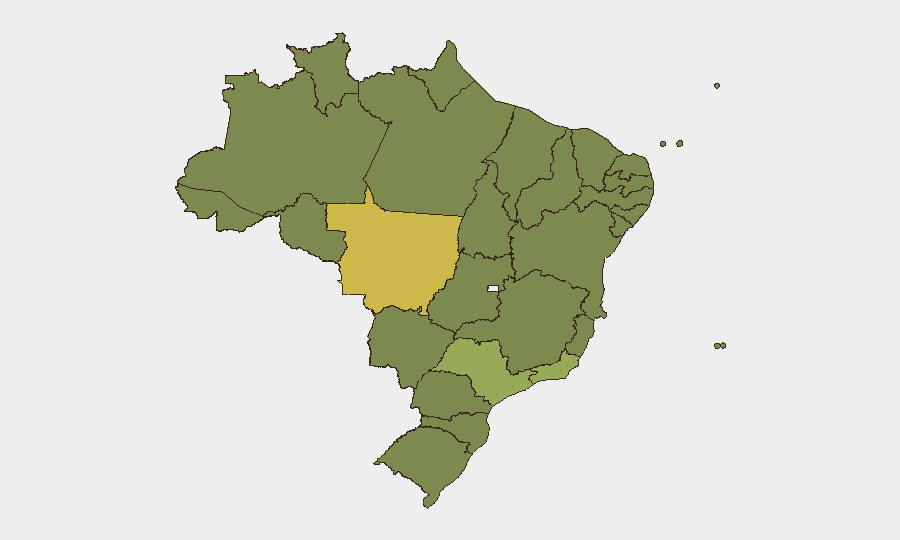
Mato Grosso (63.7) and São Paulo (45.2) dominate the sub-national risk ranking, driven by land-dispute violence, organized-crime competition, and trafficking activity in Mato Grosso's agribusiness and frontier zones, and gang-turf conflicts in São Paulo's metropolitan periphery. Rio de Janeiro (41) follows, with favela-based organized-crime networks, police incursions, and criminogenic poverty creating persistent localized flashpoints—evidenced by today's BOPE operations in the West Zone. Secondary elevation in Pernambuco (37.1), Amazonas (36.9), and Santa Catarina (36.1) reflects criminal networks, environmental-crime activity, and precarious urban margins; the remaining ranked states cluster around 34–35, indicating diffuse but manageable baseline risk outside these hotspots.
How GeoBit Would Assist
Corporate security teams operating in Brazil should leverage AOI Monitoring & Early Warning on high-risk state capitals and operational zones (Mato Grosso, São Paulo, Rio) to detect police operations, gang violence escalation, and protest formations in real time. Intel Sweep and multi-language OSINT fusion (X/Twitter, Telegram, local news) enable tracking of political rhetoric, trade-dispute narratives, and sectoral unrest signals that could trigger supply-chain or staffing disruption. Routing & Network Analysis and GIS spatial analysis support dynamic adjustment of employee travel patterns and asset positioning to avoid emerging crime hotspots and zones of police-criminal engagement.
7-Day Outlook
Political tension is likely to remain elevated as Supreme Court decisions on Bolsonaro and coup-law constitutionality proceed, potentially triggering protest activity by aligned segments. Economic friction with the United States will drive government communication and possible labor mobilization in agribusiness and trade-exposed sectors. Organized-crime violence in Mato Grosso and Rio is expected to persist at current tempo, with police operations likely to continue in response; no systemwide escalation anticipated unless trade disputes trigger sectoral strikes or political polarization reaches demonstration threshold.
Highest-Risk Areas — Ranked
| # | State / Region | Risk |
|---|---|---|
| 1 | Mato Grosso | 63.7 |
| 2 | São Paulo | 45.2 |
| 3 | Rio de Janeiro | 41 |
| 4 | Minas Gerais | 37.3 |
| 5 | Pernambuco | 37.1 |
| 6 | Amazonas | 36.9 |
| 7 | Santa Catarina | 36.1 |
| 8 | Paraná | 34.6 |
| 9 | Acre | 34.6 |
| 10 | Tocantins | 34.6 |
| 11 | Maranhão | 34.5 |
| 12 | Piauí | 34.5 |
Sources
Previous Daily Briefs
A new Brazil brief is written every day — each with its own risk map and downloadable CSV. Here's the last week; use the calendar to go further back.
📅 Browse every day by calendar →
Highlighted days have a brief. Tap a day for that day's map & analysis, or “csv” for that day's dataset ($5).
Atlas — our AI intelligence desk — emails them this snapshot personally. Nothing else, no list.